
Tether invokes 'The Big Short' as S&P keeps USDT at its weakest stability score, Cointelegraph reports
S&P Global Ratings left its assessment of USDT's ability to hold its dollar peg at 5 (weak), citing a rising share of higher-risk reserve assets and limited disclosure. Tether told Cointelegraph the problem is S&P's framework.
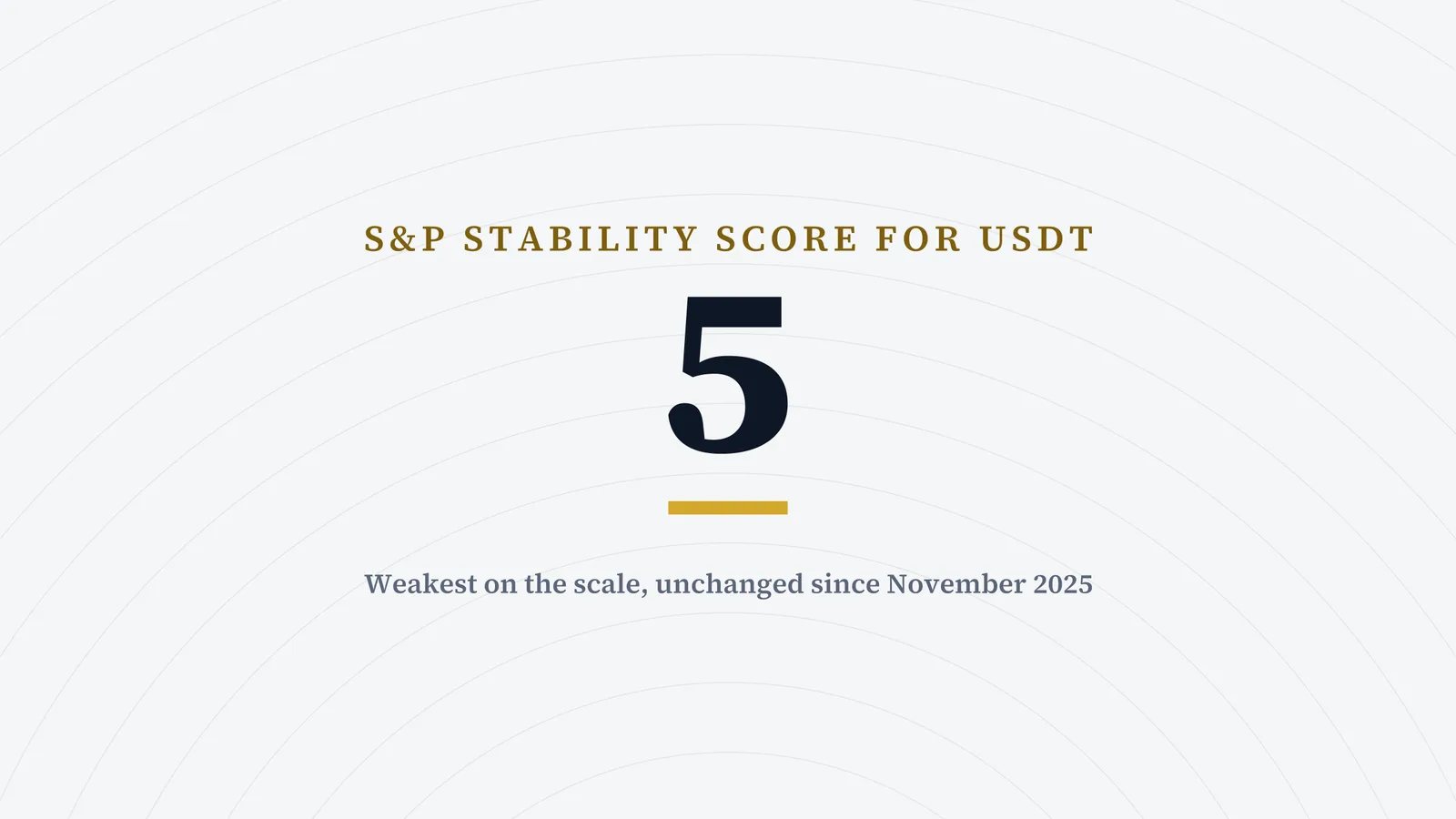
S&P Global Ratings has kept its assessment of the USDT stablecoin's ability to hold its dollar peg at 5 (weak), the lowest score on its scale, in a report published on Wednesday, November 18, 2026, Cointelegraph reported. Tether, the issuer of USDT, rejected the assessment and pointed to "The Big Short," the film about the 2008 financial crisis.
We could not open S&P's report itself: its pages on spglobal.com refused our access. The details of the assessment below are as Cointelegraph reported them.
What S&P assessed
According to Cointelegraph, the score is unchanged from November 2025. S&P found further weaknesses but did not lower the score because, in its words, "our assessment cannot be lower than 5." S&P first cut USDT to 5 from 4 (constrained) on November 26, 2025, Reuters and The Block reported at the time.
S&P's main concern is the makeup of the reserves. Gold, bitcoin, publicly listed shares, secured loans and corporate bonds, which S&P treats as higher-risk assets, were equal to 28% of USDT in circulation on September 30, 2026, up from 24% a year earlier, Cointelegraph reported. S&P warned that a significant fall in the value of these assets could leave USDT undercollateralized, meaning its assets would no longer cover the tokens outstanding.
The assessment also looks at oversight. Tether moved to El Salvador in January 2025, and S&P noted that the country's National Commission of Digital Assets (CNAD) requires 70% of reserves to be held in assets that can be sold within 30 days, according to Cointelegraph. S&P called the framework broad because it allows assets such as gold, bitcoin and loans, and flagged that there is no requirement to segregate reserve assets, unlike rules in the US and Europe.
On disclosure, S&P noted that Tether's audited financial statements for 2025 have not been published, Cointelegraph reported, even though KPMG has confirmed it issued an unqualified opinion on those accounts. S&P also said Tether's reserve reports do not name the custodians and counterparties holding its assets, and that its attestations are quarterly while other stablecoins generally report monthly.
S&P did credit Tether with a good record of price stability, particularly over the past 12 months, according to Cointelegraph.
Tether's response
"The problem is S&P's framework, not our reserves," Tether told Cointelegraph. The company added that "their own history shows the underlying problem" and referred to "The Big Short." Cointelegraph did not name the Tether spokesperson. We found no statement from Tether on its own website or on X about the new assessment.
The response echoes Tether's reply to the 2025 downgrade, when Chief Executive Paolo Ardoino wrote on X that Tether wears S&P's "loathing with pride," The Block reported at the time.
The reserve figures behind the dispute
Tether's third-quarter reserves report, attested by accounting firm BDO, showed total assets of $191.45 billion and liabilities of $183.50 billion on September 30, 2026, leaving about $7.95 billion of excess reserves. Treasury bills, held directly and indirectly, made up $132.4 billion of the assets, with $8.37 billion in bitcoin and $19.08 billion in precious metals, according to that report.
Tether announced the KPMG audit of the USDT issuer in August 2026. On November 12, it said it had received a second KPMG audit, of Tether Gold's issuer, for 2025. In the US, the Office of the Comptroller of the Currency finalized its rule implementing the GENIUS Act for stablecoin issuers in October.
What it could mean for USDT holders
The score is S&P's view of how well USDT can hold its peg; it does not mean the peg has failed, and S&P itself credits Tether with good price stability. The dispute is about what goes into the reserves and how much of it outsiders can check. Points to watch are whether Tether publishes its audited statements, how the share of higher-risk assets changes in its next quarterly report, and how US and European reserve rules apply to issuers outside those markets.
Sources
- Cointelegraph — Tether invokes The Big Short in swipe at S&P over USDT reserve risks (November 18, 2026)
- The Block — Tether's USDT stability score cut to 'weak' level as S&P says reserves can't absorb bitcoin drop (November 26, 2025)
- Reuters (via The Star) — Tether's stablecoin downgraded to 'weak' in S&P assessment (November 26, 2025)
This article was researched and drafted with the help of AI tools, checked against its sources in a separate AI fact-check and edit, and approved for publication by Trading Metrics. Read our AI use policy.
This article is for information only and is not financial advice. Crypto assets and leveraged products are volatile and you can lose money. Do your own research and consider your circumstances before trading.