
Zcash developers urge holders to move about $280 million of ZEC out of the older Sapling pool
The Zakura team says Sapling's proof system relies on pairing-based cryptography and wants a network upgrade to stop new deposits sooner. It calls a practical break highly speculative, and a draft rule would leave withdrawals open.
Contents
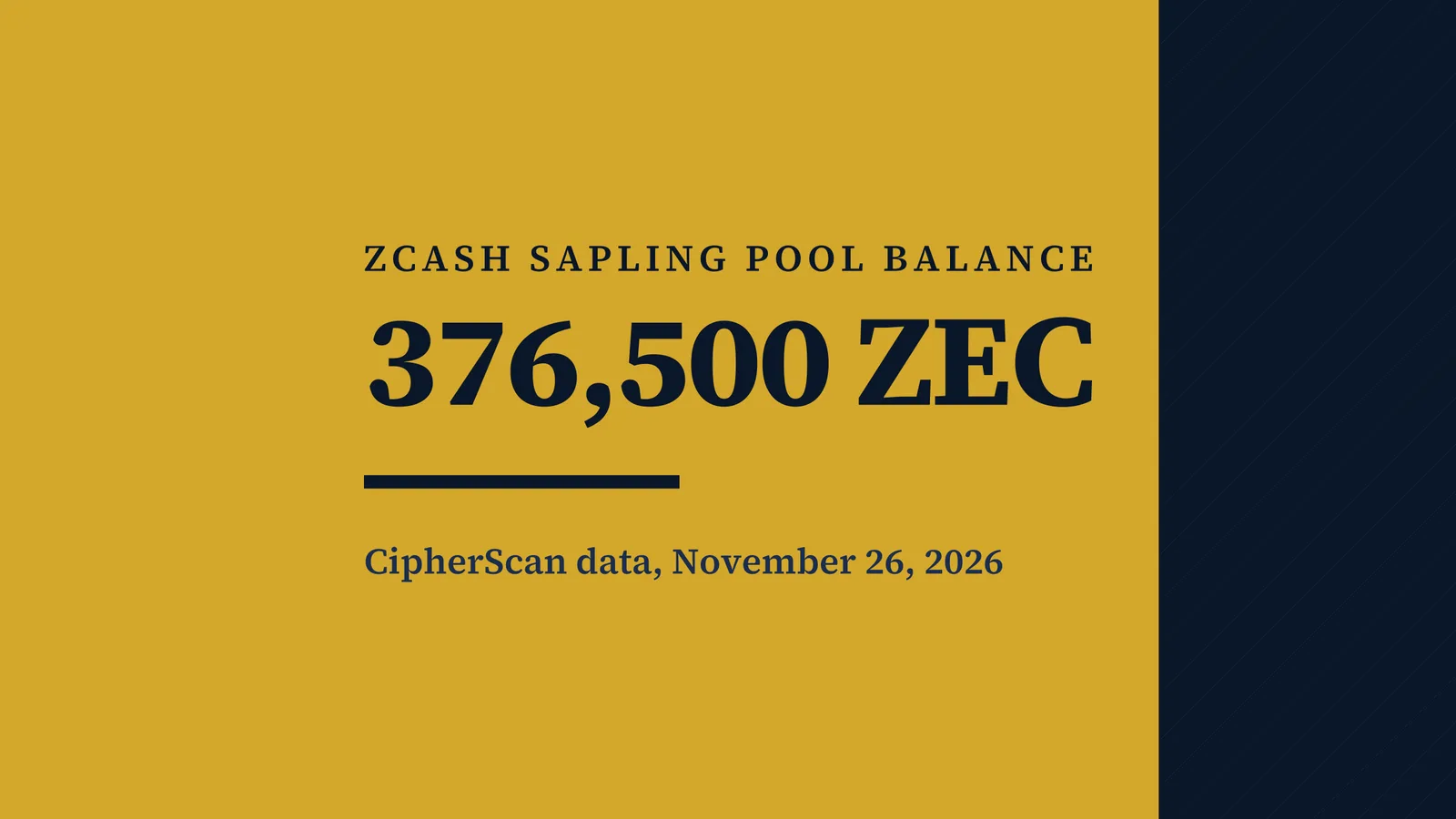
The developers behind Zakura, a Zcash (ZEC) full node, on Thursday, November 26, 2026, urged holders to move their coins out of Sapling, the network's older shielded pool, and called for a network upgrade that would stop new deposits into it sooner. About 376,500 ZEC sat in the pool at 07:21 UTC, worth roughly $282 million at CoinGecko's price of $748.89, according to CipherScan pool data.
What the developers are asking for
In a long post on X published at 01:40 UTC, the Zakura team wrote: "Let's deprecate Sapling faster, and if you're in that last 2% please migrate to Ironwood!" Ironwood is Zcash's newer shielded pool. A shielded pool is the part of the chain where balances and transfers are hidden.
The team's recommendation is that "payments into Sapling should be disabled by a network upgrade." It added that the community should stand ready to freeze the pool completely "upon credible risk to pairing security." CoinDesk, which reported on the post, described Zakura as led by Zcash's Sean Bowe and Dev Ojha. Zakura's X profile says the node is developed by Tachyon and Valar Group.
The post puts the pool's holdings at 400,000 ZEC and "less than 2%" of supply. CipherScan's balances at 07:21 UTC showed 376,497.84 ZEC, about 2.2% of the roughly 17.06 million ZEC across all pools in the same data. CoinDesk's $300 million figure used the 400,000 ZEC estimate and a price near $755.
Why Sapling, and how serious the risk is
Zakura says Sapling users' private keys and note commitments do not depend on pairings, a type of elliptic-curve cryptography, but its proof system does. If pairings were broken, an attacker could forge proofs, which would put the pool's funds at risk, the team wrote. Ironwood and transparent transactions rely on neither pairings nor integer factoring, it said.
The team framed the post around claims that the Riemann hypothesis has been proven and rumors that AI labs have made progress on factoring large numbers. Trading Notified has not verified either claim. Zakura itself said the theoretical link it describes is "far from evidence that the rumors are true."
The developers stress that no break exists today. "Practical pairing breaks are highly speculative," they wrote. Their own cost estimate says that even with an assumed billionfold speedup in attacks, breaking BLS12-381, the pairing curve Zakura analyzed, would cost in a range of $1 trillion to $300 trillion. No working attack on Sapling has been shown, CoinDesk noted.
Zakura also says Sapling funds could be recovered even after a pairing break, because the proof system can be replaced without replacing the note commitments. That depends on freezing the pool "before its state is compromised," the post says.
The draft rule: withdraw-only from NU8
The formal proposal is older than the X post. On October 27, Ojha opened a draft Zcash Improvement Proposal titled "Disabling Sapling Pool Deposits." It has no ZIP number yet, and the pull request had not been merged when checked on November 26.
The draft would apply from the NU8 network upgrade, the one after NU7:
- No new value could enter the Sapling pool from any transaction, including mining rewards.
- Holders could still spend Sapling funds to other pools and make transfers within Sapling.
- No date would be set after which Sapling notes can no longer be spent. That, and the fate of any value left in the pool, is left to a future proposal.
The draft also gives a quantum reason. It says Sapling is not "quantum recoverable," so an adversary able to compute discrete logarithms, for example with a quantum computer, could steal funds in the pool. Ironwood notes are quantum recoverable, it says. The draft copies the approach used for Zcash's original Sprout pool at the Canopy upgrade, and says about 22,000 ZEC still sat in Sprout six years later. CipherScan showed 12,224 ZEC in Sprout on November 26.
Who still uses Sapling
Most remaining Sapling activity comes from mining pools, according to the developers. In the 30 days to October 27, 58.8% of Sapling transactions were attributable to mining pools shielding block rewards, the draft says, and the Zcash Community Grants funding stream also swept its coins into Sapling. The draft says both should move to Ironwood before activation. The grants stream is also the subject of a separate proposal on the grants treasury.
On November 25, Ojha wrote in the forum thread that the exchange Gemini now supports shielded deposits to Ironwood. To his knowledge, Gemini had been the only exchange taking shielded deposits and withdrawals, he wrote.
When he opened that thread in April, Ojha said a token holder vote is "absolutely a requirement for any change of this scale." Neither the draft nor the X post gives an activation date for NU8.
| Pool | ZEC at 07:21 UTC, Nov 26 |
|---|---|
| Ironwood | 4,182,719.51 |
| Sapling | 376,497.84 |
| Orchard (withdraw-only) | 319,203.31 |
| Sprout | 12,224.21 |
Source: CipherScan. Ironwood held about 85.5% of shielded ZEC.
What it could mean for ZEC holders
In our assessment, the practical question for most holders is which pool their coins sit in, not whether a cryptographic break has happened. The developers say transparent and Ironwood funds are not exposed to a pairing break, and the draft rule would still let Sapling holders withdraw after it takes effect. Holders who use custodians or multi-asset wallets depend on those providers supporting Ironwood. ZEC traded at $748.89 at 07:15 UTC, up 2.4% over 24 hours according to CoinGecko, after it fell below $1,000 on November 11.
The debate adds to wider attention on cryptographic risk; the international securities regulators' body IOSCO warned that finance is early in preparing for quantum risk.
Points to watch are whether the draft gets a ZIP number, whether a holder vote is scheduled, an activation date for NU8, and how fast the Sapling balance falls.
Sources
- Zakura (X) — Riemann is solved. Zcash adapts. (November 26, 2026)
- GitHub (zcash/zips) — Add draft ZIP: Disabling Sapling Pool Deposits (pull request 1415) (October 27, 2026)
- Zcash Community Forum — Sapling withdraw-only discussion kickoff (April 3, 2026)
- CoinDesk — Zcash developers want users to move $300 million out of an older privacy system (November 26, 2026)
- CipherScan — Mainnet chain value pool balances (API)
- CoinGecko — Zcash price (API)
This article was researched and drafted with the help of AI tools, checked against its sources in a separate AI fact-check and edit, and approved for publication by Trading Metrics. Read our AI use policy.
This article is for information only and is not financial advice. Crypto assets and leveraged products are volatile and you can lose money. Do your own research and consider your circumstances before trading.