
Ethereum's Glamsterdam gas changes could break up to about 15,000 contracts, core developer says
Two proposals that make new storage and new accounts far more expensive in gas also change how gas is counted, and audits found deployed contracts that rely on the old rules. Core developers have not decided whether to ship them as written.
Contents
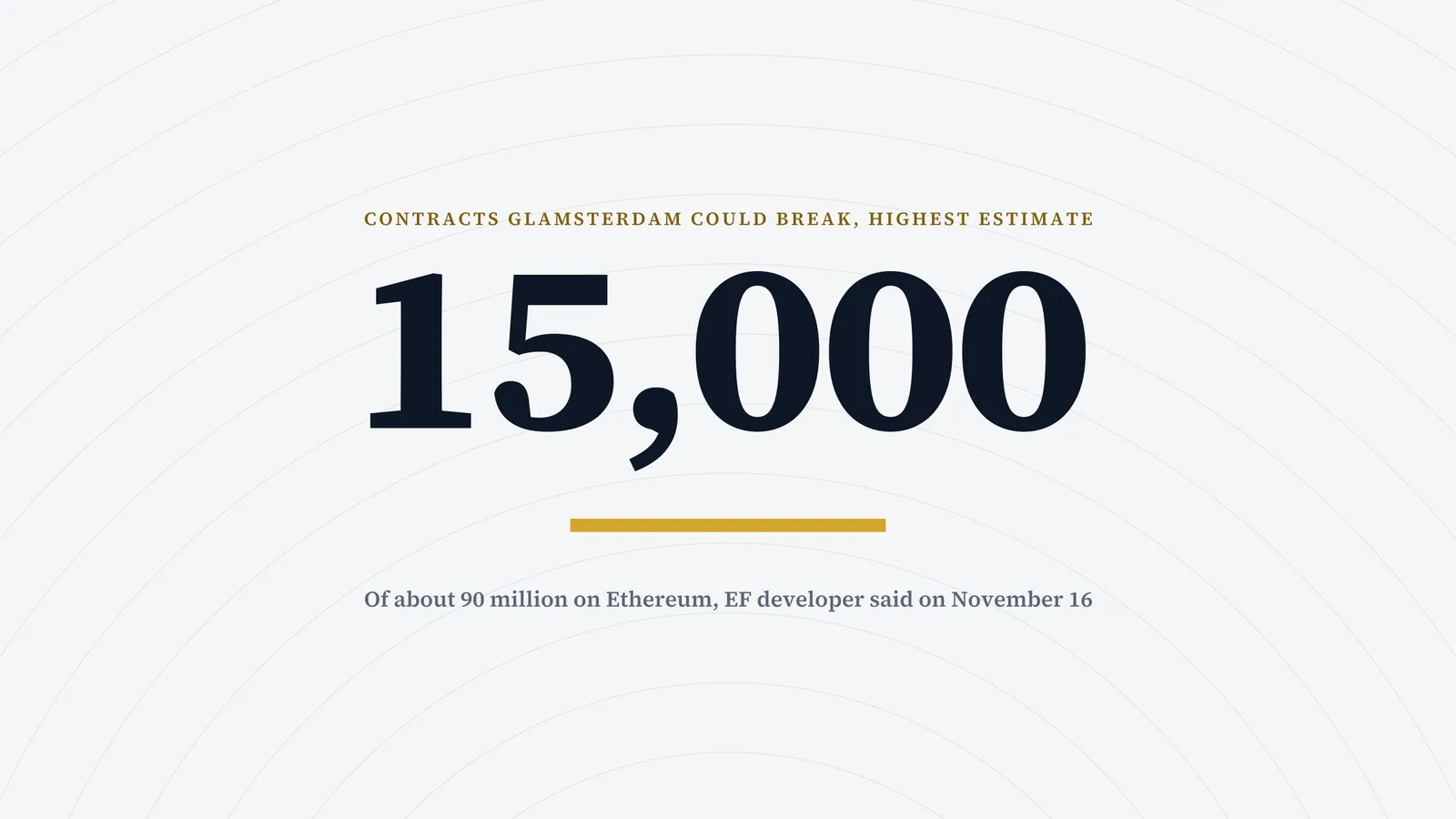
Ethereum's planned Glamsterdam upgrade would change gas costs in ways that could break up to roughly 15,000 of the about 90 million smart contracts on the network, by the highest estimate that Ethereum Foundation developer Marius van der Wijden gave on a core developers' call on Monday, November 16, according to the call transcript. The potential breakage comes from two proposals, EIP-8037 and EIP-8038, which make creating and changing data on Ethereum more expensive in gas and change how part of that gas is counted. Developers made no decision on the call and will take up the question again on Thursday, November 19. CoinDesk reported the estimate on November 17.
Which changes cause the breakage
Gas is the unit Ethereum uses to price computation and storage. EIP-8037 sets a single price of 1,530 gas for each byte of new "state," the data every node has to keep, such as account balances and contract storage. A new storage slot counts as 64 bytes and a new account as 120 bytes, which puts their charges at 97,920 and 183,600 gas. Today a new storage slot costs 20,000 gas, a contract deployment 32,000 and a new account 25,000. Deployed contract code rises from 200 to 1,530 gas per byte.
The proposal says it aims for average state growth of 120 gibibytes (GiB) a year at a reference block gas limit of 150 million. It says the state held by a Geth node was about 390 GiB in January 2026 and that nodes begin to slow at about 650 GiB.
EIP-8037 also bills this state gas apart from ordinary execution gas. When a transaction's gas limit is above 16,777,216, the excess goes into a separate "reservoir" for state gas that contract code cannot see through the usual gasleft() reading. Some state gas is also handed back during a transaction, for example when a new slot is set and cleared again or when a call reverts.
EIP-8038 raises the cost of reading and writing existing state. Changing an existing storage slot rises to 10,100 gas from 2,900 when the slot was already accessed, and to 12,100 from 5,000 when it was not, according to the Ethereum Foundation's repository for auditors.
On the call, moderator danceratopz said the changes would let Ethereum go from 60 million to 200 million gas per block while keeping state growth under control. Van der Wijden said the cost of most transactions to users would fall even though some gas charges rise. Both proposals are in "Last Call," a late stage of the Ethereum Improvement Proposal process, whose review deadline was November 1, 2026.
Which contracts are at risk
The foundation's repository lists eight assumptions that contracts may rely on and that the two proposals break. Three are about prices:
- A fixed gas amount set in a contract, a bot or a signed message is enough for the job. Creating storage, accounts and contracts costs five to eight times more under the new rules.
- A reserve of gas kept back for work after a call is enough, and the 2,300 gas that Solidity's
transferandsendpass on can cover the recipient's work. That stipend cannot pay for a new storage slot. - The small share of gas left after a call runs out of gas is too little to do anything. At the new prices, it can be enough to finish and record a failure.
The other five come from the new way of counting gas: the code after a failed call can still write storage when a reservoir exists, gas can be handed back mid-transaction, the gas left can go up during a call, and a signed EIP-7702 delegation, which lets an ordinary wallet run contract code, can be reused by anyone if it ran out of gas.
ChainSecurity, the audit firm whose findings led core developers to pause the testnet upgrade, said in an October 13 analysis that failure paths that used to revert can now complete without any change to a contract's code. Most findings so far concern hard-coded gas budgets and reserves, according to the foundation's repository and ChainSecurity's Tanguy Rocher. Rocher also said on the call that some systems assume a payment of ether (ETH) to a new address always succeeds with 21,000 gas, which no longer holds because creating the account now carries the state charge.
Application developers on the call focused on try/catch, the pattern in which a contract calls another and carries on if that call fails. Jango of Juicebox said users would be able to tune a transaction's gas so that an add-on fails and the catch block runs. Daniel Gretzke of Uniswap said the reservoir "fundamentally breaks" assumptions about try/catch.
How the 15,000 figure was arrived at
Van der Wijden gave the figure in reply to Jango. "In the highest estimates, it's around, 10, 15,000 contracts," he said, against about 90 million contracts on Ethereum, calling them "a fringe subset." He did not set out on the call how that estimate was calculated. He said he had no reliable numbers on the value at stake, but put it on the order of "a few hundred thousand," which CoinDesk reported as dollars, in contracts whose teams have not said they will upgrade. He said most failures he had seen came from hard-coded gas values, which developers have long been told to avoid.
Three searches were presented on the call:
| Search | Method described on the call | Result |
|---|---|---|
| ChainSecurity | AI agents working from deployment lists and verified source code, plus replays of about a year of mainnet transactions under old and new rules | 152 findings, 76 of them also found by the foundation; about 200 with the foundation's own findings combined |
| Dedaub | Scan of decompiled contracts for unusual uses of the gas opcode, limited to contracts with transactions in the past six months: about 25,000 candidates | 12 high and 70 medium findings confirmed by replays; 22 the foundation had not found, CoinDesk reported |
| Ethereum Foundation | Replays of millions of past transactions and source code from the Sourcify registry | 3 high-severity cases (1 fixed, 2 to be fixed within a month); at least 25 confirmed medium cases |
The numbers are not counts of contracts. Rocher said each ChainSecurity finding is a class of affected contracts, so a pattern deployed many times counts once. He said the search was not complete, because of dormant code paths, unverified code and private off-chain systems, and that it covered Ethereum mainnet only, not layer-2 networks. The 25,000 contracts in Dedaub's study were candidates for review, not confirmed cases.
What developers proposed
Ansgar Dietrichs, who moderates the execution-layer calls and is a co-author of both proposals, said there is a strong desire to go ahead with the fork as it stands. He tied that to Ethereum's move to post-quantum accounts, which he said users will need a long time to adopt. He added that no decision had been made in advance. The moderator said removing EIP-8037 could delay Glamsterdam by about half a year and that work on Hegotá, the upgrade after it, already builds on Glamsterdam.
Toni Wahrstätter of the Ethereum Foundation said small changes to the rules, such as returning gas into the reservoir instead of execution gas, would break other assumptions, and that about 90% of the breakage comes from state becoming more expensive. He said dropping EIP-8037 would also mean the large contracts that application developers have long asked for could not be deployed, because of the cap on gas per transaction added in the previous upgrade. Gretzke said EIP-8037 "should definitely be reconsidered," especially its reservoir, and that he would prefer to wait for a larger contract size limit if that meant the other issues could be fixed.
Neville of Dedaub suggested a new instruction that would let a contract check why its last call failed. Van der Wijden said that would add three to four months to Glamsterdam and would not fix contracts that are already deployed.
Several speakers said core developers should spell out which behaviors may change in future upgrades. The call's agenda lists a planned proposal documenting the invariants that could break and a new foundation group, the Access Layer cluster, to work with application teams. The foundation said in a November 9 update to its blog post that several revised versions of the proposals are being prototyped for the Thursday call.
Where the upgrade stands
The foundation said on November 6 that core developers decided to delay the fork and not upgrade the Hoodi test network until the issues are resolved. Glamsterdam has no mainnet date. The All Core Devs - Execution call on November 19 at 14:00 UTC is due to discuss the findings and next steps, according to the foundation's blog post; the call's agenda lists Glamsterdam.
The foundation asks teams that think they are affected to report by email to glamsterdam@ethereum.org rather than in a public issue, so problems can be fixed before they are widely known. Other projects follow a similar practice; Bitcoin Core, for example, published details only after fixes had shipped (see Bitcoin Core's disclosure of three flaws).
The debate also touches the post-quantum plans. Ethlabs' proposal to make Ethereum post-quantum in 2027 said Glamsterdam should go ahead on its current schedule, and speakers on Monday's call cited advances in quantum computing and AI as reasons to move quickly.
What it could mean for Ethereum users and developers
Nothing changes on mainnet until the upgrade activates, and its date is not set. The findings presented on the call describe a small share of contracts, concentrated in code that hard-codes gas or relies on failed calls behaving a certain way, including some immutable contracts that can only be fixed by redeploying. By those accounts, teams that use such patterns, and the services built on them, would be the most directly exposed. The open questions for Thursday are whether developers keep EIP-8037 as written, adopt one of the prototyped revisions, or remove it, and how each choice affects Glamsterdam's timing and the post-quantum work behind it.
Sources
- Ethereum Improvement Proposals — EIP-8037: State Creation Gas Cost Increase (October 1, 2025)
- Ethereum Improvement Proposals — EIP-8038: State-Access Gas Cost Update (October 3, 2025)
- Ethereum Foundation — EIP-8037/EIP-8038 Glamsterdam (November 6, 2026)
- Ethereum (GitHub) — EIP-8037/8038: broken invariants, for auditors
- Forkcast — All Core Devs - Testing (ACDT) #103, November 16, 2026: transcript (November 16, 2026)
- Ethereum Magicians — All Core Devs - Testing (ACDT) #103, November 16, 2026 (November 10, 2026)
- ChainSecurity — Glamsterdam Hard Fork: When Spent Gas Comes Back (October 13, 2026)
- Ethereum (GitHub) — All Core Devs - Execution (ACDE) #249, November 19, 2026
- CoinDesk — Ethereum's Glamsterdam upgrade risks breaking up to 15,000 automated apps (November 17, 2026)
This article was researched and drafted with the help of AI tools, checked against its sources in a separate AI fact-check and edit, and approved for publication by Trading Metrics. Read our AI use policy.
This article is for information only and is not financial advice. Crypto assets and leveraged products are volatile and you can lose money. Do your own research and consider your circumstances before trading.