
Binance hack launderers have pushed $247 million in Bitcoin through coinjoins, Elliptic says
At least 3,930 BTC converted from stolen assets has gone into coinjoin rounds since November 1, almost all of them run by one coordinator, Kruw, according to Elliptic. Most of the stolen ether still has not been swapped.
Contents
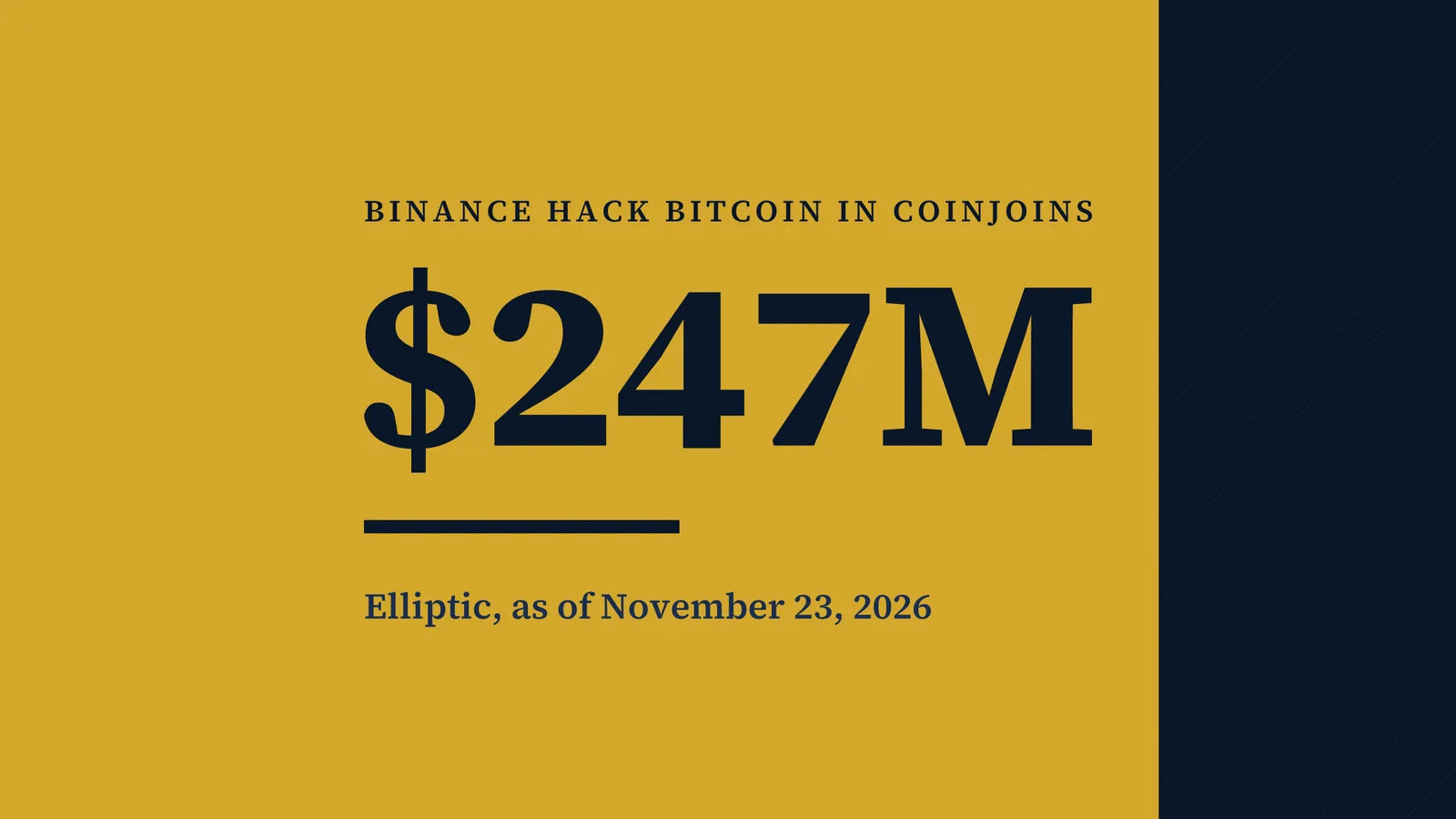
At least 3,930 BTC, worth about $247 million, that was converted from assets stolen from Binance on October 29 has gone through coinjoin transactions since November 1, blockchain analytics firm Elliptic said in an update to its tracing report dated 09:30 UTC on Monday, November 23, 2026. Almost all of those coinjoins were organized by a single coordinator, Kruw, the firm said.
How the mixing grew
Coinjoins first appeared in the laundering on November 2, with about 8 BTC over two days, Elliptic said. By November 12 the total was about 135 BTC. The pace changed after November 17, when the attacker began moving the largest ether holdings and swapping them into Bitcoin (BTC) through the cross-chain swap protocol THORChain. Much of the new Bitcoin went into coinjoins, often within two hours of arriving, according to the report.
| Date (2026) | Converted Bitcoin sent into coinjoins, per Elliptic |
|---|---|
| November 17 | about 480 BTC ($31 million) |
| November 18 | about 590 BTC ($38 million) |
| November 19 | about 520 BTC ($33 million) |
| November 20 | about 780 BTC ($48 million) |
| November 21 | about 580 BTC ($34 million) |
| November 22 | about 410 BTC ($25 million) |
| November 23, to 09:19 UTC | about 350 BTC ($22 million) |
Dollar values are Elliptic's. Since November 21, most of the Bitcoin entering coinjoins had been converted from XRP earlier in the month rather than from the new ether swaps, the firm said. Elliptic counts each stolen bitcoin only once, when it first enters a coinjoin, and said much of it has since been mixed again.
The coordinator
Elliptic said almost all of the coinjoins were coordinated by Kruw, which it describes as the most widely used coordinator for users of Wasabi Wallet. The rounds use WabiSabi, the protocol behind Wasabi Wallet and similar wallets.
Tom Robinson, Elliptic's co-founder, wrote on LinkedIn that the activity has become concentrated in a core set of daily hours. He cautioned that this is not conclusive and asked whether the funds may have been handed to China-based launderers, as has happened in other North Korean thefts. CoinDesk reported the findings on Monday.
On November 17, Kruw posted on X that users of the coordinator "consume 1.6% of Bitcoin's total blockspace." Blockchain investigator ZachXBT replied that the coordinator's largest "user" was Lazarus Group "laundering hundreds of millions from exploits." We found no public response from Kruw to Elliptic's findings by about 19:30 UTC on Monday.
The ether swaps paused, then resumed
Between November 17 and 20, the attacker emptied five of the nine largest ether addresses, each time between 06:50 and 08:30 UTC, and split about 488,000 ETH into new batches of 12,000 ETH, Elliptic said. Those batches were then swapped one or two at a time: each was split across about ten new addresses, which sent the ether through THORChain into Bitcoin in hundreds of small deposits.
The swaps stopped at 06:28 UTC on November 21 and started again at 06:50 UTC on Monday, when another batch created on November 17 was split across ten new addresses, the firm said. About 3,000 ETH ($5 million) had gone into THORChain by 09:00 UTC. In all, about 58,000 ETH ($100 million) has been swapped for about 1,630 BTC since November 17, which Elliptic called "still only a small part" of the roughly 425,000 ETH waiting in batches. The other four large ether addresses still hold about 41,000 ETH, it said.
Our own check is consistent with that. Two FBI-listed wallets sent 335,061.97 ETH to 28 new addresses on November 19 and 20, and those addresses still held exactly that amount in total at about 19:30 UTC on Monday, according to Blockscout data on the transfers from the first and second sending wallet. Elliptic does not publish the addresses behind its figures, so we could not check its coinjoin totals ourselves.
Where the funds stand
Of the $6.43 billion that Elliptic counts as stolen, $2.85 billion has been frozen or seized and about $2.22 billion remains in addresses linked to the theft, the firm said. The 18,270 BTC taken directly from Binance has not moved since it was split across 19 addresses on the night of the theft. About 2,300 BTC ($143 million) of Bitcoin converted from other stolen assets still sits in new addresses, down from about 3,200 BTC on November 20.
The coinjoins are one of several mixing routes. Elliptic estimated that about 11,000 ETH had gone into the mixer Tornado Cash by November 10, and said about $6.7 million went into the privacy protocol Privacy Cash on November 3 and 4. Around $16 million has been sent to addresses that also hold proceeds of the September 2026 Bitget exploit, which is also believed to be the work of TraderTraitor, according to the report. Elliptic's earlier tracing described the routes through Tron and THORChain, and the launderers have also used home-made memecoins.
Elliptic said the vast majority of the stolen funds has not been cashed out. To turn them into spendable money, the attacker needs a counterparty such as a centralized exchange or an over-the-counter (OTC) broker, "and that is where the funds can potentially be identified and stopped," the firm said.
Automation, not AI agents
Elliptic said the evidence points to conventional automation rather than AI agents moving the funds: fixed timing, set amounts, blind retries, and pauses that look like human working patterns. On Tron alone, the stolen funds moved in about 34,000 transactions. Each emptying of a main ether address happened between 06:50 and 08:30 UTC, and Monday's restart also began at 06:50 UTC, which suggests new steps are started on a schedule, the firm said.
The FBI has attributed the theft to North Korea's TraderTraitor operation, and North Korea has rejected the accusation. We found no statement from Binance on Elliptic's latest figures.
What it could mean for tracing the Binance hack funds
In our assessment, the coinjoin figures show the laundering moving from conversion into mixing, the step that most weakens the on-chain trail. Elliptic's numbers still put most of the stolen value elsewhere: frozen, sitting in the 18,270 unmoved BTC, or parked as ether in batches that have not been swapped. The points that the public data can show are how quickly the 425,000 ETH in batches is swapped, whether the share routed through coinjoins keeps rising, and whether any of the funds reach exchanges or OTC desks, where Elliptic says they could still be stopped.
Sources
- Elliptic — How North Korea is laundering the $6.4 billion stolen from Binance (updated November 23, 2026) (November 3, 2026)
- Tom Robinson on LinkedIn — Post on coinjoins and the Binance hack funds (November 23, 2026)
- Blockscout (Ethereum explorer) — Transactions of the address beginning 0xc887aF
- Blockscout (Ethereum explorer) — Transactions of the address beginning 0x8532FA
- Kruw on X — Post on the coordinator's share of Bitcoin blockspace (November 17, 2026)
- CoinDesk — Binance hackers push $247 million through transactions designed to cloud the source (November 23, 2026)
- ZachXBT on X — Reply to Kruw (November 17, 2026)
This article was researched and drafted with the help of AI tools, checked against its sources in a separate AI fact-check and edit, and approved for publication by Trading Metrics. Read our AI use policy.
This article is for information only and is not financial advice. Crypto assets and leveraged products are volatile and you can lose money. Do your own research and consider your circumstances before trading.