
Binance resumes withdrawals in phases, says it has replaced about 98% of stolen assets
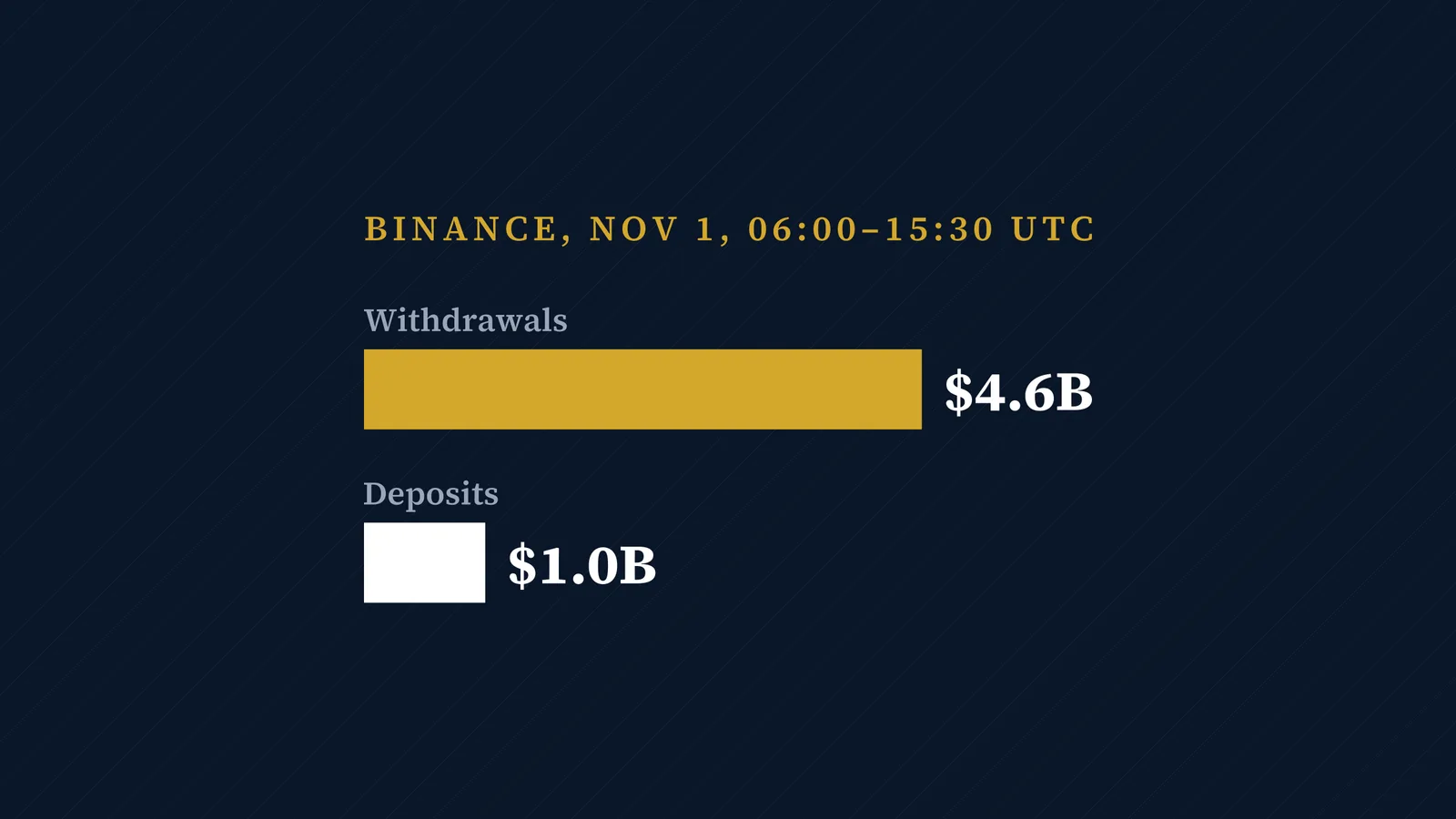
Bitcoin withdrawals came back first on November 1. Users pulled a net $3.6 billion between 06:00 and 15:30 UTC that day, according to figures Binance shared.
Binance began restoring withdrawals on Sunday, November 1, three days after the October 29 hack, and said it had covered about 95% of the stolen assets from its own resources, according to TechCrunch and crypto.news. It later raised that figure to about 98%.
What happened
The reopening ran network by network. Binance said the Bitcoin network was the "first batch network now opened," CNBC reported, followed by Ethereum and BNB Smart Chain. Crypto.news described the first phase as Bitcoin plus selected assets across 15 blockchain networks, scheduled from 06:00 UTC on November 1. On Sunday morning, Binance's status page still showed Bitcoin withdrawals as "partially suspended," TechCrunch reported.
How much is covered
Binance's coverage figure rose as it moved money into place:
- Saturday, October 31: "covered up to 90%" of the stolen assets, Binance said, according to CNBC.
- Sunday, November 1: about 95%, according to Binance's update cited by TechCrunch and crypto.news.
- By November 4: about 98%, Binance said, according to Fortune and Bitcoin.com News, which cited a November 4 post by the exchange.
CNBC listed the sources of the money as Binance's Secure Asset Fund for Users (SAFU), a portion of its futures insurance fund, and its corporate treasury. Binance also said that "all BTC, ETH, USDT, BNB, SOL, USDC, XRP, USD1, RLUSD, and ZEC are fully backed 100%," CNBC reported.
Covering losses is not the same as recovering them. As CNBC pointed out, restoring backing for 90% of the assets does not mean Binance has recovered 90% of the funds from the attacker. Binance says it replaced the missing assets with its own funds. Most of the stolen money is still in attacker-linked addresses or frozen: Elliptic counted $3.13 billion remaining in addresses linked to the theft and $2.85 billion frozen or seized as of November 7.
"Our commitment remains unchanged: Binance will bear the financial impact of the stolen funds," the exchange said, as quoted by TechCrunch.
The first day of withdrawals
Between 06:00 and 15:30 UTC on November 1, Binance processed $4.6 billion in withdrawals and $1.0 billion in deposits, a net outflow of $3.6 billion, according to figures the exchange shared, TechCrunch reported. Binance put that at 2.1% of its total assets. Trading Notified could not independently verify the figures.
Why it matters
The speed of the reopening and the size of the outflows are the clearest public tests of user confidence. A net outflow of $3.6 billion in under 10 hours is large in dollar terms, but small relative to the assets Binance says it holds.
What it could mean for traders
Until every network is open, some tokens cannot leave Binance, which can create price gaps between Binance and other venues for those tokens. Users who need to move a specific token have to check its network status first. Binance's status updates, its reserve figures, and the daily net flows are the markers to watch; see which networks are still suspended and what the hack changes for exchange risk.
Sources
- CNBC — Binance resumes withdrawals following $6.3 billion hack, says 90% of stolen user assets are covered (October 31, 2026)
- TechCrunch — Binance resumes withdrawals following $6.3 billion breach (November 1, 2026)
- Fortune — North Korea used LinkedIn, fake job interviews to trick Binance engineer in $6.3 billion hack (November 3, 2026)
- crypto.news — Binance reopens Bitcoin withdrawals after $6.3B hack, says 95% restored (November 1, 2026)
- Bitcoin.com News — Binance Restores HYPE, APT as Data Reveals Billions in Reserve Outflows (November 8, 2026)
- Elliptic — How North Korea is laundering the $6.4 billion stolen from Binance (November 3, 2026)
This article was researched and drafted with the help of AI tools, checked against its sources in a separate AI fact-check and edit, and approved for publication by Trading Metrics. Read our AI use policy.
This article is for information only and is not financial advice. Crypto assets and leveraged products are volatile and you can lose money. Do your own research and consider your circumstances before trading.