
Former Robinhood engineer pleads guilty to wire fraud over Hyperliquid trades ahead of token listings
Huaisong Xiang agreed to forfeit $125,523, CoinDesk reported. Prosecutors say he traded perpetual futures on Hyperliquid using confidential Robinhood listing plans; his co-defendant's case is still pending.
Contents
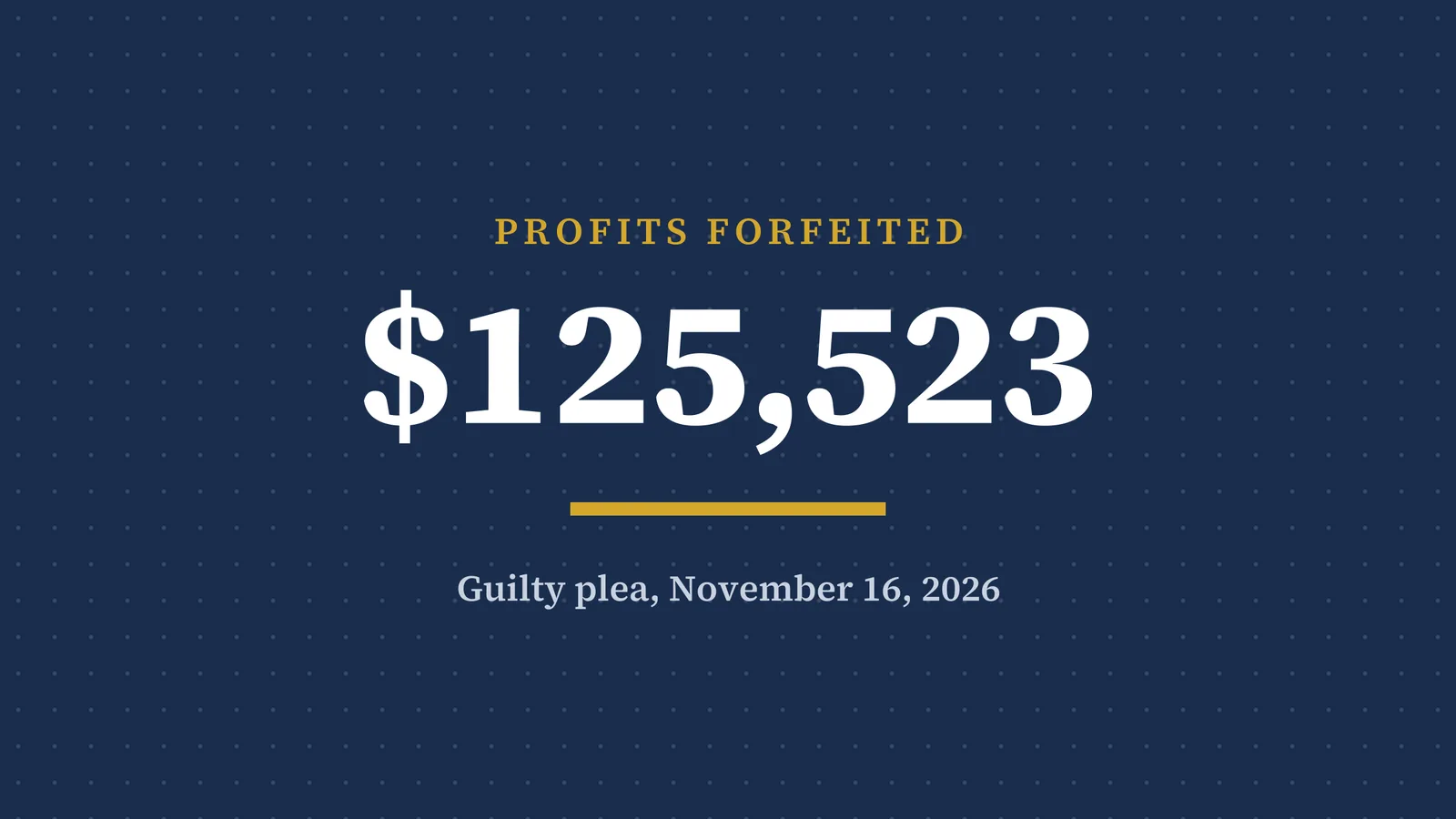
Huaisong Xiang, a former Robinhood software engineer, pleaded guilty to wire fraud on Monday, November 16, 2026, in a case over perpetual futures trades on Hyperliquid placed ahead of Robinhood's crypto listing announcements, CoinDesk reported. He entered the plea before US District Judge Colleen McMahon in Manhattan and agreed to forfeit $125,523 in profits, according to the report. That sum is more than double the "more than $50,000" in profits prosecutors cited when they charged him in September.
The US Attorney's Office for the Southern District of New York announced the plea. We could not open that release, so the plea details here rest on CoinDesk and BeInCrypto, which reported the same plea and forfeiture amount. The September charging documents are public and are cited below.
What prosecutors said he did
According to the complaint against Xiang, he was a software engineer in Robinhood's Manhattan office from about 2024 to September 2026 and worked on listing new digital assets on Robinhood Crypto. That role put him in a restricted group the company called "Coin Aware Individuals," which had access to a private Slack channel where planned listing dates were shared.
Robinhood's insider trading policy barred that group from trading a newly listed asset on Robinhood or any other platform before the announcement and for 24 hours after it, the complaint says. The trades it describes were in perpetual futures on Hyperliquid, a decentralized derivatives exchange. A perpetual future is a contract that tracks a token's price, has no expiry date and can be traded with borrowed money.
The complaint lists a first trade in POPCAT, a meme token, in March 2025, and "at least ten other occasions" between May 2025 and February 2026, including trades in MEW, MOODENG, ONDO and RENDER. A token often became tradable on Robinhood up to an hour before the public announcement, and prices tended to rise in that window, the complaint says. In several of the listed cases, Xiang closed his positions inside that window, before Robinhood announced the listing.
The charges and the plea
The Justice Department announced the charges on September 15, 2026. Xiang, 30, of Jersey City, New Jersey, and a second Robinhood engineer, Hefu Chai, 36, of Menlo Park, California, were each charged with one count of commodities fraud under the Commodity Exchange Act, which carries a maximum of 10 years in prison, and one count of wire fraud, which carries a maximum of 20 years. The release said each man profited by more than $50,000.
On Monday, Xiang pleaded guilty to wire fraud, CoinDesk reported. The reports we read did not say what happens to the commodities fraud count. BeInCrypto reported that sentencing is set for February 25, 2027; CoinDesk said the announcement did not specify a sentencing date. We could not confirm the date in a court record.
"No matter the trading platform, corporate insiders will be held accountable," US Attorney Jamie McDonald said in a statement on Monday, as quoted by CoinDesk.
Co-defendant's case is still open
Chai has not pleaded guilty, and the charges against him remain allegations. The complaint against Chai accuses him of buying perpetual futures on Hyperliquid ahead of Robinhood listing announcements on at least 10 occasions between 2025 and January 2026. The plea announcement gave no update on his case, CoinDesk reported. He is presumed innocent unless proven guilty.
What Robinhood said
When the charges were announced in September, a Robinhood spokesperson told The Block that the company "takes market integrity seriously and has zero tolerance for insider trading." The company said it had investigated, reported the matter to law enforcement and regulators, and would keep cooperating. We did not find a new Robinhood comment on the plea in the reports we read, and no comment from Hyperliquid or from Xiang's lawyer was reported.
The case is unrelated to a pseudonymous trader's claim about a Robinhood memecoin listing, reported by The Block on November 15, whose profit figures have not been verified.
Why the case matters for exchange listings
The prosecutors' theory is that a company's listing plans are confidential business information, and that trading on them is fraud even when the trades happen on another venue and in derivatives rather than the token itself. Hyperliquid restricts users with US IP addresses through geofencing, the complaint says, but it adds that a VPN can get around this. Venues that list stock perpetual futures on Hyperliquid extend the same kind of contract to other assets. Questions about insider trading have also reached other new markets, including insider trading on prediction markets, which a House Oversight Committee staff memo examined on November 13.
In our assessment
The guilty plea is the first resolution in this case. It is a plea to wire fraud, a charge brought under a general fraud statute rather than securities law, so the case has not required a court to decide whether any of the listed tokens is a security. The complaints also describe what prosecutors see as a listing leak in practice: a small group with early knowledge, a short window between a token going live and the announcement, and trades placed in derivatives on a decentralized venue. Robinhood says it investigated and reported the matter to authorities. Chai's case and the sentencing of Xiang are the next steps on the public record.
Sources
- US Attorney's Office, Southern District of New York — Two Robinhood Employees Charged With Fraud (September 15, 2026)
- US District Court, Southern District of New York — United States v. Huaisong Xiang, sealed complaint, 26 MAG 3718 (September 15, 2026)
- US District Court, Southern District of New York — United States v. Hefu Chai, sealed complaint, 26 MAG 3716 (September 15, 2026)
- CoinDesk — Former Robinhood engineer pleads guilty to insider trading scheme on Hyperliquid (November 16, 2026)
- BeInCrypto (via Yahoo News) — Ex-Robinhood Staffer Pleads Guilty to Trading on Confidential Crypto Listing Information (November 16, 2026)
- The Block — DOJ charges Robinhood former engineers with front-running crypto listings on Hyperliquid (September 15, 2026)
This article was researched and drafted with the help of AI tools, checked against its sources in a separate AI fact-check and edit, and approved for publication by Trading Metrics. Read our AI use policy.
This article is for information only and is not financial advice. Crypto assets and leveraged products are volatile and you can lose money. Do your own research and consider your circumstances before trading.