
China's retail sales rise 0.4% in October as industrial output and investment also miss forecasts
Official data showed retail sales up 0.4% from a year earlier and industrial output up 4.8%, both below economists' forecasts, while fixed-asset investment fell 8.1% in the first ten months.
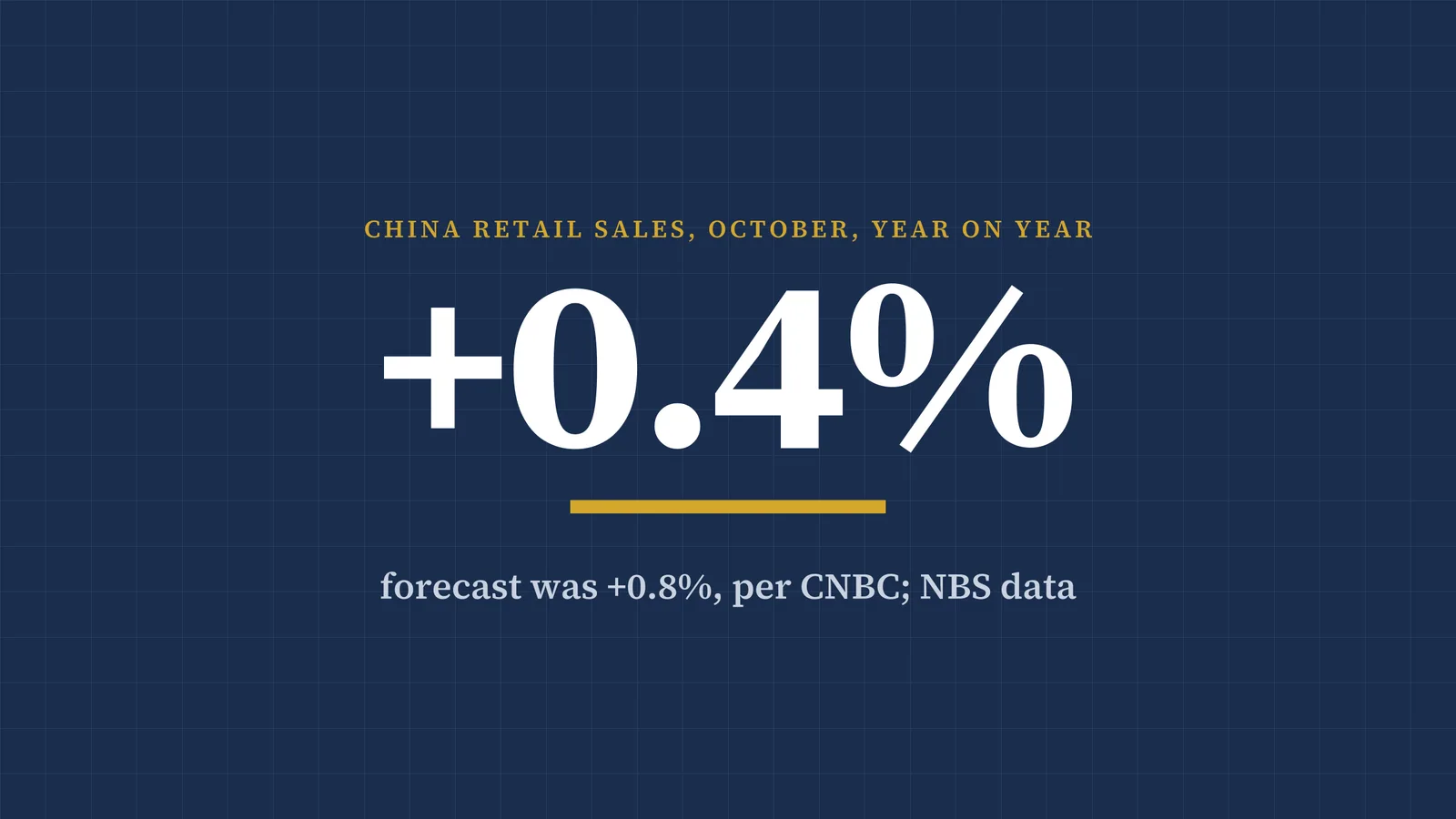
China's retail sales rose 0.4% in October 2026 from a year earlier, and industrial output grew 4.8%, the National Bureau of Statistics said on Monday, November 16. Both figures fell short of economists' forecasts, and investment in fixed assets shrank 8.1% in the first ten months of the year, more than expected, CNBC reported.
The October figures
Retail sales of consumer goods reached about 4.65 trillion yuan in October, the statistics bureau said. Economists had expected growth of 0.8%, according to CNBC, and sales had risen 1.1% in September.
Industrial output, measured as value added at larger industrial companies, grew 4.8% from a year earlier, slower than the 5.5% of September and below the 5.3% economists expected, CNBC reported. Within that total, high-tech manufacturing grew 17.6% and equipment manufacturing 10.6%, the bureau said.
Fixed-asset investment, which covers spending on factories, infrastructure and property, totaled about 36.48 trillion yuan from January to October, down 8.1% from a year earlier. Economists had expected a 7% decline, CNBC said. Investment in real estate development fell 21.6%, infrastructure investment 5.1% and manufacturing investment 2.9%, according to the bureau, and private investment dropped 11.4%.
The urban surveyed unemployment rate was 5.1% in October, down from 5.2% in September. Exports in October were 28.7% higher than a year earlier in yuan terms, the bureau said.
Weak spending at home, strong sales abroad
The data point to a widening gap between spending in China and demand from abroad. Consumer spending has been held back by a property downturn that has eroded household wealth for a fifth year, CNBC reported, while exports, driven largely by global demand for AI-related equipment, have kept growing. China's economy grew 4.5% in the third quarter from a year earlier, according to the statistics bureau.
Zhiwei Zhang, president and chief economist at Pinpoint Asset Management, told CNBC that markets had been worried about a slowdown in AI capital spending even before what CNBC called the Nvidia scandal put flows of restricted chips to China under renewed scrutiny, and that "now the risk has become even more serious." US lawmakers have asked former Nvidia chief executive Jensen Huang to answer questions about the company's chip exports to China, and Nvidia has said it complies with US export laws, according to NBC News.
Goldman Sachs expects China's growth to slow to 4.6% in 2026 from 5% in 2025, according to CNBC.
The statistics bureau described the economy as "generally stable" and pointed to growth in services output, which rose 4.6% in October.
Why the reliance on exports matters
In our assessment, the figures add to signs that China's growth depends more on exports than on spending at home, which leaves it exposed to any slowdown in AI-related demand or to new trade barriers. The data do not show how Beijing will respond; no new stimulus was announced with the release.
Sources
- National Bureau of Statistics of China — National Economy was Generally Stable with Innovation-Led and High-Quality Development in October (November 16, 2026)
- National Bureau of Statistics of China — Preliminary Accounting Results of GDP for the Third Quarter of 2026 (October 21, 2026)
- CNBC — China's slowdown deepens in October as industrial output, retail sales, investment miss estimates (November 16, 2026)
- NBC News — Howard Lutnick agrees to testify as bipartisan pressure grows over Nvidia scandal (November 12, 2026)
This article was researched and drafted with the help of AI tools, checked against its sources in a separate AI fact-check and edit, and approved for publication by Trading Metrics. Read our AI use policy.
This article is for information only and is not financial advice. Crypto assets and leveraged products are volatile and you can lose money. Do your own research and consider your circumstances before trading.