
Grayscale's 2x Zcash ETF falls 13% on its first day of trading
The fund, ticker ZECX, uses swaps to target twice the daily move of Grayscale's spot Zcash ETF. Its prospectus warns that holders could lose almost all their money in one day if ZCSH falls 50% or more.
Contents
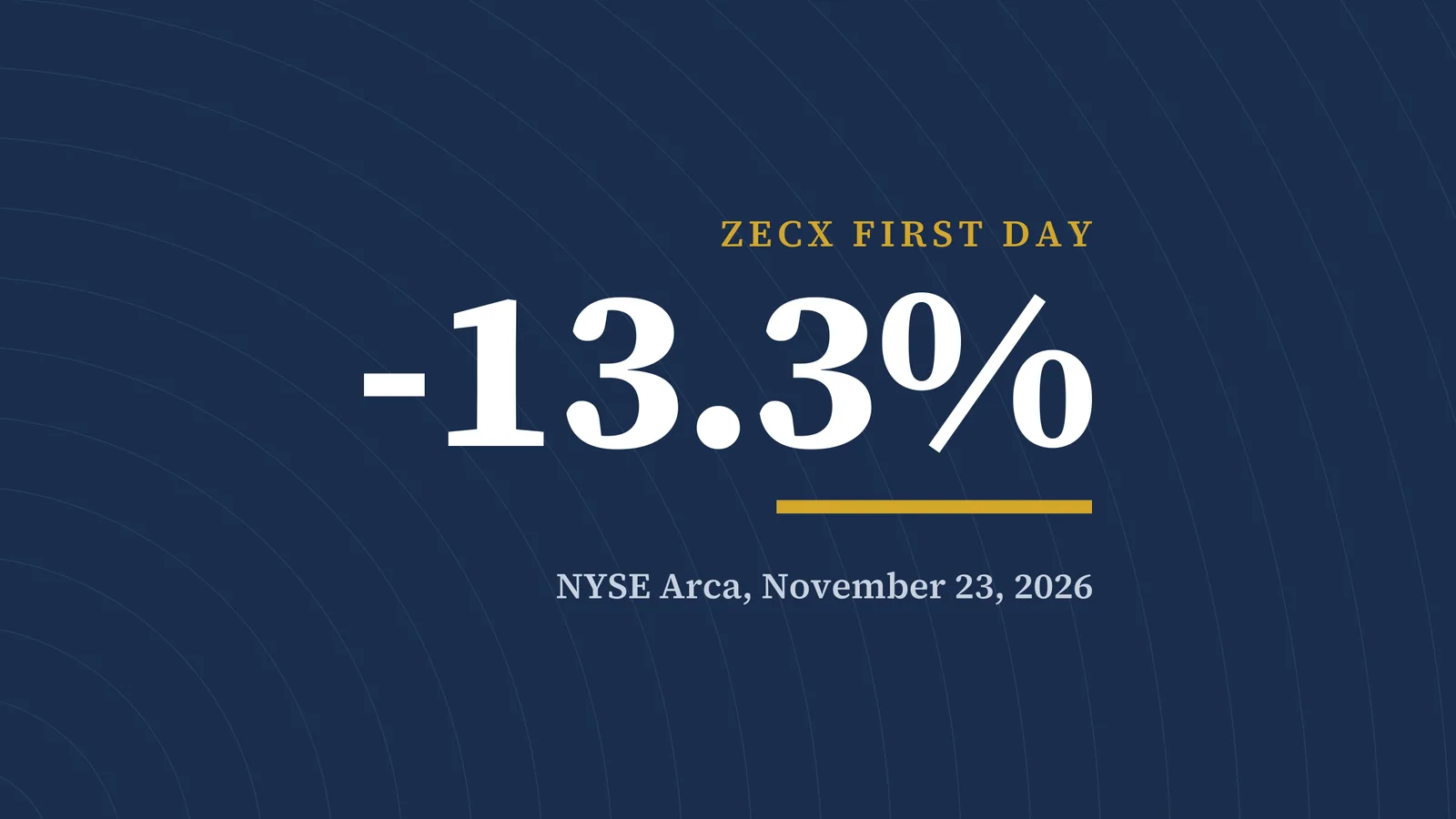
Grayscale's new leveraged Zcash fund, the 2x ZCSH ETF, lost 13.3% in its first session on NYSE Arca on Monday, November 23, 2026. The fund, which trades under the ticker ZECX, closed at $28.63 against a reference price of $33.04, according to Yahoo Finance data. The Block reported the drop on Monday evening.
ZECX does not hold Zcash (ZEC). It seeks twice the daily return of Grayscale's spot Zcash exchange-traded fund (ETF), ZCSH, before fees and expenses, mainly through swap agreements, according to the fund's summary prospectus dated November 23.
How the first session went
The first trade with volume came at 15:40 UTC at $34.22, according to Yahoo Finance's 5-minute data. The price then slid through the afternoon to a low of $28.59, and the last trade came at 20:51 UTC. About 8,900 shares changed hands during the day. ZCSH, by comparison, traded about 1.29 million shares.
ZCSH itself had a volatile day. It opened at $23.81, up about 22% from Friday's close of $19.55, then fell for most of the session and closed at $21.24, Yahoo Finance data shows. That left it 8.6% higher than on Friday but 10.8% below its opening price. Between ZECX's first trade at 15:40 UTC and the close, ZCSH fell about 7.8% and ZECX about 16.3%, by our calculation from the same data.
The swing followed the coin. Zcash rose from about $795 at 12:00 UTC to an hourly high of about $860 at 15:00 UTC, then fell back to about $776 by 22:00 UTC, according to CoinGecko's hourly data. The Block linked the morning jump to a rally in crypto-related stocks after Nvidia reinstated Jensen Huang as chief executive. Zcash traded at about $770 at 06:16 UTC on Tuesday, CoinGecko data shows.
What the fund holds and what it costs
According to the prospectus, ZECX will not hold ZEC or control any private keys. It plans to get its exposure mainly through cash-settled swaps that reference ZCSH, held through a Cayman Islands subsidiary, and if necessary through options on ZCSH shares. The filing also allows for Zcash futures, but says that as of its date no such contracts were listed on any US futures exchange registered with the Commodity Futures Trading Commission. Grayscale Advisors is the adviser and Tidal Investments the sub-adviser.
The fund's management fee is 1.85%. Grayscale has agreed to waive 1.00 percentage point of it through at least April 30, 2028, which brings total annual operating expenses to 0.95%. On top of that, the prospectus estimates the financing cost embedded in the swaps at about 7.50% a year of the fund's average daily net assets, a cost that is not shown in the fee table and reduces returns. ZCSH's own 2.50% sponsor's fee is already reflected in ZCSH's price.
Grayscale said ZECX is the first 2x leveraged ETF tied to Zcash, The Block reported. We could not open Grayscale's own announcement; its website returned errors when we tried. ZCSH, the former Grayscale Zcash Trust, has traded on NYSE Arca since August 25, 2026. "Financial privacy is one of the most important opportunities in crypto," Kyle Dacruz, Grayscale's head of product development, said, according to The Block.
What the prospectus says about daily leverage
The 2x target applies to one day only, measured from one ZCSH closing price to the next. Over longer periods, the fund's return is the product of its daily returns, so it can differ widely from twice the move of ZCSH. The prospectus says the fund "will lose money if the performance of ZCSH is flat" over periods longer than a day, and that it can lose money even if ZCSH rises over such a period. Higher volatility and longer holding periods increase that effect, it says.
The filing describes the fund as "intended to be used as a short-term trading vehicle" for investors who actively monitor their positions. Because the fund will not limit its daily gains or losses, it warns that if ZCSH falls 50% or more in a single day, investors "could lose all or substantially all of their money in a single day."
What it could mean for traders following Zcash
In our assessment, the fund adds a listed way to take leveraged, short-term exposure to Zcash, but it is two steps removed from the coin. It tracks ZCSH, which can trade above or below the value of its ZEC and carries its own fee, and it relies on swaps with costs the fee table leaves out. Its first day showed how quickly a daily-leveraged product can move when the underlying swings: Zcash, which fell below $1,000 on November 11, rose and gave back its gains within hours. Points to watch are how much money the fund attracts, whether its shares trade close to their net asset value, and whether any regulated Zcash futures are listed.
Sources
- US Securities and Exchange Commission (EDGAR) — 2x ZCSH ETF, summary prospectus (Form 497K) (November 23, 2026)
- Yahoo Finance — ZECX chart data (daily and 5-minute) (November 23, 2026)
- Yahoo Finance — ZCSH chart data (daily and 5-minute) (November 23, 2026)
- The Block — Grayscale's new 2x leveraged Zcash ETF takes 13% opening day tumble (November 23, 2026)
- CoinGecko — Zcash price (hourly market chart API)
This article was researched and drafted with the help of AI tools, checked against its sources in a separate AI fact-check and edit, and approved for publication by Trading Metrics. Read our AI use policy.
This article is for information only and is not financial advice. Crypto assets and leveraged products are volatile and you can lose money. Do your own research and consider your circumstances before trading.