
Institutions bought a net $4.1 billion of Bitcoin ETFs in the third quarter after three quarters of selling, Galaxy says
Galaxy Research's count of 13F filings shows 49,229 BTC of net buying, led by wealth platforms and Wells Fargo. The data stops on September 30, and the funds have shed Bitcoin since then.
Contents
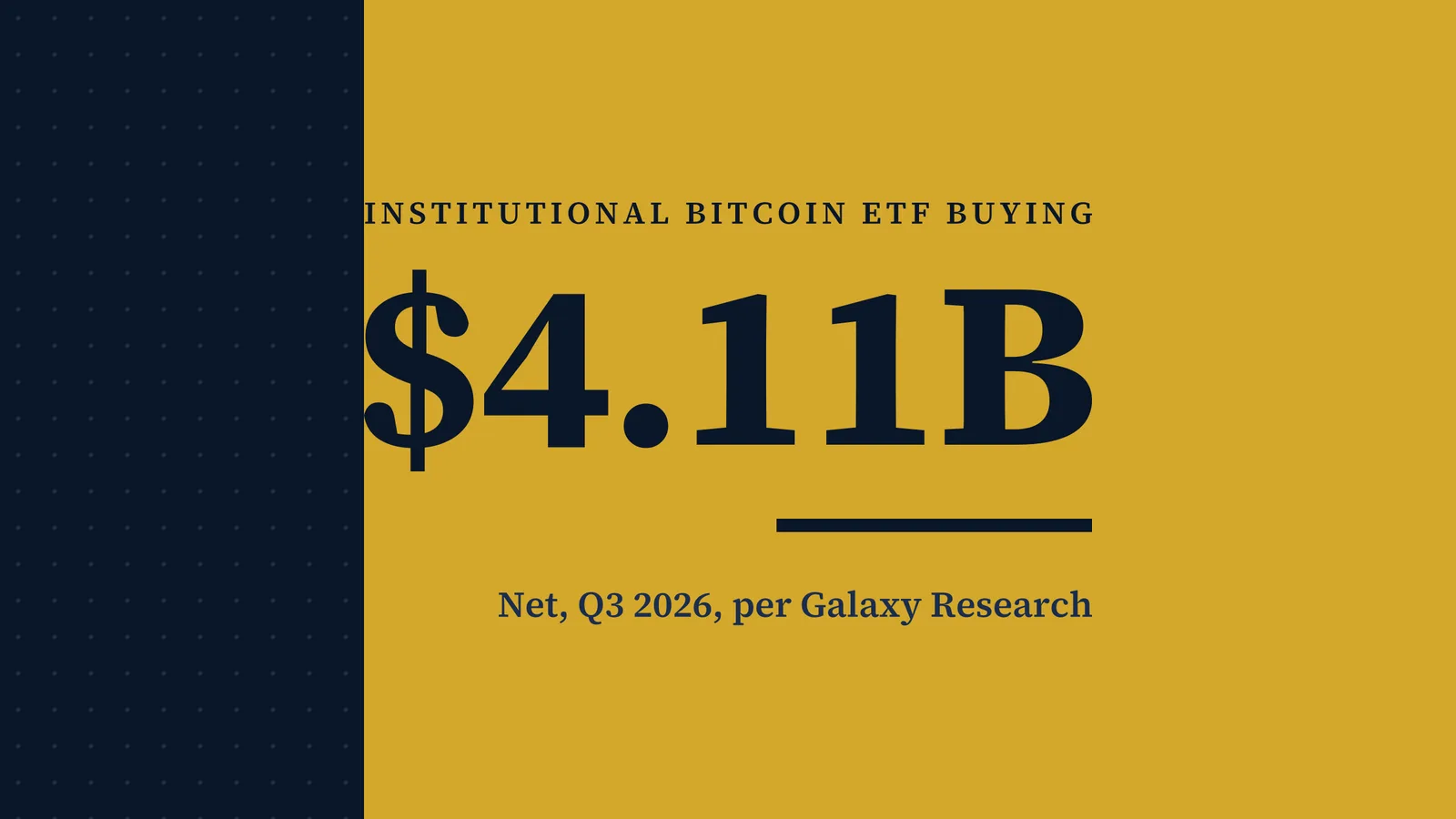
Institutional investment managers bought a net 49,229 Bitcoin (BTC) worth of US spot Bitcoin exchange-traded fund (ETF) shares in the third quarter of 2026, about $4.11 billion at September 30 prices, according to a Galaxy Research analysis of Form 13F filings published on November 19. The buying more than offset the 47,054 BTC that filers sold over the previous three quarters combined, Galaxy said.
What Galaxy's 13F count shows
Galaxy converts the fund shares reported on each 13F into the Bitcoin those shares represent, so that changes in the Bitcoin price do not distort the totals. On that basis, it said, 2,166 managers reported spot Bitcoin fund positions on September 30, 191 more than on June 30, and together they held 356,491 BTC, the highest on record. The quarter's net addition was the largest since the second quarter of 2025.
The filers held 27.6% of the 1,290,670 BTC in the funds, up from 24.8% in the second quarter, according to Galaxy. Its figures cover 13F filings made through November 17.
BlackRock's iShares Bitcoin Trust (IBIT) accounted for 232,453 BTC of the reported holdings, 65.2% of the total, after filers added 34,744 BTC to it in the quarter, Galaxy said. Fidelity's Wise Origin Bitcoin Fund (FBTC) followed with 41,429 BTC.
| Holder group (Galaxy) | BTC held, Sept. 30 | Q3 net change |
|---|---|---|
| Advisors and wealth platforms | 144,307 | +24,838 |
| Market makers and bank desks | 77,769 | +14,600 |
| Macro hedge funds | 16,656 | +10,492 |
| Basis and relative-value hedge funds | 34,053 | +9,184 |
| Asset managers | 41,211 | −1,024 |
| Other hedge funds and crypto firms | 16,933 | −5,295 |
The table shows six of Galaxy's eight groups. Pensions, sovereign funds and endowments added 181 BTC, and family offices and corporates sold 3,798 BTC, according to the report.
Wealth platforms led the buying
Advisors and wealth platforms, from independent advisory firms to the large brokerages known as wirehouses, have been net buyers for nine quarters in a row, Galaxy said. Hedge funds held 19.0% of the 13F holdings at the end of September, down from 50.6% at the end of 2024.
The buying was concentrated. The 50 largest holders added 59,578 BTC, while all other managers together sold a net 10,349 BTC, CoinDesk reported, citing Galaxy's data. Alex Thorn, Galaxy's head of firmwide research, wrote in the report that the quarter's accumulation "was the work of a few dozen large institutions."
What the filings of two large buyers show
Wells Fargo's holdings rose by 14,636 BTC to 30,553 BTC, making it the largest 13F holder for the first time, according to Galaxy. Its 13F information table lists 49.6 million shares of BlackRock's iShares Bitcoin Trust across five group entities, plus smaller positions in Bitwise, Grayscale and Invesco Galaxy funds. Galaxy's figure covers all of those funds; CoinDesk's November 17 estimate of about 28,070 BTC was for the IBIT shares alone. About 85% of the position sits in Wells Fargo's advisory and brokerage arms, CoinDesk reported, citing Galaxy.
Brevan Howard added 8,606 BTC, Galaxy said. The hedge fund manager's September 30 information table lists 22,405,494 long IBIT shares in two rows, with a reported value of about $1.06 billion, up from 7,205,004 shares in its June 30 table. The September table also lists call options on 5,483,000 IBIT shares and puts on 517,600, compared with calls on 7,230,000 and puts on 5,273,700 in June.
Galaxy also named Millennium Management, up 7,114 BTC, and Jane Street, up 6,180 BTC, among the large buyers. Bank of America added 7,201 BTC, but most of it sits in its dealer and trading units, and Galaxy's report reads the increase "as dealer positioning, not as demand from wealth clients." Goldman Sachs added 5,499 BTC, according to Galaxy; its own filing shows it shifted much of its Bitcoin fund exposure into Fidelity's fund while trimming its IBIT shares.
The limits of the data
Because short positions and most derivatives are left out, a fund purchase on a 13F may be one leg of a hedged trade. A hedge fund can buy spot ETF shares and sell Bitcoin futures to earn the price gap, a basis trade, which looks like buying on the form while carrying little net exposure to Bitcoin, CoinDesk noted. Large banks also report put and call positions on IBIT whose purpose the filings do not explain.
Galaxy added that client-directed brokerage accounts are generally absent from the filings, so in its view wealth-channel ownership is understated, and that late filings or amendments could change the figures.
A different picture since September
The data ends on September 30, before the decline in Bitcoin's price. The spot Bitcoin funds held 38,531 fewer BTC on November 16 than at the end of September, falling to 1,252,139 BTC, while Bitcoin's price fell from $83,580 to $64,943 over the same period, according to Galaxy.
US spot Bitcoin ETFs had net outflows of $515 million in October, Cointelegraph reported, citing TFTC data. November outflows reached about $1.6 billion by November 10 and about $2.9 billion through November 18, according to the TFTC flow tracker. The 13F reports for the fourth quarter are due in February.
What it could mean for the ETF flow picture
In our assessment, the report shows who held the funds at the end of September more than what institutions are doing now: the fourth-quarter outflows came after the snapshot, and the flow data does not show which holders sold. Galaxy argues that advisors who rebalance toward target allocations tend to buy when prices fall, CoinDesk reported; the February filings will show whether wealth-platform holdings held up through the decline. Points to watch are the wealth-channel share in those filings, whether hedge fund positions shrink as basis trades unwind, and the daily flow data in the meantime.
Sources
- SEC EDGAR — Wells Fargo, Form 13F information table, September 30, 2026 (November 16, 2026)
- SEC EDGAR — Brevan Howard Capital Management, Form 13F information table, September 30, 2026 (November 16, 2026)
- SEC EDGAR — Brevan Howard Capital Management, Form 13F information table, June 30, 2026 (August 14, 2026)
- US Securities and Exchange Commission — Frequently Asked Questions About Form 13F
- Galaxy Research — Institutional Holdings of Bitcoin ETPs Reach New All-Time High (November 19, 2026)
- CoinDesk — Big money bought a net $4 billion of bitcoin funds in Q3, ending 9 months of selling (November 20, 2026)
- Cointelegraph — Institutions pile back into US Bitcoin ETFs in Q3 after selling streak (November 20, 2026)
- TFTC — Bitcoin ETF flows, November 2026
This article was researched and drafted with the help of AI tools, checked against its sources in a separate AI fact-check and edit, and approved for publication by Trading Metrics. Read our AI use policy.
This article is for information only and is not financial advice. Crypto assets and leveraged products are volatile and you can lose money. Do your own research and consider your circumstances before trading.