
Stablecoin supply falls 5.3% in 30 days, its steepest decline since mid-2022
DefiLlama data show about $16 billion of stablecoins leaving circulation since mid-October, most of it USDT and USDC. CoinDesk links the shrinking supply to the pressure from spot Bitcoin ETF outflows.
Contents
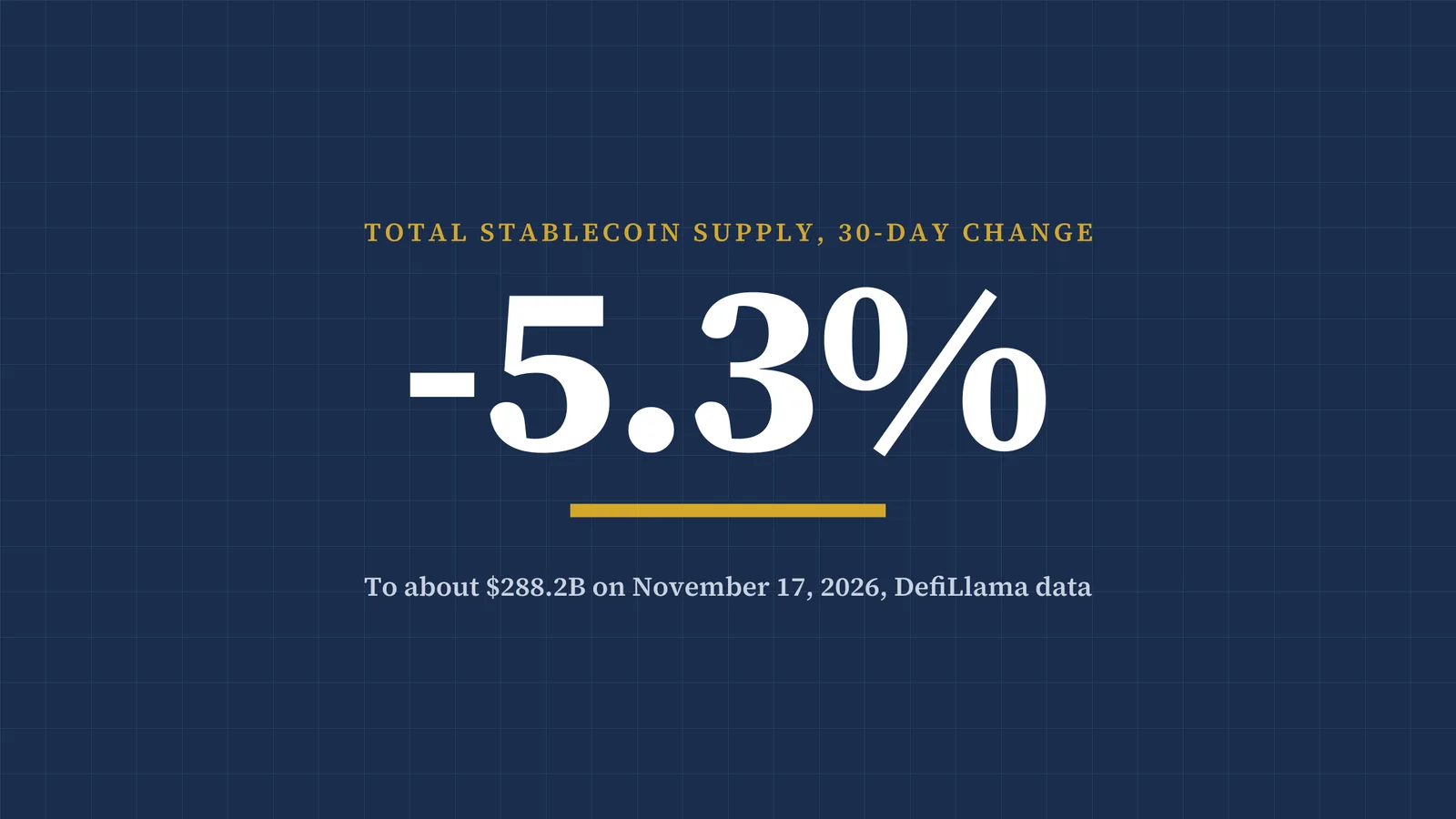
The total supply of stablecoins fell about 5.3% over the past 30 days, according to DefiLlama's stablecoin data, its steepest 30-day decline since June 2022. Supply stood at about $288.2 billion at 14:46 UTC on Tuesday, November 17, 2026, down from $304.2 billion on October 18, a drop of about $16 billion. In a newsletter published on November 17, CoinDesk described stablecoins as crypto's "casino chips" and said their shrinking supply adds to the pain from outflows from spot Bitcoin (BTC) exchange-traded funds (ETFs).
What the data show
The figures below come from DefiLlama's public stablecoin API, which tracks the circulating supply of stablecoins across blockchains. DefiLlama records one value per day; the November 17 figure is the live value at the time we fetched it, 14:46 UTC. The changes are our calculations from those values.
| Measure | November 17 | Change over 7 days | Change over 30 days | Change from 2026 peak |
|---|---|---|---|---|
| All stablecoins | $288.2bn | -$3.95bn (-1.4%) | -$16.05bn (-5.3%) | -$26.2bn (-8.3%), peak May 17 |
| Tether (USDT) | $175.4bn | -$1.04bn (-0.6%) | -$8.14bn (-4.4%) | -$15.0bn (-7.9%), peak May 20 |
| USD Coin (USDC) | $69.5bn | -$0.94bn (-1.3%) | -$3.18bn (-4.4%) | -$10.2bn (-12.8%), peak March 18 |
The total has fallen on most days since mid-October. The rolling 30-day declines of the past few days, including the one to November 17, are the steepest in DefiLlama's daily series since June 2022, according to our scan of the data. At that time total supply was still falling after the collapse of the TerraUSD stablecoin in May 2022.
The issuers' own figures are close to DefiLlama's. Tether's transparency data showed about $175.5 billion of USDT in circulation when we checked, calculated as the tokens it lists across chains minus those it lists as reserve balances, with total liabilities of about $175.4 billion. Circle's supply data showed about $69.2 billion of USDC, updated at 14:45 UTC. At the end of September, Circle reported $73.9 billion of USDC in circulation, and Tether's attested reserves report put its liabilities at $183.5 billion.
How CoinDesk reads it
CoinDesk's November 17 newsletter, written by Omkar Godbole, put combined stablecoin supply at $284.24 billion, down 5.3% over 30 days, citing DefiLlama. That is about $4 billion lower than the total in the DefiLlama chart data we used, which counts stablecoins pegged to every currency, so the two figures appear to cover slightly different sets of tokens. CoinDesk also said that, by its own analysis, USDT and USDC together fell 4.5%, or about $11.6 billion, to $244.5 billion, their sharpest 30-day decline since 2022. Our figures from DefiLlama's per-asset data show a combined fall of about $11.3 billion, or 4.4%, to about $244.9 billion.
The newsletter said more tokens are being turned back into dollars than are being created, which it read as a sign that money is leaving crypto, and it quoted the analytics firm CryptoQuant: "Stablecoin growth funded every rally this cycle. That fuel is draining." CoinDesk presented this as adding to the pressure from spot ETF outflows. That is CoinDesk's interpretation. Supply figures show that tokens were redeemed and taken out of circulation, not who redeemed them or why.
The ETF backdrop
The decline in stablecoin supply has coincided with withdrawals from US spot Bitcoin ETFs. BlackRock's iShares Bitcoin Trust (IBIT) recorded 11 straight sessions of outflows worth about $2.35 billion from October 30 to November 13, according to Farside Investors data, before taking in $76.5 million on November 16.
Neither the stablecoin data nor the ETF flow data link the two directly. The supply figures count tokens issued and redeemed; they do not identify the holders who redeemed them, and the ETF flow figures do not show where sellers moved their money.
What it could mean for crypto markets
The data show that the pool of dollar stablecoins, which traders often hold between trades and post as collateral on exchanges, has shrunk for a month at a pace not seen in more than four years, with the two largest issuers accounting for most of the decline. CoinDesk treats this as a sign of capital leaving crypto alongside ETF outflows. The supply figures are consistent with that reading, but they do not show who redeemed the tokens or whether the dollars left the crypto market or moved elsewhere within it.
Sources
- DefiLlama — Stablecoins API, total circulating supply chart (all chains)
- DefiLlama — Stablecoins API, list of stablecoins with circulating supply
- DefiLlama — Stablecoins API, Tether (USDT) circulating supply history
- DefiLlama — Stablecoins API, USD Coin (USDC) circulating supply history
- Tether — Tether transparency data feed
- Circle — Circle stablecoin supply API
- CoinDesk — Crypto's casino chips are disappearing, adding to pain from spot ETF outflows (November 17, 2026)
This article was researched and drafted with the help of AI tools, checked against its sources in a separate AI fact-check and edit, and approved for publication by Trading Metrics. Read our AI use policy.
This article is for information only and is not financial advice. Crypto assets and leveraged products are volatile and you can lose money. Do your own research and consider your circumstances before trading.