
Europol operation with Binance, Coinbase and Chainalysis traces over €26 million in crypto behind illegal IPTV
Police from 11 countries followed crypto payments to illegal streaming services during a five-day operation in Seville. Europol reports traced transactions and 57 disrupted services, but no arrests or seizures.
Contents
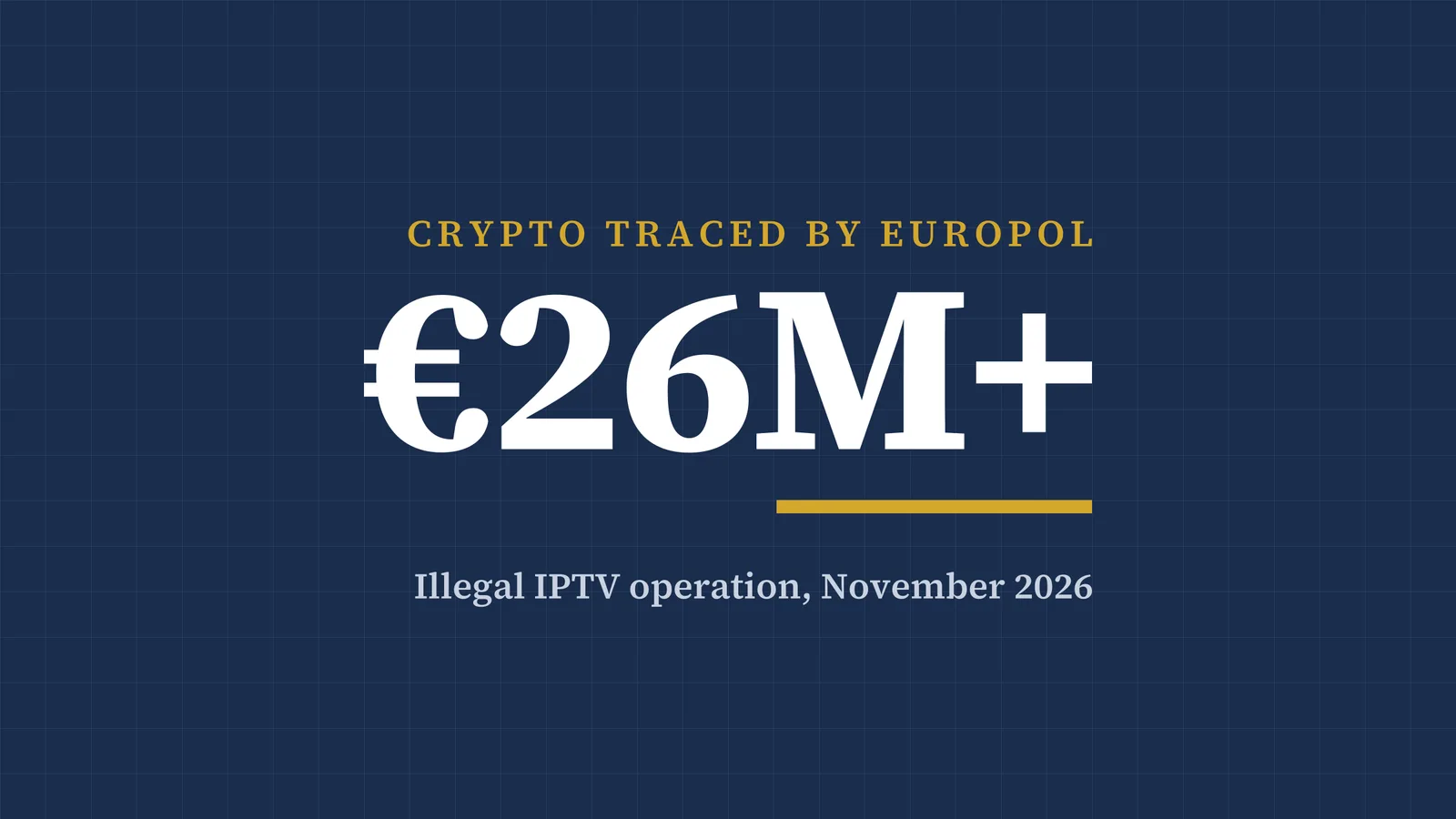
Investigators have traced more than €26 million in cryptocurrency transactions linked to illegal streaming services after a five-day operation coordinated by Europol, the European Union's law enforcement agency, said in a press release on Tuesday, November 24, 2026. Crypto exchanges Binance and Coinbase and blockchain analytics firm Chainalysis took part alongside police from 11 countries.
The Block put the figure at about $28.5 million. Europol said the analysis is still ongoing, so the total may change.
What Europol says the operation found
The operation targeted illegal IPTV services. IPTV, or internet protocol television, delivers TV channels over the internet; the illegal versions sell access to premium channels, live sports and films without paying the rights holders. Europol said these providers often collect subscription payments in crypto.
According to Europol, the five days in Seville led to:
| Result | Figure |
|---|---|
| Illegal IPTV services disrupted | 57 |
| Websites identified as offering copyrighted content illegally | 321 |
| Combined annual traffic of those websites | more than 7.3 million visits |
| Crypto transactions traced so far | over €26 million |
Europol did not say how the 57 services were disrupted, and it did not name any of them. The release reports no arrests, no seized funds and no frozen accounts.
During the operation, investigators followed suspicious transactions across blockchains, looking for links between the services, the wallets that received payments and the people who control them, Europol said. The agency wrote that "the use of cryptocurrency does not make criminals invisible."
Who took part
The operation took place at the Spanish National Police headquarters in Seville. The law enforcement officers came from Belgium, Bulgaria, Croatia, Greece, Ireland, Italy, the Netherlands, Portugal, Romania, Spain and the United States, Europol said.
Europol organized it through its Intellectual Property Crime Coordinated Coalition (IPC3), providing analysis, real-time intelligence checks and secure information exchange. The European Union Intellectual Property Office (EUIPO), INTERPOL and the Audio-visual Anti-Piracy Alliance (AAPA), an industry group, were also involved, along with Binance, Coinbase and Chainalysis.
The release does not say what data the three companies provided or what actions they took. We found no statement from Binance or Coinbase on this year's operation. Decrypt reported that Chainalysis commented in a post on X; we did not locate that post.
Following the money, not just the sites
Europol framed the operation as a shift in how piracy is policed. Instead of only taking illegal services offline, investigators are targeting the payments and the people who profit. "Removing an illegal service does not necessarily stop the criminals behind it," the agency said.
The information gathered will feed national investigations, including efforts to identify suspects, disrupt services and trace assets, according to Europol. Europol did not announce arrests or seizures from the Seville operation itself; any such steps would be a matter for those national cases.
Europol cited AAPA estimates that about 60 million people in Europe use unauthorized IPTV services. AAPA puts losses for legitimate providers at €4.83 billion a year and lost tax revenue for governments at a further €1.08 billion. These are industry estimates, not Europol's own measurements.
A repeat of last year's exercise
The Seville operation follows a similar Europol exercise a year earlier. From November 10 to 14, 2025, Europol, the EUIPO and the Spanish National Police held an "Intellectual Property Crime Cyber-Patrol Week" in Alicante, Spain, with 30 investigators. In its release on that week, Europol said investigators traced crypto worth around $55 million (over €47 million) through accounts linked to the services, and referred 25 illicit IPTV services to the participating crypto service providers for disruption.
In 2025, investigators bought the services with crypto themselves to identify the operators and then reported them to partners, including major exchanges, Europol said at the time. The 2026 release does not say whether the same method was used.
Piracy profits held in crypto can be large. In the Movie2k case, investigators in the German state of Saxony said in January 2024 that they had provisionally secured nearly 50,000 Bitcoin, which a suspect transferred to government wallets. In November 2026 the judge in the trial over the former film piracy site proposed ending the case if the alleged main operator hands over 40,000 Bitcoin, according to German reports.
What it could mean for crypto exchanges and piracy enforcement
In our assessment, the operation suggests exchanges and analytics firms are being built into routine police work on crimes outside finance, such as copyright piracy. Payments that end up at a regulated exchange can often be linked to a customer account, which gives investigators a point where they can ask for information or a freeze. Chainalysis has recently joined a task force with Tron and Tether aimed at freezing USDT linked to crime faster, and Germany's Bundestag has passed a bill to let customs freeze crypto of unclear origin without a criminal case.
The headline number needs care. Traced transactions show where money moved; they are not proceeds that have been recovered. Points to watch are whether the national investigations lead to arrests or seizures, whether Europol updates the €26 million figure as analysis continues, and whether Binance, Coinbase or Chainalysis describe their role.
Sources
- Europol — Law enforcement follow crypto money trail behind billion-euro illegal streaming industry (November 24, 2026)
- Europol — EUR 47 million in crypto traced to disrupt digital piracy services (November 19, 2025)
- The Block — Europol operation involving Binance, Coinbase and Chainalysis traces more than $28.5 million in crypto behind illegal streaming services (November 24, 2026)
- Decrypt — Europol traces $28M in crypto behind Europe's illegal streaming industry (November 24, 2026)
This article was researched and drafted with the help of AI tools, checked against its sources in a separate AI fact-check and edit, and approved for publication by Trading Metrics. Read our AI use policy.
This article is for information only and is not financial advice. Crypto assets and leveraged products are volatile and you can lose money. Do your own research and consider your circumstances before trading.