
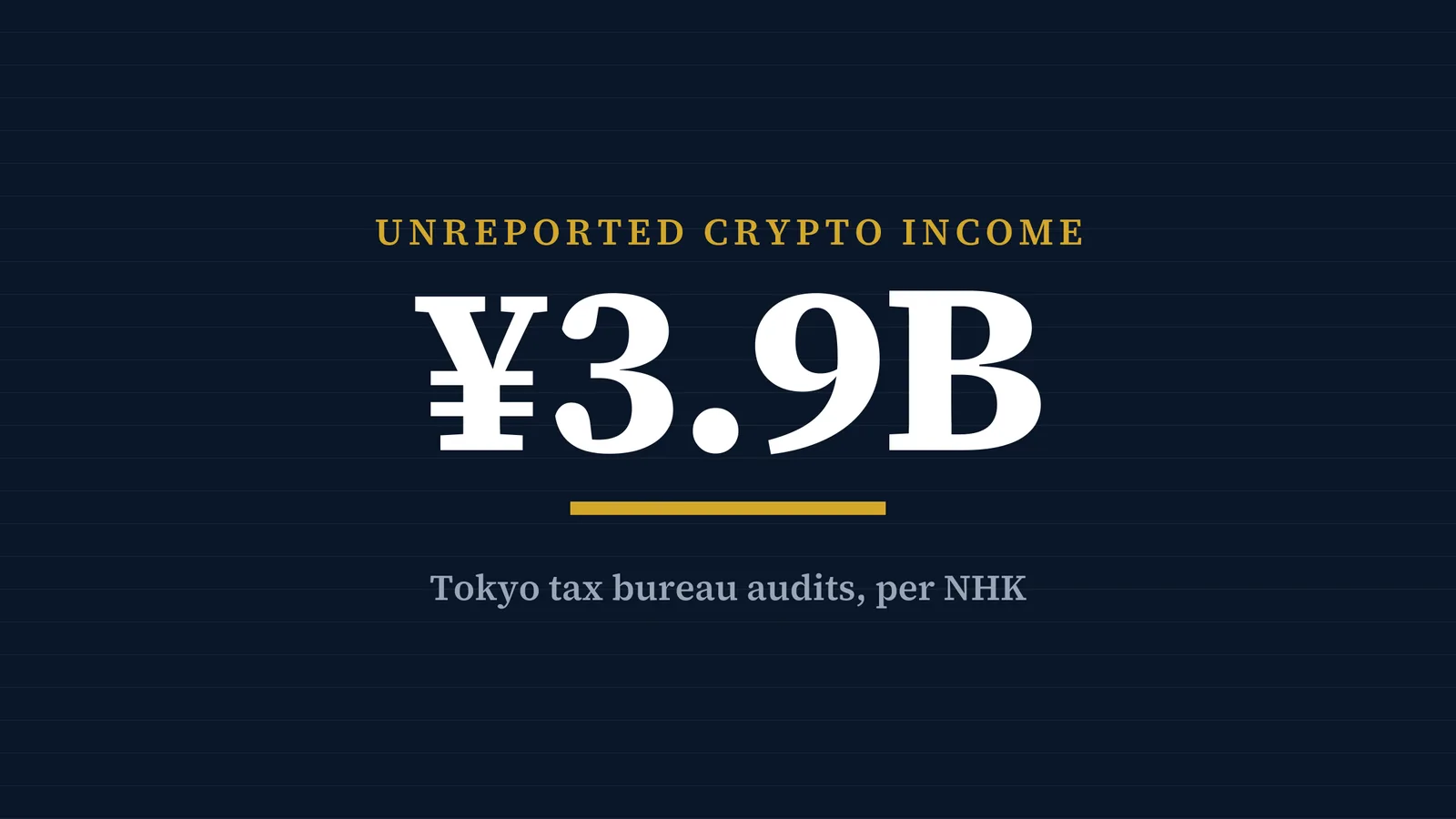
Japan's tax authorities plan more crypto audits after Tokyo found ¥3.9 billion in unreported income, NHK reports
NHK says the Tokyo Regional Taxation Bureau audited about 90 crypto users and found the undeclared income. Published national data already show crypto audits rising, and foreign trading data will start arriving in 2027.
Contents
Japan's tax authorities plan to strengthen their audits of crypto users after the Tokyo Regional Taxation Bureau found more than ¥3.9 billion (about $24.5 million) of unreported income, public broadcaster NHK reported early on November 22, 2026, Japan time (20:51 UTC on November 21), citing people involved. NHK said the bureau audited a little over 90 crypto users in the last fiscal year. The National Tax Agency (NTA) has not published these figures, so the numbers rest on NHK's reporting.
What NHK reported
According to the part of NHK's report that is publicly visible, crypto users in Japan are increasing every year, and many of them do not file tax returns. Its headline says the tax authorities will strengthen their audit system. The rest of the article is not publicly visible, and Trading Notified did not read it.
CoinDesk reported, citing NHK, that the bureau audited 91 crypto users in its previous fiscal year and assessed about ¥1.2 billion (about $7.5 million) of additional tax. CoinDesk said many of those audited had not filed a return. It also reported that Tokyo investigators used transaction data to estimate earnings and pick audit targets, and that the bureau and local tax offices plan to add specialists and new tools and share findings between regional bureaus. Trading Notified could not confirm these details from NHK's visible text or from an official source.
NHK's figures do not match the Tokyo bureau's last published crypto data, which cover a different period (see below). NHK's visible text does not say which twelve months "last fiscal year" refers to or whether the figures cover all of the bureau's crypto audits.
What the official data show
The NTA runs its audits on a program year from July to June and publishes the results each year, in recent years in November or December. Its national report for July 2024 to June 2025, released in December 2025, has a section on individuals who trade crypto assets.
| Crypto field audits | Japan (NTA) | Tokyo bureau |
|---|---|---|
| Audits | 613 (prior year 535) | 202 (prior year 158) |
| Undeclared income | ¥15.6 billion | ¥8.0 billion |
| Additional tax | ¥4.6 billion | ¥2.5 billion |
| Extra tax per audit | ¥7.45 million | ¥12.58 million |
The national figure for extra tax per crypto audit, ¥7.45 million (about $46,800), was 2.5 times the ¥2.99 million average for all field income tax audits, the NTA said. In the Tokyo bureau's report for the same year, the figure was ¥12.58 million (about $79,000), 2.8 times the bureau's overall average of ¥4.48 million. Undeclared income per crypto audit averaged ¥25.38 million nationwide and ¥39.54 million in Tokyo.
In both reports, the tax authorities say they collect and analyze information on people who trade crypto assets and audit them actively (our paraphrase of the Japanese text).
The reports for July 2025 to June 2026 were not yet out when Trading Notified checked the Tokyo bureau's press release index at about 15:00 UTC on November 23.
Foreign trading data from 2027
Japan will also get more data on cross-border trading. In a December 2025 leaflet, the NTA said Japan will begin exchanging information under the OECD's Crypto-Asset Reporting Framework (CARF) in 2027. More than 60 jurisdictions have committed to start such exchanges in 2027 or 2028, according to the leaflet.
Under Japan's rules, which took effect on January 1, 2026, crypto service providers must collect self-certifications of tax residence from customers. By April 30, 2027, they must report the 2026 trades of customers resident in other jurisdictions, including the type of crypto asset and the total value of purchases and sales. The NTA then sends that information to the foreign tax authorities once a year, and Japan receives the matching data on its own residents from abroad.
The planned move to a 20% tax rate
The audits come as Japan prepares to change how crypto gains are taxed. A December 2025 summary by the Financial Services Agency (FSA) of the fiscal 2026 tax reform outline says gains on crypto assets handled by registered crypto trading businesses would be taxed separately at 20%, the rate for listed shares. Today such gains are added to other income and taxed at rates of up to 55%, the FSA said.
The FSA summary says the change depends on amendments to Japan's securities law. It also says losses could be carried forward for three years, and that crypto businesses would have to report customers' crypto trades to the tax authorities. The summary does not give a start date. Japan's parliament passed the securities-law amendments in July 2026, The Block reported, adding that the tax change is expected to take effect in January 2028; Trading Notified has not confirmed that date in an official source.
Other governments in Asia are also writing new crypto rules. South Korea is preparing rules opening crypto investment to companies, and Hong Kong published a bill to license crypto dealers and custodians on November 20.
What it could mean for crypto traders in Japan
In our assessment, NHK's report fits a trend that the NTA's own data already show: more crypto audits, and higher extra tax per case than in income tax audits as a whole. Trading data from foreign tax authorities from 2027, and the planned reporting duty for crypto businesses in Japan, could give auditors more ways to compare what traders declare with what they traded. The points to watch are the NTA's and the Tokyo bureau's reports for July 2025 to June 2026, which would show whether NHK's figures appear in the official data, and the start date of the 20% separate tax. This article is not tax advice.
Sources
- National Tax Agency (Japan) — Income tax and consumption tax audits, program year 2024 (in Japanese) (December 2025)
- Tokyo Regional Taxation Bureau — Income tax and consumption tax audits, program year 2024 (in Japanese) (December 2025)
- Tokyo Regional Taxation Bureau — Press release index (in Japanese)
- National Tax Agency (Japan) — Introduction of Reporting System for Automatic Exchange of Information on Crypto-Asset Transactions of Non-Residents (December 2025)
- Financial Services Agency (Japan) — FY2026 tax reform: main FSA-related items in the tax reform outline (in Japanese) (December 2025)
- NHK — 暗号資産利用者の申告漏れ多く 国税当局が調査体制強化へ (November 22, 2026)
- CoinDesk — Japan to ramp up crypto tax audits after uncovering $24.5 million in hidden income (November 23, 2026)
- The Block — Japan passes key bill recognizing crypto as financial product, lowering tax rate (July 15, 2026)
- Yahoo Finance — USD/JPY exchange rate (JPY=X)
This article was researched and drafted with the help of AI tools, checked against its sources in a separate AI fact-check and edit, and approved for publication by Trading Metrics. Read our AI use policy.
This article is for information only and is not financial advice. Crypto assets and leveraged products are volatile and you can lose money. Do your own research and consider your circumstances before trading.