
BTCS sold ether below cost to protect a $64 million Aave loan, its quarterly report shows
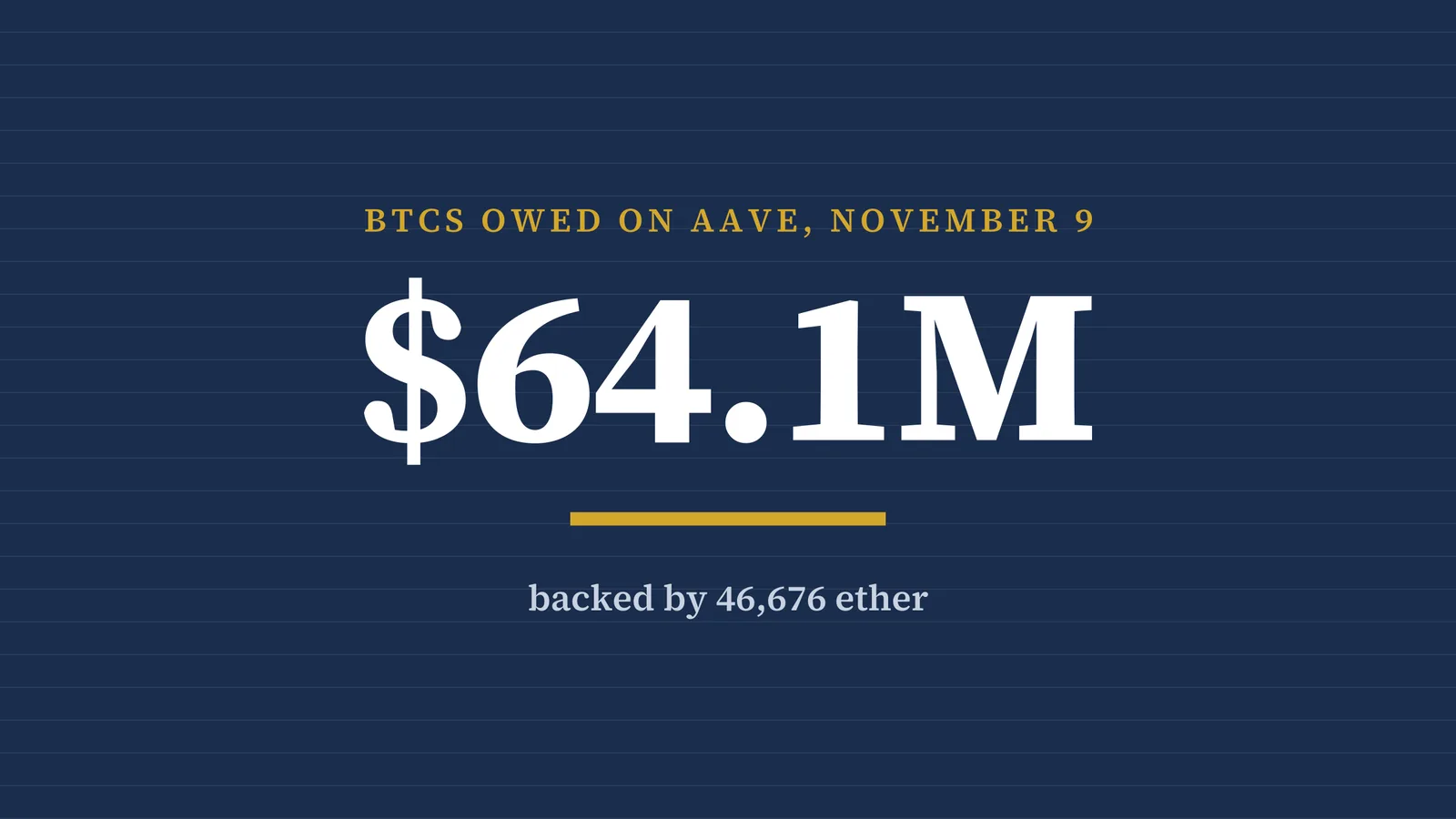
The Nasdaq-listed company owed about $64.1 million against 46,676 ether on November 9. By our calculation, Aave could start selling that collateral at an ether price near $1,717 if those figures have not changed.
Contents
BTCS, a Nasdaq-listed company that holds ether (ETH) as its main asset, said it sold ether for less than it paid in order to protect loans it has taken on the lending protocol Aave. The company owed about $64.1 million on Aave as of November 9, 2026, according to its quarterly report filed on Thursday, November 12. The debt was backed by about 46,676 ether, worth $99.3 million at the November 9 price of $2,127.
What BTCS disclosed about its Aave loans
Aave is a decentralized finance (DeFi) protocol: software on a blockchain that lends against collateral without a bank in the middle. BTCS deposits ether and borrows stablecoins, mainly USDT and GHO, against it.
From January 1, 2025, through November 11, 2026, the company borrowed about $152.4 million of stablecoins through Aave and repaid about $89.4 million, the report says. The loans have no fixed maturity date.
The filing explains why the company has been selling. Realized losses on digital assets rose to $30.6 million in the first nine months of 2026, from $8.6 million a year earlier. The company said this was mainly because of ether sales made "to manage collateral levels and repay borrowings," and because of how deposits into liquidity pools are accounted for. In the company's words, sales of ETH "were executed at prices below their original cost basis."
The report does not say how much ether was sold for that purpose.
The ether price at which Aave could sell the collateral
Aave scores every loan with a health factor, which compares the collateral that the protocol counts with the debt. According to the filing, the protocol's liquidation threshold is generally 80% for ether collateral, and a health factor below 1.0 can trigger a liquidation, in which the protocol's code sells part of the collateral. BTCS said it had not had any full or partial liquidation as of November 11.
Using the company's November 9 figures, 80% of $99.3 million is about $79.4 million, against $64.1 million of debt. That gives a health factor of about 1.24. The same numbers put the liquidation point at an ether price of about $1,717. These are our calculations, and CoinDesk reached similar figures.
Ether has fallen since the snapshot. It was at about $1,950 at 10:57 UTC on November 13, according to CoinGecko. At that price the same 46,676 ether would be worth about $91 million, and the health factor would be about 1.14. The company may have changed the position since November 9 by repaying debt or adding collateral, so the current figures could be different.
BTCS's board allows borrowing on Aave up to a loan-to-value ratio of 50% "at the time of borrowing," the filing says. The ratio is the debt divided by the collateral's value, so a falling ether price raises it after the borrowing: at the November 9 figures it was about 65%.
Why it matters
Cash was $463,250 on September 30, and the filing says a "significant majority" of the company's digital assets measured at fair value were deployed on Aave as collateral on that date, where they are not freely available for other uses while the loans are outstanding. The company also said it had about $142.6 million of cash, stablecoins and liquid digital assets, mainly ether, on November 9. That passage does not say how much of the amount is tied up as collateral.
BTCS reported net income of $54.5 million for the third quarter, helped by unrealized gains on its digital assets, but a net loss of $49.5 million for the nine months. Third-quarter revenue fell 17% from a year earlier to $4.1 million.
Other companies that built treasuries around crypto have also reported losses or changed loan terms this week. Bitmine, which describes itself as the largest corporate holder of ether, reported a $6.3 billion annual net loss on November 10, and the Bitcoin holder Nakamoto said on November 12 that it had pushed back part of a loan from Kraken.
What it could mean for traders
A liquidation on Aave is automatic. If the health factor drops below 1.0, the protocol can sell part of the collateral without notice, and the filing says the company would have no recourse against the protocol. The company can avoid that by repaying debt or adding collateral. The filing says it has already sold ether to manage its collateral and repay borrowings.
For shareholders, the numbers to follow are the price of ether against the roughly $1,717 level and any update from the company on the size of the loan. That level moves whenever the company repays or borrows, so it is a snapshot, not a fixed line.
Sources
- BTCS Inc. (SEC filing) — Form 10-Q for the quarter ended September 30, 2026 (November 12, 2026)
- CoinDesk — Ethereum treasury firm BTCS sold ether at a loss to keep $64 million Aave loan healthy (November 13, 2026)
- CoinGecko — Ethereum price
This article was researched and drafted with the help of AI tools, checked against its sources in a separate AI fact-check and edit, and approved for publication by Trading Metrics. Read our AI use policy.
This article is for information only and is not financial advice. Crypto assets and leveraged products are volatile and you can lose money. Do your own research and consider your circumstances before trading.