
Canaan's mining-machine revenue falls 96% from a year earlier; it plans a buyback of up to $20 million and a reverse ADS split
The Avalon maker reported an $8.0 million quarterly profit that came from fair-value gains on its crypto holdings and derivatives, not from operations, and said it has been selectively monetizing crypto to fund share repurchases.
Contents
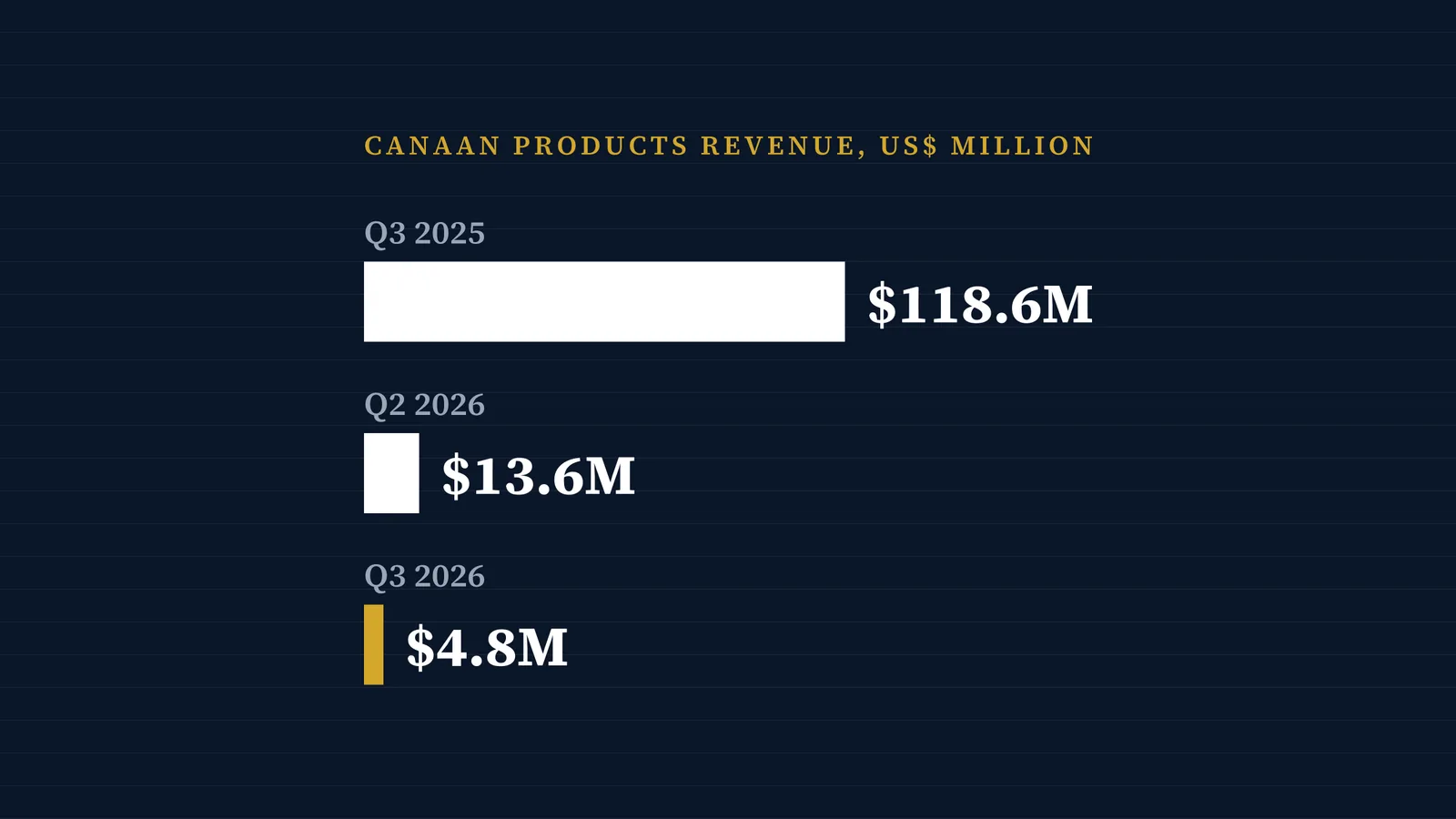
Canaan, the maker of Avalon Bitcoin (BTC) mining machines, reported third-quarter 2026 revenue of $14.5 million on November 10, 2026, down from $150.5 million a year earlier, as revenue from selling machines fell 96% to $4.8 million. In the same results release, filed with the US Securities and Exchange Commission, the Nasdaq-listed company (CAN) announced a share repurchase program of up to $20 million and a plan to consolidate its American depositary shares (ADSs) at a ratio of 1-for-25.
Revenue by business line
| Revenue line | Q3 2026 | Q2 2026 | Q3 2025 |
|---|---|---|---|
| Products (mining machines) | $4.8M | $13.6M | $118.6M |
| Mining | $9.5M | $17.7M | $30.6M |
| Other | $0.3M | $0.6M | $1.3M |
| Total revenue | $14.5M | $31.9M | $150.5M |
Canaan attributed the drop in products revenue to less computing power sold and a lower average selling price, the result of weaker market demand. Chairman and Chief Executive Nangeng Zhang cited "continued weakness in bitcoin mining equipment demand and intense industry pricing competition."
The company's own mining produced 133 BTC in the quarter and brought in more revenue than machine sales. Canaan said mining revenue fell from a year earlier mainly because of a lower average Bitcoin price and less computing power in operation.
Total revenue was near the upper end of the company's guidance, Zhang said. For the fourth quarter, Canaan expects revenue of $18 million to $22 million.
A profit that came from Bitcoin's price
Canaan recorded a gross loss of $8.6 million and a loss from operations of $42.9 million. It still reported net income of $8.0 million, compared with a net loss of $97.6 million in the second quarter and a net loss of $27.7 million a year earlier.
The gap was closed mainly by two non-operating items: a $20.1 million gain from the change in fair value of its cryptocurrency and a $31.9 million gain from the change in fair value of financial derivatives. The company said the gains were mainly due to a higher Bitcoin price on September 30 than on June 30. Chief Financial Officer James Cheng said the gain "is distinct from underlying operating performance."
Bitcoin holdings and the buyback
As of September 30, Canaan held 1,875.5 BTC in total:
- 517.5 BTC owned by the company and reported as cryptocurrency assets
- 1,258 BTC pledged for secured term loans
- 100 BTC transferred to a fixed-term product
About two-thirds of the holdings were therefore pledged as loan collateral at quarter-end. The company had $72.8 million of cash and restricted cash, of which $50.0 million was restricted cash posted as collateral for a letter of credit supporting long-term infrastructure-related contracts, a step Cheng listed among those backing its power infrastructure development.
On November 6, Canaan's board approved share repurchases of up to $100 million over 12 months, and the company is starting with a program of up to $20 million. Zhang said Canaan maintained its long-term holding strategy while "selectively monetizing cryptocurrency holdings to fund share repurchases." The release does not say how much cryptocurrency has been or will be monetized, whether that means outright sales, how the $20 million program will be funded, or how much Bitcoin the company holds now.
For scale, 517.5 BTC was worth about $38 million at Bitcoin's price of $73,371 at 11:06 UTC on November 12, according to CoinGecko data and our calculation.
Another Bitcoin miner has disclosed outright sales: MARA sold 13,597 BTC and repaid its Bitcoin-backed loans after its third quarter ended.
The reverse ADS split
Canaan plans to change its ADS ratio from one ADS for 15 Class A ordinary shares to one ADS for 375, which works as a 1-for-25 reverse split: every 25 existing ADSs become one. It expects the change to take effect on or about December 4, 2026.
Canaan said the aim is to help it get back above Nasdaq's minimum bid price requirement and possibly to widen its base of institutional investors. Holders keep the same proportion of the company and the number of ordinary shares outstanding stays the same, except where fractional ADSs are adjusted, the company said.
Power projects in Texas
Canaan describes itself as an innovator in compute and energy infrastructure. It said a 1-gigawatt large-load project in Duval County, Texas, received a conditional classification in the Texas grid operator ERCOT's connection process, subject to further studies and approvals, and that a separate 1-gigawatt power resource project in Zapata County, Texas, is in early-stage development.
What it could mean for traders
The reverse ADS split changes how many ADSs exist, not what they add up to: each new ADS stands for 25 times as many ordinary shares, so a holder's stake stays the same apart from fractional ADSs. The buyback is harder to size. Zhang tied share repurchases to monetizing crypto holdings, but the release gives no holdings figure after September 30 and does not say how the $20 million program will be funded, so the program cannot be compared with the Bitcoin Canaan holds today.
Results reported in the week of November 9, 2026, by companies that hold crypto show the same accounting effect in both directions. Fair-value changes lifted Canaan to a profit despite an operating loss; in Tron Inc.'s third-quarter results, an unrealized gain on its tokens was larger than its net income, while falling prices produced Bitmine's $6.3 billion annual net loss. Canaan's gain reflects Bitcoin's price on September 30 against June 30; the fourth-quarter figure will be measured at December 31 and can run in either direction.
What happens next
The ADS ratio change is expected on or about December 4. Canaan said further details of the change will be announced, and its fourth-quarter revenue guidance of $18 million to $22 million is the next figure to compare against.
Sources
- Canaan Inc. (SEC filing) — Canaan Inc. Reports Unaudited Third Quarter 2026 Financial Results (Form 6-K, Exhibit 99.1) (November 10, 2026)
- CoinGecko — Bitcoin price (simple price API)
This article was researched and drafted with the help of AI tools, checked against its sources in a separate AI fact-check and edit, and approved for publication by Trading Metrics. Read our AI use policy.
This article is for information only and is not financial advice. Crypto assets and leveraged products are volatile and you can lose money. Do your own research and consider your circumstances before trading.