
Hyperscale Data sold its last Bitcoin and says it still lacks the cash to finish its AI data center build
The former Bitcoin miner's quarterly report puts the remaining build cost for its 20-megawatt Michigan contract at $74.8 million and repeats a going-concern warning. Its at-the-market share sales are suspended.
Contents
Hyperscale Data (NYSE American: GPUS), a former Bitcoin miner that is turning its Michigan mining site into a data center for artificial intelligence (AI) computing, said its cash will not be enough to fund its plans over the next 12 months, including about $74.8 million it still expects to spend on the build. The warning is in the company's quarterly report, filed with the US Securities and Exchange Commission (SEC) on Wednesday, November 18, 2026, at 22:26 UTC, after the market close. The filing also confirms that the company sold all of its remaining Bitcoin (BTC) on November 6.
What the filing says about cash
At the end of September, Hyperscale Data had about $17.3 million of cash and cash equivalents, according to the filing, down from about $36.8 million at the end of June in its previous quarterly report. It also held about $27.8 million of restricted cash, which can only be used for purposes permitted under the related arrangements.
Current liabilities were about $231.2 million and exceeded current assets by about $128.1 million, the company said. Its consolidated net loss for the first nine months of 2026 was about $62.1 million.
The key passage in the notes to the financial statements says the company's existing cash and other available liquidity "are not expected to be sufficient" to fund operating needs, existing obligations and planned capital spending, "including those associated with the Michigan data center," over the 12 months after the statements were issued. "Accordingly, these conditions and events raise substantial doubt about the Company's ability to continue as a going concern," the filing says.
A going-concern warning means management cannot conclude that the company will be able to meet its obligations over the next year without new funding. It is not a bankruptcy filing. Hyperscale Data carried a similar warning in its June-quarter report, filed on August 19.
The Michigan AI contract
On June 23, 2026, a Hyperscale Data subsidiary, Alliance Cloud Services, signed a master services agreement with a customer that the filing does not name. It covers about 20 megawatts (MW) of capacity for AI computing at the company's campus in Dowagiac, Michigan, delivered in two 10 MW phases.
The customer gets an exclusive license to a designated area for an initial term of 10 years, with two five-year extension options. If the customer exercises both extensions, the total contract value is about $1.2 billion, "subject to the Provider meeting its obligations," the filing says. A right of first offer on another 32 MW could lift that to about $3.0 billion if exercised within two years.
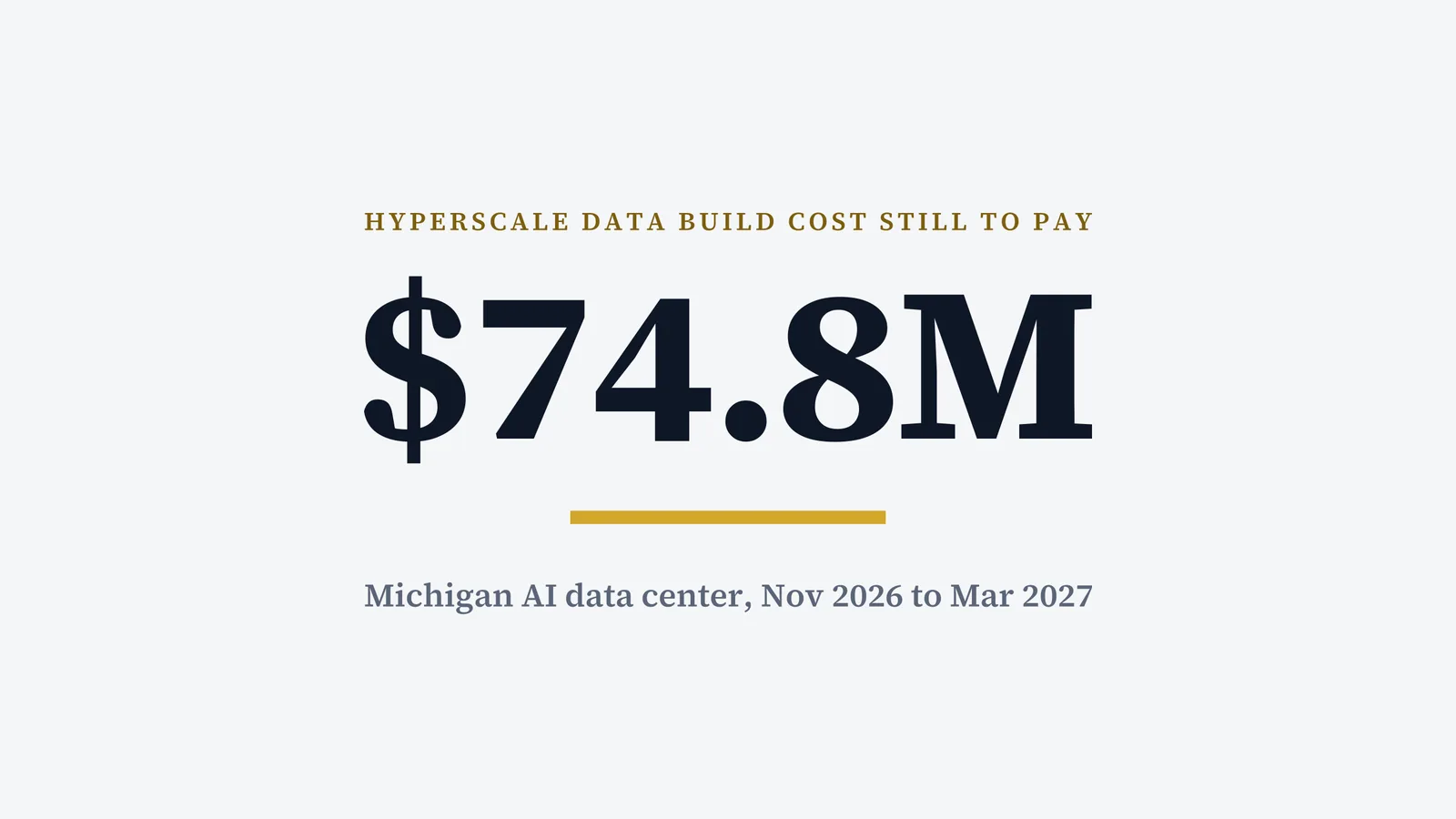
The first 10 MW is targeted to be ready for service in December 2026, and the second by the end of March 2027. The company estimates the total cost to build, equip and commission the two phases at about $122.1 million. It had paid about $47.3 million through October 31 and expects to pay the remaining $74.8 million between November 2026 and March 2027, though the filing says the cost and timing may change.
The company stopped mining Bitcoin at the Michigan site on September 1 to free up power for the customer, after booking a $2.3 million impairment on certain mining equipment in the second quarter. A proposed class action filed in May on behalf of nearby residents alleges excessive noise from the site; the company says the claims are without merit.
How the Bitcoin was sold
The filing traces the sales. In August, Hyperscale Data sold about 686 BTC for about $43.4 million and repaid all its borrowings through the Morpho lending protocol, where it had pledged Coinbase Wrapped Bitcoin (cbBTC) as collateral. On November 6 it sold "all of its Bitcoin holdings," about 211.6 BTC, for gross proceeds of about $16.0 million.
Most of that last batch, about 208.4 BTC, had been pledged to the JGB lenders under senior secured convertible notes. On November 16 the company repaid those notes in full, including about $12.8 million of principal and a 10% prepayment premium of about $1.3 million.
Where new money could come from
Management plans to raise money through equity sales, debt or other financing, cash from operations, and sales of investments or other assets. Sales under its at-the-market program, which lets a company sell new shares gradually into the market, have been suspended since October 22, after raising about $50.6 million in total.
After the quarter, the company raised $15.0 million in gross proceeds from two convertible note closings with an unnamed institutional investor on November 6 and November 18. Up to $10.0 million more is possible if both sides agree, subject to stockholder approval.
Separately, Hyperscale Data said on November 17 that it intends to start an exchange offer on or about November 20 for up to 192,308,000 common shares. Holders would receive $2.00 in cash and one preferred share with a $24.00 stated value per 100 shares exchanged. At the full amount, the cash part would come to about $3.8 million, by our calculation.
How the stock traded
GPUS closed at $0.157 on November 18, up 1.75% from $0.1543 the day before, according to Yahoo Finance chart data. That close came before the filing was released, as CoinDesk, which reported the warning overnight, noted.
Other listed miners have also been selling Bitcoin and raising debt to pay for power and data center plans. MARA sold 13,597 BTC and repaid its Bitcoin-backed loans and later priced $185 million of notes for its Long Ridge power plant deal, while Ionic Digital sold about 737 BTC to fund its Texas data center sites.
What it could mean for Hyperscale Data shareholders
In our assessment, the filing shows a company whose main growth plan depends on raising money it does not yet have. The $1.2 billion headline figure covers the full term of up to 20 years, and it depends on the customer extending twice and on Hyperscale Data delivering the capacity. The near-term numbers are smaller and more pressing: about $74.8 million of build costs over five months, set against $17.3 million of unrestricted cash at the end of September and $15.0 million of new convertible notes. With the share sale program suspended and the stock below $0.20, new equity or convertible financing could dilute existing holders. Points to watch are whether Phase 1 is delivered in December, the terms of any new financing, and the final terms of the exchange offer once it is filed.
Sources
- Hyperscale Data (SEC filing) — Form 10-Q for the quarter ended September 30, 2026 (November 18, 2026)
- Hyperscale Data (SEC filing) — Form 10-Q for the quarter ended June 30, 2026 (August 19, 2026)
- Hyperscale Data (SEC filing) — Schedule TO-C with the November 17 exchange offer press release (November 17, 2026)
- CoinDesk — Bitcoin miner that sold its last BTC warns it may run short of cash for $1.2 billion AI deal (November 19, 2026)
- Yahoo Finance — GPUS daily chart data
This article was researched and drafted with the help of AI tools, checked against its sources in a separate AI fact-check and edit, and approved for publication by Trading Metrics. Read our AI use policy.
This article is for information only and is not financial advice. Crypto assets and leveraged products are volatile and you can lose money. Do your own research and consider your circumstances before trading.