
Bots went after researchers' Bitcoin trap wallets within seconds of a nonce reuse, study finds
University of Liège researchers made wallet keys recoverable on purpose by reusing a signature nonce. On Bitcoin, sweep attempts hit the mempool at once; on Ethereum it took about three hours.
Contents
Two computer scientists at the University of Liège in Belgium deliberately made the private keys of small Bitcoin (BTC) and ether (ETH) wallets recoverable, and on Bitcoin, transactions trying to take the coins appeared in the mempool "at the second the addresses became vulnerable," according to their peer-reviewed paper. CoinDesk reported the findings on November 20, 2026.
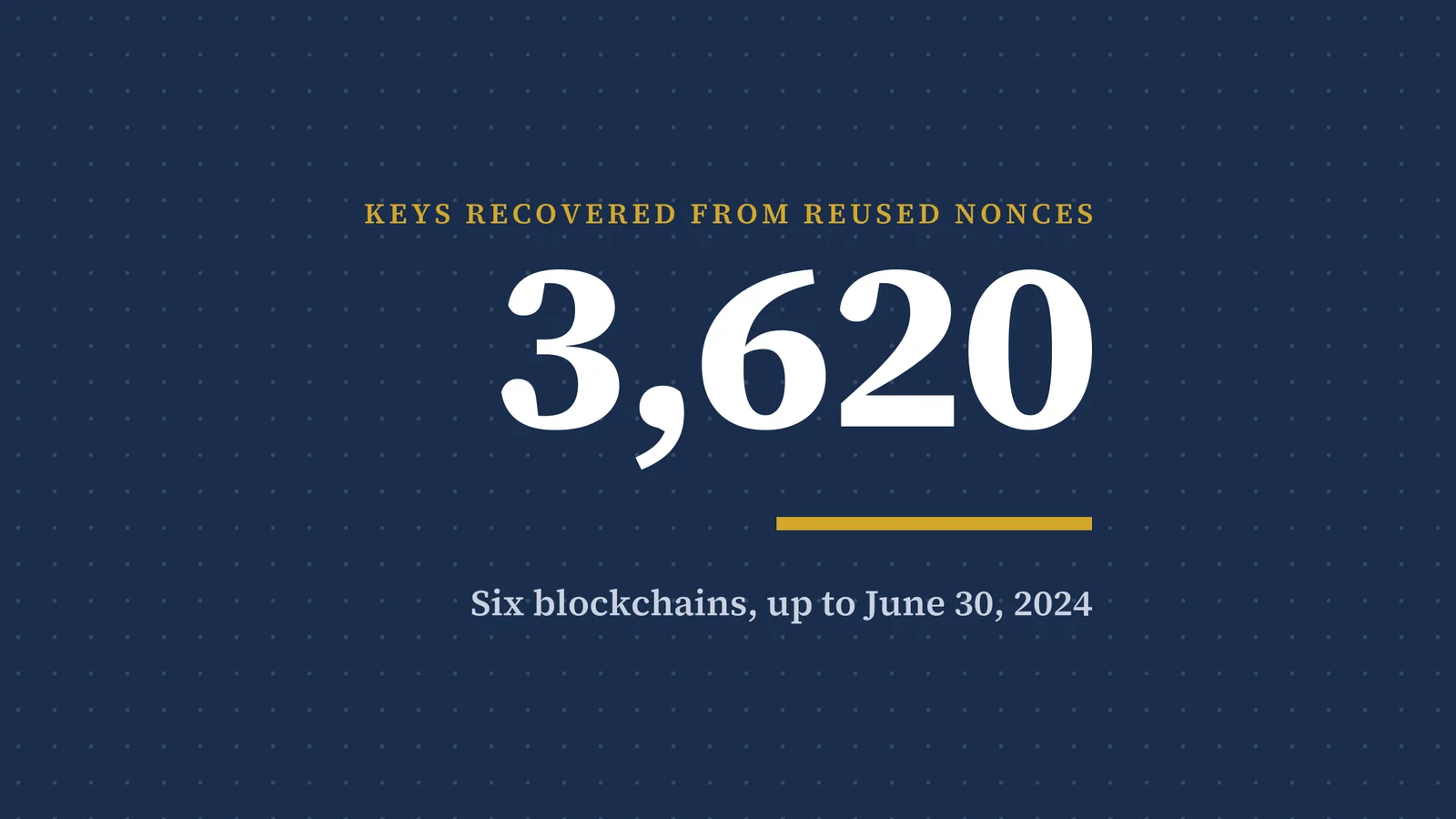
The study by Vincent Jacquot and Benoît Donnet of the university's Montefiore Institute also scanned every ECDSA signature on six blockchains and recovered 3,620 private keys from reused signature nonces. The authors estimate the addresses behind those keys held cryptocurrencies worth up to €101 million at their peak balances. The University of Liège's repository record lists the paper as published in March 2026 in the proceedings of the Financial Cryptography and Data Security conference, and the honeypot experiments date from April and May 2025.
How a reused nonce gives away a key
Bitcoin, Ethereum and several Bitcoin forks use the Elliptic Curve Digital Signature Algorithm (ECDSA) to sign transactions. Each signature requires a nonce, a random number that must be used only once. If the same key signs two different transactions with the same nonce, the two signatures form a simple pair of equations, and anyone can solve them for the private key, the paper explains. The paper also covers a less obvious case, where a nonce is reused across different keys and several keys can be solved together.
Because signatures are public, the leak happens on the blockchain itself. No file, paste site or code repository is involved.
The honeypots
On April 28, 2025, the researchers set up traps they call honeypots on Bitcoin and Ethereum, each funded with between $3 and $5 worth of crypto, according to the paper. Some traps used the same nonce twice under one key. Others needed an attacker to solve a system of several keys, and one reused a single nonce across a Bitcoin and an Ethereum signature to test whether anyone watches both chains. The authors watched the Bitcoin mempool, the pool of unconfirmed transactions, through a Bitcoin Core node.
The on-chain record of one Bitcoin trap address, which CoinDesk linked, matches the paper's description. Data from the mempool.space block explorer show:
| Block time (UTC), April 28, 2025 | What happened |
|---|---|
| 11:30 | A single transaction sends 7,200 satoshis each to six new addresses, including the trap |
| 12:33 | The trap and a partner address pay each other, both signatures sharing the same nonce value |
| 13:12 | The trap signs a second payment with that same nonce, which makes its key computable |
| 13:21 | The trap's remaining 5,200 satoshis go to an outside address, 4,700 after a 500-satoshi fee |
The confirmed sweep landed two blocks after the trap's key became computable. The block timestamps show when blocks were mined, not when the competing transactions first reached the mempool; the paper's account of sweep attempts arriving at once rests on the researchers' own mempool monitoring. The receiving address had not moved the 4,700 satoshis when Trading Notified checked on November 20, 2026.
What the attackers did, and did not do
On Bitcoin, only the traps that directly reused a nonce under one key were hit right away, the paper says, which suggests automated tools that look only for that simplest pattern. The partner address, whose key could be found only through the shared nonce, was emptied on May 11, 2025, the date on which the paper says another attack took all the remaining untouched Bitcoin traps. The authors saw two distinct attempts to spend from one trap, which they read as attackers competing with each other. "No transaction shows any sign of boosted fees," they wrote.
On Ethereum, every vulnerable trap address was drained, but only after about three hours, and the funds went to the same address. The authors describe that actor as more methodical but probably not fully automated. The cross-chain trap had not been touched as of December 2025, which suggests attackers were not watching for the same nonce on both chains, the paper says.
The researchers say they never shared the keys they derived and never used them to withdraw funds from other people's addresses.
Up to €101 million at peak, 3,620 keys
For the wider scan, the team took every signature on Bitcoin, Bitcoin Cash, Litecoin, Dogecoin, Dash and Ethereum from each chain's start to June 30, 2024. Blockchain analytics firm TRM Labs provided raw data for Bitcoin and its forks; for Ethereum, the team used its own archive node. Run chain by chain, the method recovered 3,605 distinct keys, 3,278 of them on Bitcoin. Combining all six chains raised the total to 3,620, because some nonces were reused across chains.
All euro values in the paper use prices from November 25, 2024. On that basis, the vulnerable addresses held up to €101 million at their peak balances. Value exposed at a single time passed €1 million nine times, mostly between 2014 and early 2016, and peaked at about €25 million in December 2014. More recent peaks came in October 2022, at €11.2 million, and February 2023, at €1.2 million, mostly on Ethereum. About two-thirds of the vulnerable addresses held less than €100.
These are amounts that could have been taken, not confirmed thefts. On Bitcoin and its forks, the authors measured how fast deposits left vulnerable addresses and found periods of fast, systematic withdrawals starting in the fourth quarter of 2015 on Bitcoin, while noting they lack definitive proof that these were attacks. On Ethereum, they traced one address that became vulnerable in October 2022: a 62 ETH transfer followed 13 hours later, and in November deposits of 6 ETH and then 350 ETH were taken by another address 12 seconds after they arrived.
The authors found fewer signs of activity on Dogecoin, Dash and Litecoin, which they say are "likely not under active scrutiny by attackers," possibly because of their lower value or popularity. They also note that most of the Bitcoin that is still vulnerable sits at an address using an uncommon format, which may be why it has not been swept.
Why nonces get reused
The paper names three causes. The most common repeated nonce, seen in 2.48 million Bitcoin transactions, produces a shorter signature and so a slightly lower fee. Faulty software is the second, such as a 2013 Android bug and a JavaScript client whose random number generator was not seeded correctly. The third is nonces that look chosen by hand, such as 123456.
RFC 6979, a standard that derives the nonce deterministically from the key and the message, would prevent repeated nonces if it were used everywhere, the authors write. They say they are releasing their key recovery tool and have written two exercises on ECDSA flaws for Ethernaut, a smart contract security training game.
Key exposure has come up in other forms this month, from Binance warning of an iOS flaw it says could expose wallet keys to a theft at Lighter through a trader's leaked API key.
What it could mean for Bitcoin and Ethereum users
In our assessment, the study shows how little time there is between a key becoming computable on a public blockchain and someone trying to use it, at least for the simplest pattern. The weakness the paper describes sits in wallet software and signing devices rather than in Bitcoin or Ethereum themselves: a wallet that generates nonces correctly does not produce these signatures. The paper's data also show that being missed by attackers for years is not protection, since vulnerable deposits were sometimes taken within seconds and sometimes left alone. Points to watch are whether the longer version of the paper that the preprint cites is published, and whether wallet makers name RFC 6979 or an equivalent safeguard in their signing code.
Sources
- University of Liège (ORBi) — Short Paper: Oops... I Did It Again. I Reused my Nonce. (author preprint, PDF) (March 2026)
- University of Liège (ORBi) — Repository record for the nonce reuse paper by Jacquot and Donnet (March 2026)
- mempool.space — Bitcoin trap address used in the study's honeypot
- IETF (RFC Editor) — RFC 6979: Deterministic Usage of the Digital Signature Algorithm (DSA) and Elliptic Curve Digital Signature Algorithm (ECDSA) (August 2013)
- CoinDesk — Bitcoin bots pounced within seconds when researchers exposed their keys (November 20, 2026)
This article was researched and drafted with the help of AI tools, checked against its sources in a separate AI fact-check and edit, and approved for publication by Trading Metrics. Read our AI use policy.
This article is for information only and is not financial advice. Crypto assets and leveraged products are volatile and you can lose money. Do your own research and consider your circumstances before trading.