
Lighter reopens withdrawals after about $10.4 million in USDC is taken through a trader's leaked API key
The perpetuals exchange said its protocol and smart contracts were not affected. It returned about $5 million to the trader and reopened withdrawals the same day.
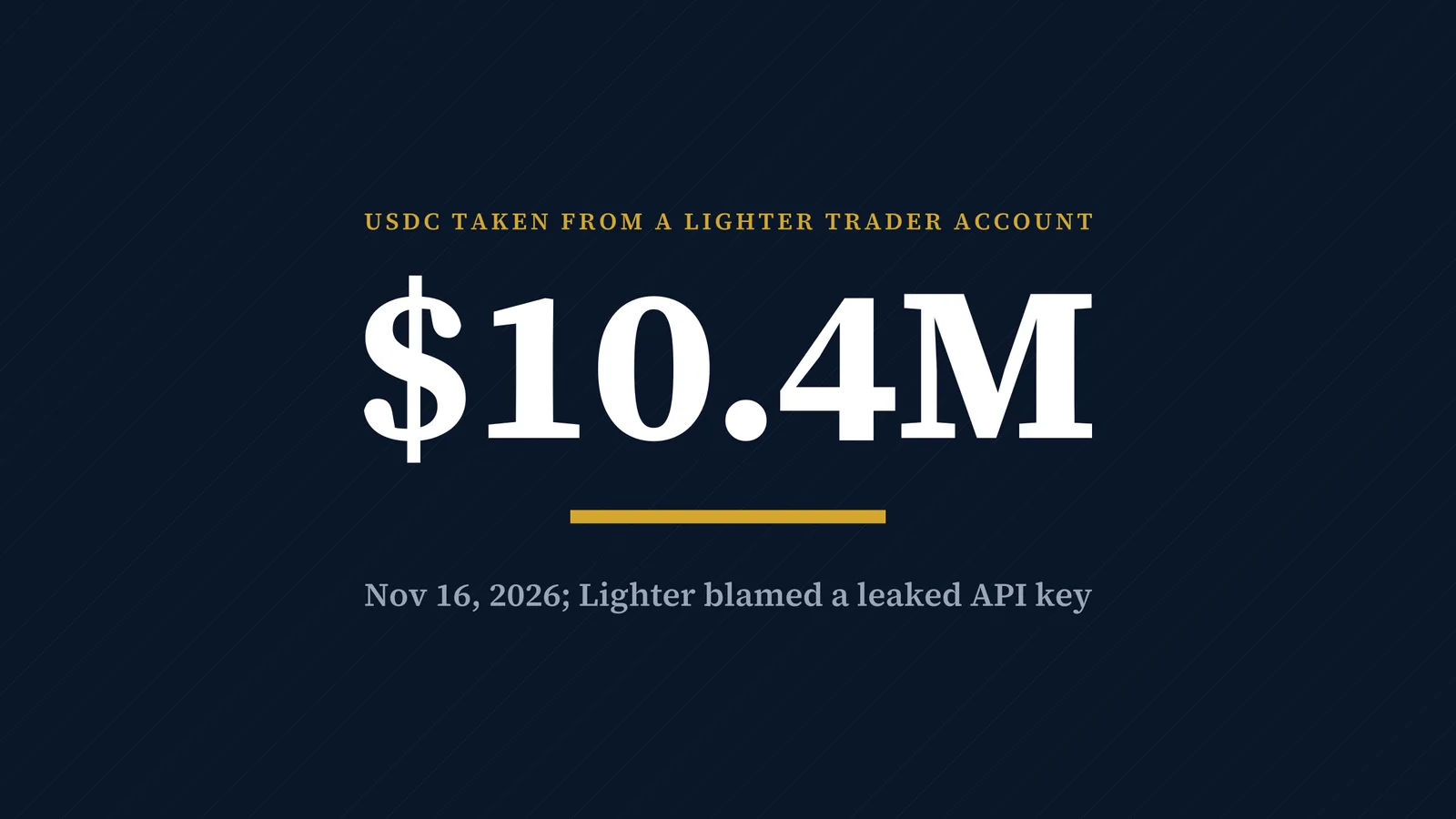
Lighter, a decentralized exchange for perpetual futures, paused all withdrawals on Monday, November 16, 2026, after an attacker obtained a trader's leaked API key and moved funds out. About 10.39 million USDC left Lighter's Ethereum contract for a single wallet that morning, according to on-chain data. Lighter said its protocol and smart contracts were not affected, and it reopened withdrawals later the same day after returning about $5 million to the affected trader.
What Lighter said
Lighter first posted on X at 11:02 UTC that it was investigating a security incident that "appears to involve a single compromised external party," and that it had suspended all withdrawals and the creation of new pools as a precaution.
In an update at 12:49 UTC, the exchange said the incident was caused by "a leaked API key for a specific trader's account" and that the Lighter protocol and smart contracts were unaffected. It said it had switched on Guardian mode on its smart contract, a safeguard that paused withdrawals, and that its Security Council would carry out a contract upgrade, with the main priority being to recover funds from a further withdrawal attempt by the attacker. Lighter named the wallet it believed was tied to the attacker, an Ethereum address beginning 0xb3fffca2.
In a post-mortem published at 18:20 UTC, Lighter said the affected accounts had used signing code other than its official software development kits, and that this code reused signing nonces, the one-off random values each signature needs. Because signatures on Lighter were public, anyone could calculate the private API keys from them, the company said. It wrote that the attacker "needed no access to the accounts or to Lighter's systems."
According to the post-mortem, the attacker used a leaked key to create a public pool from the affected account, minted pool shares in a separate account it controlled, moved the victim's funds into the pool and then redeemed the shares and withdrew. Lighter said its Guardian mechanism was triggered by the anomaly, which paused withdrawals and let the Security Council return about 5 million USDC to the trader. "Withdraws are now unpaused and all pending withdrawals are being processed," the post said. Less than a minute later, Lighter posted that deposits and withdrawals were back to normal after its Security Council switched off Guardian mode.
The exchange said it now requires a wallet signature to move funds into a public pool and has made API key signatures non-public. It plans IP allowlists and per-key permissions and limits, and will monitor signatures for nonce reuse.
What researchers reported
The on-chain record shows a transfer of 10,393,056.79 USDC from Lighter's Ethereum contract to the wallet Lighter named, at 10:11:47 UTC, in this transaction. Lighter itself has not given a dollar figure for the losses.
The blockchain data firm Bitquery reported that the wallet swapped almost all of the USDC for ether within minutes. It said 1,920 ETH was then sent in 160 ETH lots to 12 new wallets and routed to Hyperliquid, another derivatives exchange, where those accounts bought about $3.46 million of XMR1, a token named after Monero. About 3,845 ETH, roughly $7 million, was still in the first wallet at 11:55 UTC, Bitquery said.
Other researchers put potential losses at about $15.5 million across two market-maker accounts, CoinDesk reported. Bitquery said that figure came from posts on X and described the second account's share as unverified, and Lighter has not confirmed it.
Bitquery also said it saw the same route, through the bridge aggregator LI.FI into XMR1 on Hyperliquid, after a separate theft of more than $6 million from a Safe wallet later on Monday and after the Kava Lend exploit two days earlier. It found no transfers linking those cases to Lighter and cautioned that a shared route is weak evidence of a common attacker, Cointelegraph reported.
Lighter's token, LIT, fell more than 10% to below $2.48 after the news before recovering to $2.62 by the time of CoinDesk's report at 16:41 UTC, CoinDesk reported. The incident comes weeks after the $6.3 billion Binance hack, and a week after the Initia network halted after a breach that began with a compromised Google Cloud key.
What it could mean for traders
In our assessment, the case shows that a decentralized exchange's smart contracts can work as designed while an individual account is still emptied. If Lighter's account is correct, the weak point was the trader's own signing code rather than the protocol. Traders who run bots through API keys depend on how those keys are generated and stored, and Lighter's post-mortem says a key that can trade can also be used to trade against its owner or open risky positions. Lighter has not said whether the rest of the trader's losses will be covered, and the company has not confirmed the full size of the losses. Lighter has not named the affected trader.
Sources
- Lighter (X) — Post on the security incident and paused withdrawals (November 16, 2026)
- Lighter (X) — Update on the leaked API key (November 16, 2026)
- Lighter (X) — Signing Safely on Lighter: Lessons from November 16 (November 16, 2026)
- Blockscout — Ethereum transaction 0x5b6f27de...f958c9 (November 16, 2026)
- Lighter (X) — Post on deposits and withdrawals back to normal (November 16, 2026)
- Bitquery — Lighter Incident: $10.4M Withdrawn, Leaving 160 ETH at a Time (November 16, 2026)
- CoinDesk — Lighter suspends all withdrawals after $10.4 million crypto exploit (November 16, 2026)
- Cointelegraph — Lighter pauses withdrawals after reported $10M account theft (November 16, 2026)
This article was researched and drafted with the help of AI tools, checked against its sources in a separate AI fact-check and edit, and approved for publication by Trading Metrics. Read our AI use policy.
This article is for information only and is not financial advice. Crypto assets and leveraged products are volatile and you can lose money. Do your own research and consider your circumstances before trading.