
Block builders took the largest share of the $3.4 million K3 Capital sBOLD exploit, Bitquery data shows
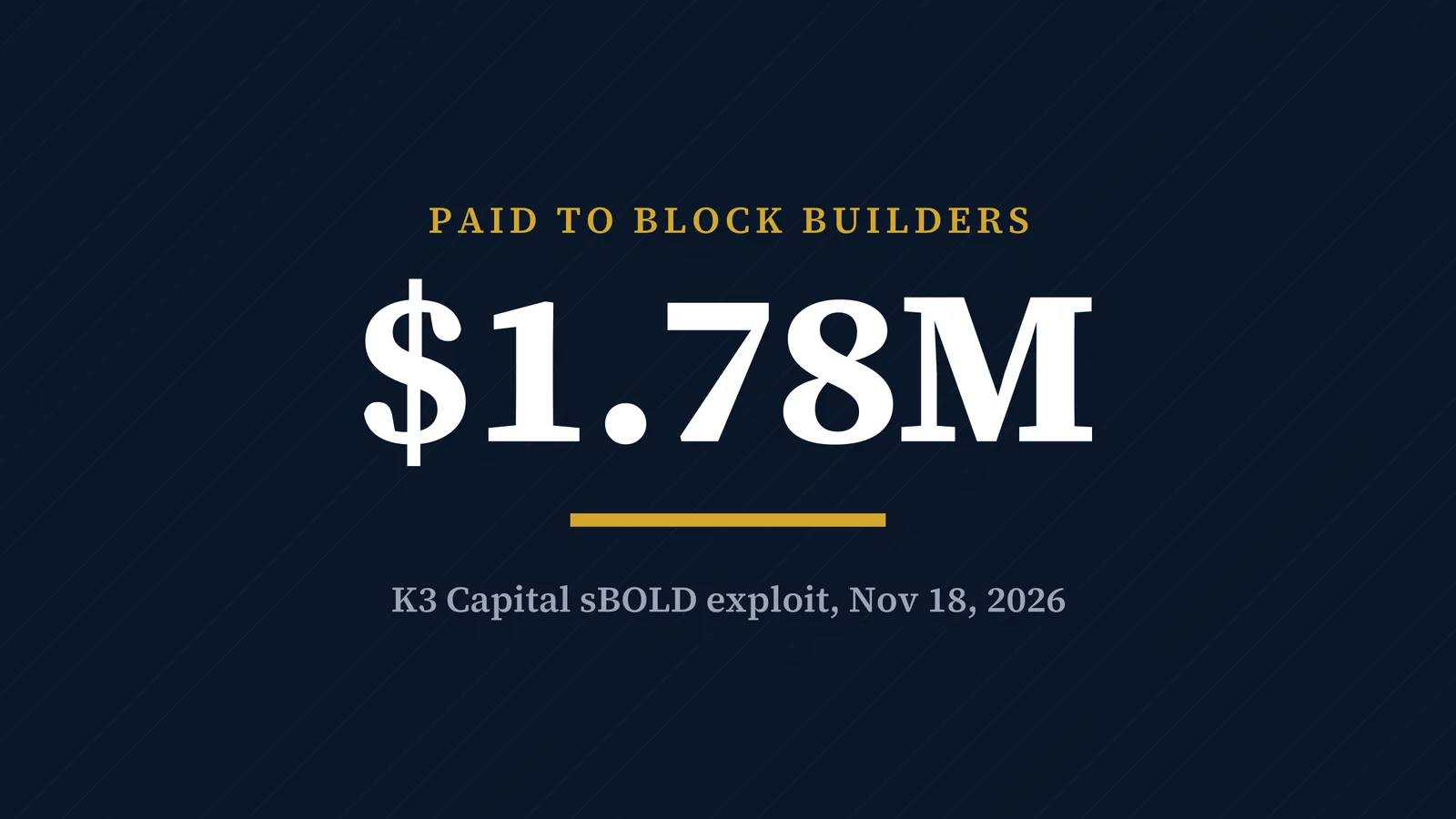
Ethereum block builders received about $1.78 million, most of it from a copycat bot paying to get its drain transactions in first, according to Bitquery. The original attackers kept far less, and K3 Capital has not yet explained what went wrong.
Contents
Attackers drained about $3.42 million from K3 Capital's sBOLD savings vault on Ethereum on Wednesday, November 18, 2026, and the largest share of that money ended up with Ethereum block builders rather than with the attackers, according to an on-chain analysis by Bitquery. Bitquery estimates that builders received about $1.78 million, mostly from a bot that copied the attack and paid heavily to get its transactions processed first.
What happened to the sBOLD vault
sBOLD is a savings vault built on the stability pools of Liquity V2, a lending protocol whose stablecoin, BOLD, trades at about $1, according to Bitquery. Liquity said on X that sBOLD is "a vault built and run independently by @k3_capital" and that Liquity V2 itself "is NOT affected." It told users not to deposit into sBOLD until further notice.
Security firm Blockaid flagged the exploit on X at 12:50 UTC, calling it ongoing and putting the loss at about $3.43 million across about 34 transactions so far. At 13:08 UTC, K3 Capital said on X: "We are investigating malicious activity involving sBOLD. Contracts have been paused." By then the drain had ended, according to Bitquery's timeline.
In general terms, the attackers used a flash loan, a loan borrowed and repaid within one transaction, and exploited how the vault valued its shares. Bitquery says they could redeem shares for more BOLD than they had paid in, repeating the step many times. Blockaid's first description said the attackers self-liquidated a Liquity position; Bitquery says it found that no position was liquidated.
A check of the transaction Blockaid flagged shows it was included in block 26,441,931 at 12:25:47 UTC, sent from one of the exploiter addresses Blockaid listed (beginning 0xdc0e) to the helper contract it named (beginning 0x19ad).
Why block builders received the most
On Ethereum, specialized block builders assemble the transactions in each block and send them to relays, which pass the most profitable block to the validator proposing it, according to Flashbots' MEV-Boost documentation. Builders' blocks include a fee for that validator. Bots chasing maximal extractable value (MEV), the profit from placing transactions in a particular order, compete for position by paying the block's fee recipient, which Bitquery treats as a payment to the builder.
That is what happened here, according to Bitquery. Once the drain began, several wallets raced for whatever was left in the vault. One MEV bot sent 57 of the 97 drain transactions from 13 wallets through a single contract and took about $1.91 million, or 56% of the total. To win each race it paid the fee recipient of each block, and Bitquery says its payment rose from 12.5 ETH on its first drain to 44 ETH in one block near the end.
Bitquery puts total payments to builders at 986 ETH, about $1.78 million at an ETH price of $1,801: 930 ETH from the bot and 56 ETH from another early wallet. That is about 52% of the stolen amount. Bitquery says it has "no sign that the builders knew what the bot was doing."
Our own scan of blocks 26,441,925 to 26,441,974 found 57 transactions sent to the bot's contract. Titan built the blocks holding 31 of them, BuilderNet 13, Ultrasound 7 and Quasar 6, based on the builder names recorded in those blocks. That matches Bitquery's and CoinDesk's account that Titan built most of them.
The $1.78 million is what builders received, not what they kept. CoinDesk noted that builders also pay validators, so how much they retained is not known.
Where the rest of the money went
Bitquery traced about $520,000 to the original attacker and a second wallet it funded with 1 ETH, and says their balances had fallen below $1,000 by 16:14 UTC. It says funds were moved through THORChain and Maya Protocol, cross-chain swap networks, with the Maya transfers carrying Bitcoin addresses as destinations. Other early wallets held smaller amounts, and fees, swap costs and gas took about $428,000, or 13%.
Bitquery says it cannot tell how the first copier obtained the attack code, and it does not attribute any wallet to a person. Its figures were read at 16:14 UTC on November 18, while funds were still moving.
The audit question
ChainSecurity audited sBOLD in May 2025. Its audit summary says "the possibility of value extraction through self-liquidations has been mitigated." Bitquery says the report also flagged a share-pricing issue as high severity and marked it fixed in a later version, but that it could not check which version K3 Capital runs. CoinDesk said it is unclear whether the attack used that mechanism.
The role of MEV-Boost in Ethereum's block market was also central on November 16, when a federal judge cleared the Peraire-Bueno brothers in the $25 million Ethereum MEV case. The opinion treated the MEV-Boost specifications as descriptions of code, not rules for users.
What it could mean for sBOLD depositors and DeFi users
In our assessment, the episode shows how an exploit on Ethereum can quickly become a public race once it starts, with bots and the block-building market capturing much of the value. For depositors, the open points are whether K3 Capital publishes a post-mortem, whether it offers any recovery or compensation plan, and what happens to the paused vault. For users of other vaults, it is a reminder that a product built on a protocol can fail while the protocol itself, as Liquity says of V2, is unaffected. It came two days after the loss of about $6.4 million taken from a Safe wallet through a Zodiac Roles module, a separate case in which Safe and Zodiac said their contracts worked as built.
Sources
- K3 Capital — Post on X about malicious activity involving sBOLD (November 18, 2026)
- Liquity — Post on X about sBOLD (November 18, 2026)
- Etherscan — Ethereum transaction flagged by Blockaid, block 26,441,931 (November 18, 2026)
- Flashbots — MEV-Boost introduction
- CoinDesk — Ethereum block builders received the most in a $3.4 million vault hack, data shows (November 19, 2026)
- Bitquery — K3 Capital sBOLD Hack: Bot and Builders Kept 59% of $3.42M (November 18, 2026)
- Blockaid — Post on X detecting an exploit on sBOLD (November 18, 2026)
- Blockaid — Follow-up post on X with the flagged addresses (November 18, 2026)
- ChainSecurity — K3 sBOLD security audit (May 19, 2025)
This article was researched and drafted with the help of AI tools, checked against its sources in a separate AI fact-check and edit, and approved for publication by Trading Metrics. Read our AI use policy.
This article is for information only and is not financial advice. Crypto assets and leveraged products are volatile and you can lose money. Do your own research and consider your circumstances before trading.