
BTCPay Server issues emergency update for five nginx security flaws
The self-hosted payment processor moved its Docker setup to nginx 1.31.9 and told operators to update as soon as possible. BTCPay and CERT-EU said no attacks had been reported.
Contents
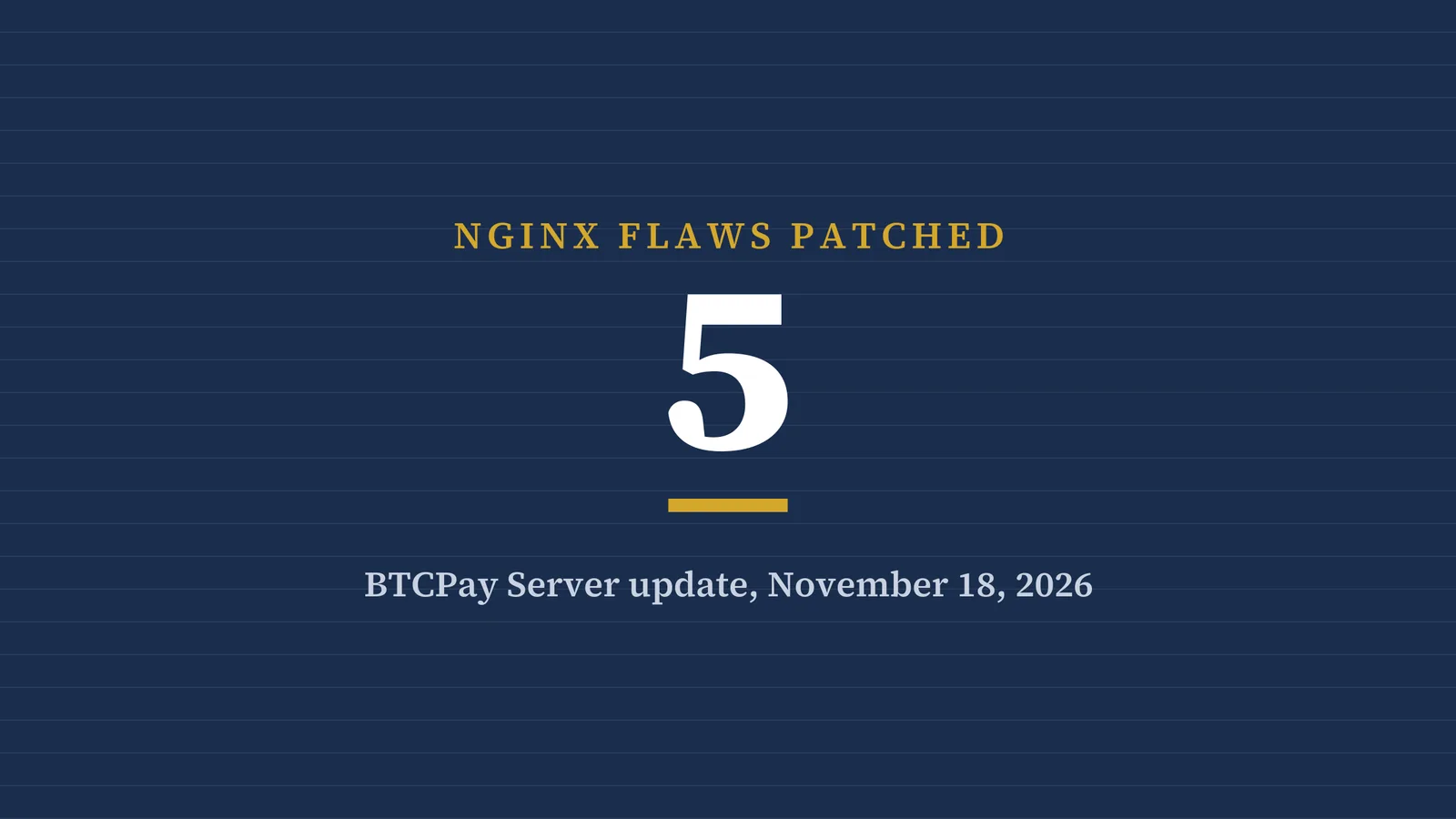
BTCPay Server, the free, self-hosted bitcoin payment processor, released an emergency update on Wednesday, November 18, 2026, to address five vulnerabilities in nginx, the web server that sits in front of the payment application in its standard Docker setup. In a post on X at 17:29 UTC, the project urged operators to update as soon as possible.
What BTCPay changed
The update replaces nginx 1.31.8 with 1.31.9 in BTCPay's Docker deployment, according to the change in the project's btcpayserver-docker repository, which was merged at 17:15 UTC on November 18. The change description says nginx 1.31.9 fixes two HTTP/2 vulnerabilities, CVE-2026-123007 and CVE-2026-123633.
BTCPay's X post listed five: those two plus CVE-2026-123634, CVE-2026-121810 and CVE-2026-113425. The nginx project released version 1.31.9 at 15:54 UTC the same day with fixes for 10 vulnerabilities in total. Its security advisories page lists versions up to 1.31.8 as vulnerable, with the oldest affected version differing by flaw, and names 1.31.9 and the stable 1.30.7 as fixed.
The latest release of the BTCPay Server application itself remains 2.4.7, from October 29. BTCPay did not name application versions affected by the nginx issue.
The five flaws
The European Union's cybersecurity service, CERT-EU, published an advisory on November 18 covering the same five CVEs. It said they allow an unauthenticated remote attacker to run code with the privileges of the nginx worker process, and it rated each at 8.1 on the CVSS scale. Each flaw depends on particular settings:
| CVE | Flaw, as nginx describes it | Needed for it to apply, per CERT-EU | nginx severity |
|---|---|---|---|
| CVE-2026-123007 | Memory corruption in HTTP/2 flow control | HTTP/2 enabled | major |
| CVE-2026-123633 | Use-after-free in HTTP/2 | HTTP/2 and requests passed to an upstream server | medium |
| CVE-2026-121810 | Use-after-free in HTTP/3 | HTTP/3 and requests passed to an upstream server | medium |
| CVE-2026-123634 | Use-after-free in the DNS resolver | A specific resolver, proxy and mirror setup | medium |
| CVE-2026-113425 | Use-after-free in the mail proxy module | Mail proxy with external authentication | major |
No confirmed attacks so far
In a follow-up post at 20:03 UTC, BTCPay said that no attacks using the flaws had been publicly confirmed so far. CERT-EU's advisory said "no exploitation in the wild has been reported yet," although it noted that researchers had demonstrated exploitation of CVE-2026-123007.
CERT-EU advised administrators to check nginx error logs for worker processes that exit on a signal. It said such crashes may point to exploitation attempts but do not prove that code was run.
BTCPay credited members of the Bitcoin Red Team with monitoring open-source software and alerting projects to the nginx CVEs.
What BTCPay told operators to do
BTCPay listed three update paths in its X thread:
- Server admins can open Server Settings, then Maintenance, and click Update.
- On Docker installs, which BTCPay says covers most servers, operators log in over SSH and run the btcpay-update.sh script from the btcpayserver-docker folder.
- Users of node platforms such as Umbrel and Start9 should install the update once their platform makes it available.
For operators who cannot update at once, BTCPay pointed to a workaround posted by one of its core contributors. It turns off HTTP/2 in the nginx container and is described as temporary and not persistent. CERT-EU said disabling HTTP/2 mitigates CVE-2026-123007 and CVE-2026-123633 only.
Earlier BTCPay incidents
The nginx update follows two earlier incidents that involved BTCPay's own code. On August 7, the project said attackers had exploited a flaw fixed in version 2.4.2 that exposed credential files for LND Lightning nodes, and that funds were stolen. On November 2, it reported Bitcoin and Litecoin thefts from hot wallets on servers still running 2.4.1 or earlier, which attackers hit through a different method of exploiting the same vulnerability.
Other self-hosted bitcoin software has also issued security fixes this month. LNbits told its operators to upgrade after a wave of attacks, and Bitcoin Core disclosed three security flaws it had fixed a year earlier.
What it could mean for merchants running BTCPay
In our assessment, the practical question for merchants this time is not BTCPay's own code but whether the web server in front of it is current. Because BTCPay is self-hosted, each operator has to apply the update, and nothing changes on servers whose owners do not run it. In the November incident, BTCPay said the attacks targeted servers still on old versions. Points to watch are when node platforms ship nginx 1.31.9, whether any of the five flaws is reported as exploited in the wild, and whether CERT-EU or nginx revise their advisories.
Sources
- BTCPay Server — Emergency update announcement and follow-up thread on X (November 18, 2026)
- BTCPay Server — Update Nginx to 1.31.9 (btcpayserver-docker pull request 1255) (November 18, 2026)
- nginx — nginx security advisories
- CERT-EU — Critical vulnerabilities in NGINX (Security Advisory 2026-022) (November 18, 2026)
- nginx — nginx 1.31.9 release notes on GitHub (November 18, 2026)
- BTCPay Server — BTCPay Server security incident: 2.4.1 and earlier (November 2, 2026)
- BTCPay Server — Security advisory: BTCPay Server 2.4.2 (August 7, 2026)
- Cointelegraph — BTCPay Server issues emergency update for 5 security flaws (November 19, 2026)
This article was researched and drafted with the help of AI tools, checked against its sources in a separate AI fact-check and edit, and approved for publication by Trading Metrics. Read our AI use policy.
This article is for information only and is not financial advice. Crypto assets and leveraged products are volatile and you can lose money. Do your own research and consider your circumstances before trading.