
About 245,000 BTC has left long-dormant Bitcoin addresses since 2018, a developer's audit finds
The pseudonymous developer behind a 2018 list of 92,076 inactive addresses says about one in nine has since spent. Decrypt valued the coins at about $14.7 billion; the author says dormant does not mean lost.
Contents
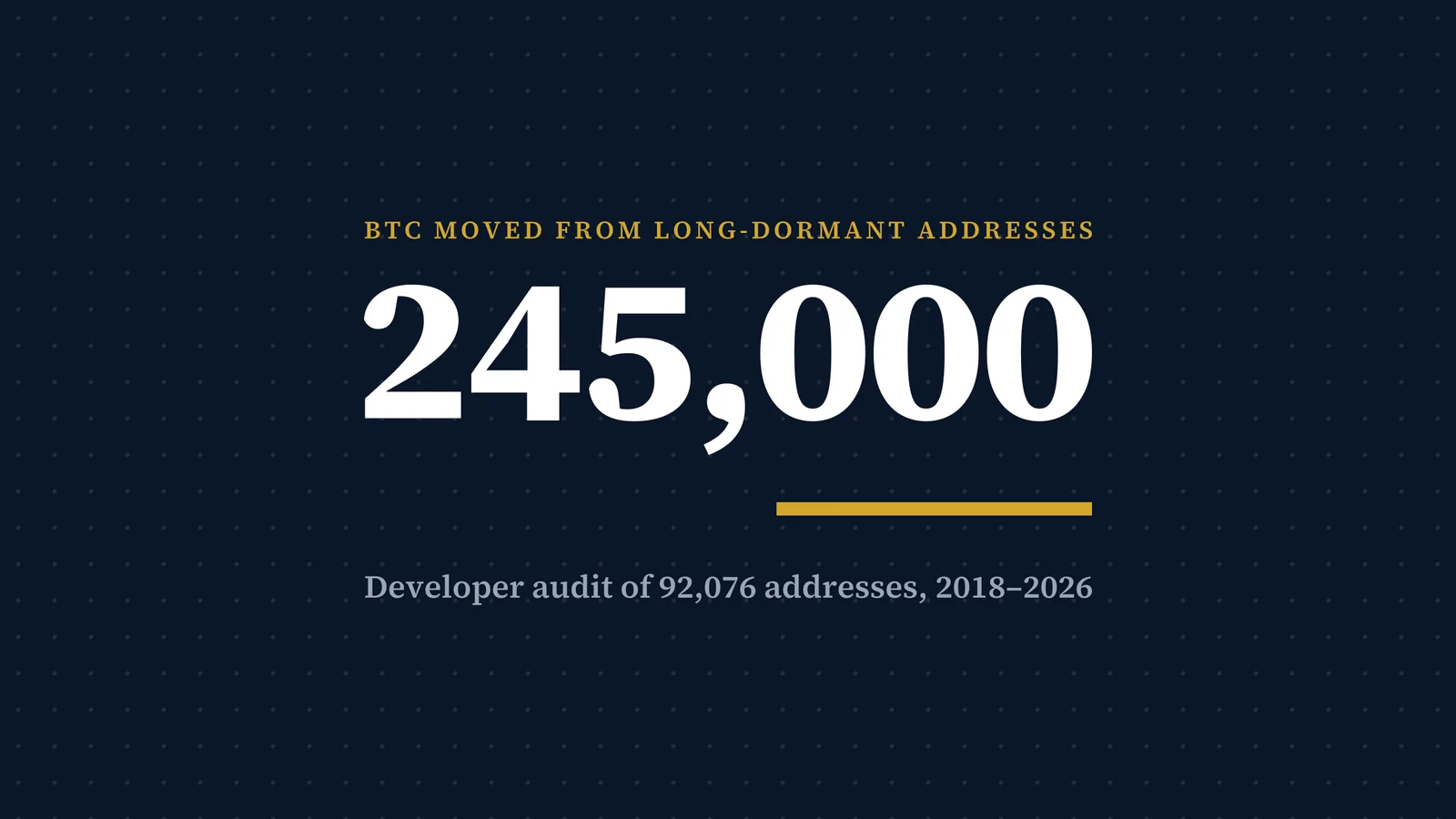
About 245,000 BTC has left a set of Bitcoin addresses that were already more than six years inactive in 2018, according to an audit by a pseudonymous developer who goes by Quickben22. Decrypt reported the findings on Tuesday, November 24, 2026, and put the value at just over $14.7 billion at Bitcoin's price when it wrote.
What the audit counted
Quickben22 says he built an app in 2018 that treated any address with no outgoing transaction for six years or more as probably lost. Decrypt reported that the app, Bitcoin Key Hunter, guesses private keys at random and checks them against the list. Decrypt said the developer did not answer whether he had ever guessed the key to a listed address.
In the audit, published in November 2026, he rechecked the preserved list of 92,076 older-format addresses. Together they held 2,530,552 BTC, more than one in every eight BTC mined so far, he writes. The balance check runs through November 11, 2026.
His results: 82,086 addresses (89.2%) have never spent and still hold 2,256,802.64 BTC. The other 9,990 (10.8%) spent, sending out about 245,000 BTC. Most of the largest balances did not move.
How we checked the numbers
The author published a per-address data file on GitHub. Trading Notified recomputed the totals from it: the 2018 balances add up to 2,530,552 BTC, and net outflows come to about 245,300 BTC. We could not reproduce the count of 9,990 spending addresses exactly, because the file records balances rather than every spend, and many addresses have since received small deposits.
Spot checks on the block explorer mempool.space matched the file. The largest address on the list still holds 79,957 BTC and has never spent, and two of the eight 10,000 BTC addresses described below have sent out almost their entire balance.
On the dollar figure: the audit counts BTC, not dollars. At $60,412, mempool.space's price at 12:55 UTC on November 24, 245,000 BTC is worth about $14.8 billion, close to Decrypt's figure. Bitcoin slipped below $60,000 on Tuesday, so the dollar value moves with the price.
The largest wake-ups
Outflows ran at roughly 11,000 to 32,000 BTC a year for seven years, according to the audit. In 2025, 95,845 BTC left, and 87,240 BTC of it came from 60 addresses.
Most of that was one event. On July 4, 2025, eight addresses holding about 10,000 BTC each sent out 80,009 BTC over eleven hours after 14.2 years without a spend, the audit says. On July 25, 2025, Galaxy said it had completed the sale of 80,000 BTC for a client as part of estate planning, CoinDesk reported. CoinDesk linked the sale to the long-dormant wallets that moved that month; Galaxy did not name the addresses, the audit notes.
Other clusters the audit lists:
- On March 26, 2024, 34 addresses holding exactly 50 BTC each, the block reward in 2010, were emptied in one transaction after about 13.5 years.
- On November 11, 2022, the day FTX filed for bankruptcy, seven addresses holding 500 BTC each were emptied after 11.3 years. The author says the timing alone proves nothing.
- From November 12 to 19, 2026, 19 more addresses funded between 2010 and 2012 sent out 241.4 BTC in total. The coins then moved through a peel chain, a series of transfers that each split off a small amount and send the rest to a fresh address.
What the data cannot show
The audit stresses that a spend proves only that someone could sign with the key, not who that was. A mover could be the original owner, an heir, a custodian, someone who found an old backup, or a thief. On-chain data alone cannot tell them apart.
The list also bears on a New York lawsuit filed in March 2026 that asks a court to treat 39,069 dormant addresses, about 3.8 million BTC, as abandoned property, according to the audit. Decrypt reported that some addresses named in the case have moved funds this year and that one holder has moved to dismiss it, saying they control a named address. The audit describes the case as pending.
The audit also argues that a properly random key is practically impossible to guess, and that only flawed key generation would make a search realistic. Separate research has shown how quickly bots go after keys exposed by a flaw in how signatures were made.
What it could mean for Bitcoin holders and the market
In our assessment, the audit is a reminder that estimates of "lost" Bitcoin rest on assumptions about inactivity, and those assumptions can be wrong. About one in nine addresses on a list built to capture lost coins later spent, though most of the BTC on it has not moved. Large sums can wake up after a decade or more, as the 80,009 BTC in July 2025 showed. Points to watch are further movements from the 94 addresses that still hold 1,000 BTC or more, 344,864 BTC in total by the audit's count, and the outcome of the New York case.
Sources
- mempool.space — Bitcoin address and price data (block explorer API)
- Decrypt — $14.7B in 'Lost' Bitcoin Has Moved Since 2018: Report (November 24, 2026)
- CoinDesk — Bitcoin Rebounds After Galaxy Completes Sale of $9B BTC From Satoshi-Era Whale (July 25, 2025)
- Quickben22 — The Great Bitcoin Sleepover (short version) (November 22, 2026)
- Quickben22 on GitHub — Per-address audit data file (CSV) (November 12, 2026)
This article was researched and drafted with the help of AI tools, checked against its sources in a separate AI fact-check and edit, and approved for publication by Trading Metrics. Read our AI use policy.
This article is for information only and is not financial advice. Crypto assets and leveraged products are volatile and you can lose money. Do your own research and consider your circumstances before trading.