
Malware planted in Optimizely scripts swapped crypto addresses on sites of 178 organizations, researchers say
Report URI says the code ran on websites including Ledger's, the BBC's and Zoom's on November 16 and also skimmed payment cards. Optimizely said it fixed the flaw the attacker used and removed the code.
Contents
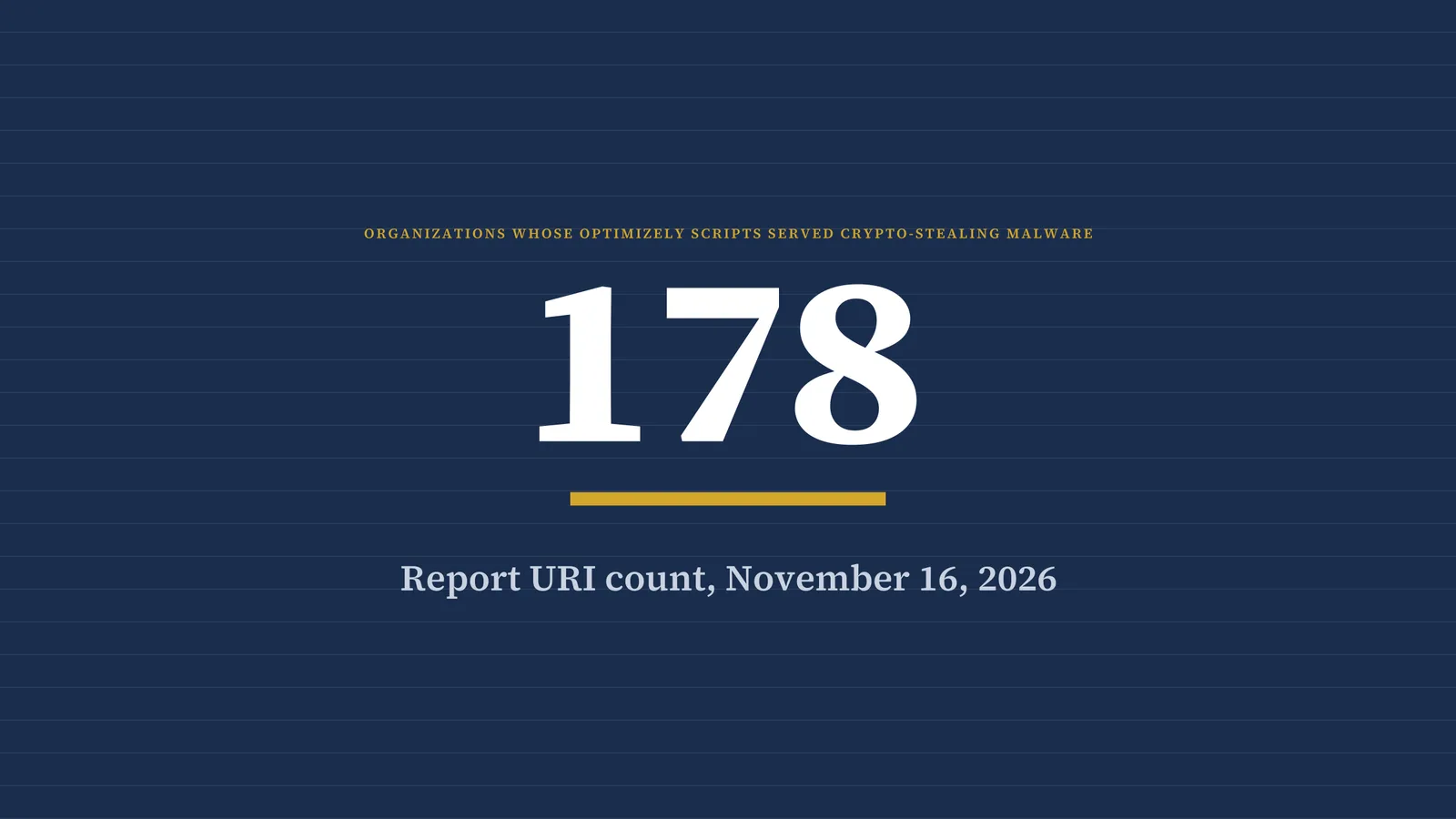
Malicious code added to Optimizely website scripts ran on the sites of 178 organizations on Monday, November 16, 2026, swapping cryptocurrency wallet addresses for the attacker's and stealing payment card details, according to an investigation by security firm Report URI. The firm listed hardware wallet maker Ledger, the BBC, CNN, Zoom, Salesforce, GitLab, IKEA and HSBC among them. Optimizely, a website experimentation platform, said in a status update that an unauthorized party exploited a vulnerability in its product and that it has fixed the flaw and removed the code.
How the attack worked
Optimizely Web customers load a JavaScript file, called a snippet, from Optimizely's servers on their own pages. Each snippet can carry custom code that the customer writes in an Optimizely dashboard and that runs on every page. Report URI said the attacker wrote a short loader into that custom-code field in customer projects, leaving the rest of each file untouched. Visitors' browsers then fetched the malware from an attacker-controlled server.
Because the files were still served from Optimizely's own domain, sites that trusted Optimizely also trusted the malware, the firm said. It wrote that this was not an attack on Optimizely's content delivery network, which "served exactly what it was given." Optimizely's own websites carried the code too, according to the report.
Optimizely said on its status page at 01:02 UTC on November 17 that the attacker "exploited a vulnerability in Experimentation" to add malicious JavaScript to "some customer projects." The company said it has taken steps to secure affected user accounts and added protections against unauthorized code. A spokesperson told Cointelegraph the flaw was in the signup flow for Experimentation accounts and that all affected customers had been notified. Report URI said it had received no response from Optimizely when it published.
What the malware did
Report URI described one script with several functions running at once:
- Address swapping. It looked for valid wallet addresses on Bitcoin (BTC), Ethereum and other EVM chains, TRON, Solana, TON, Litecoin, Bitcoin Cash and Dogecoin, and replaced them with the attacker's in page text, form fields and the clipboard. A visitor who copied an address could paste the attacker's instead.
- Card skimming. From 13:43 UTC, it captured card numbers, expiry dates and security codes typed into a site's own forms. Cards entered in payment providers' hosted fields, such as Stripe's, were out of its reach, the firm said.
- Cookie and screenshot theft. After swapping an address near wallet or payment wording, it sent the page address, readable cookies and a screenshot to the attacker's server.
- iOS exploits. On iPhones and iPads it loaded the Coruna and DarkSword exploit kits. Report URI said iOS 18.7.3 and later, and iOS 26.3 and later, are patched.
Malware of this kind is often called a clipper, because it changes an address on the clipboard. Crypto transfers generally cannot be reversed once confirmed. StepSecurity, a second security firm that read the payload, said it swapped a copied address only when nearby text contained a payment word such as "wallet" or "deposit," and advised checking an address on the hardware wallet's own screen rather than against what was copied.
Which sites were affected
Report URI said it checked 1,611 Optimizely snippets it could find and that 188 of them, belonging to 178 organizations, were infected. It said the real number is likely higher. Its crypto and trading group lists Ledger, IG, OANDA/Coinpass, interactive investor, TMS Brokers and Betashares. Other groups include banks, airlines, retailers, streaming services and news sites.
StepSecurity, working from public scan records, named 17 sites where a stored copy of the final payload was recorded, including CNN, the BBC, Zoom, Salesforce, GitLab and KLM. A separate researcher named the campaign OPTIMJACK, according to StepSecurity and Cointelegraph.
| Time (UTC), November 16 | Event, according to Report URI |
|---|---|
| 04:21 | First Optimizely injection seen, on the BBC's snippet |
| 08:28 | Address-swapping script first seen on bbc.com |
| 13:43 | Card skimmer added to the script |
| 19:24 to 19:59 | Report URI sweep finds 186 of 1,611 snippets infected |
| 20:41 | Ledger's snippet cleaned |
| 21:52 | One of 188 infected snippets still carries the code |
Security researcher Scott Helme, who wrote the Report URI investigation, said on X at 20:10 UTC on November 16 that he was tracking a breach affecting "hundreds of high value websites." The report says the attacker rebuilt the payload 26 times during the day.
How much crypto was taken
Report URI said the attacker's wallets had received about $7,040 as of 19:25 UTC on November 16, most of it in Bitcoin. StepSecurity put the amount received or held at about $6,600 and said some of the addresses were active before the campaign began, so not all of it can be tied to victims.
Alex Thorn, head of firmwide research at Galaxy Digital, said on X that his on-chain trace showed victims paid about $2,300, with most of the rest being the attacker's own money. Report URI said it cannot see how many card numbers or cookies reached the attacker's server.
Responses from affected companies
A Salesforce spokesperson told Cointelegraph the company was investigating unauthorized changes to Optimizely scripts on some of its websites and, as a precaution, was confirming that the scripts were disabled. Cointelegraph said it had contacted Ledger and Coinpass. We found no public statement from Ledger on the incident when we searched on November 17.
Neither Report URI nor StepSecurity has established how the attacker gained access to so many customer projects, and Optimizely's statement does not describe the vulnerability in detail.
Attacks through outside providers have hit other crypto firms this month. Trezor disclosed a breach at its shipping partner Skladon, Coinone reported a data leak after an attack on its customer-support contractor, and Across Protocol said an attacker hijacked its website domain through its registrar.
In our assessment
The incident shows that a crypto company's website can serve malware without its own code being changed, through a script it loads from a trusted vendor. The amounts traced on-chain are small in all three analyses, but card and cookie theft does not show on a blockchain and its scale is not known. Anyone who copied a wallet address on an affected site on November 16 can check past transfers against the intended address, as the researchers advise. The open questions are how the attacker reached the customer projects and how the vulnerability in Optimizely's product worked.
Sources
- Report URI — World's Largest Brands Infected With Malware Via Optimizely (November 16, 2026)
- Optimizely Status — Web Experimentation Security Incident (November 17, 2026)
- Scott Helme on X — Tracking a breach of a third-party JavaScript host (November 16, 2026)
- Cointelegraph — Hackers inject credit card, crypto-stealing malware into 178 major websites (November 17, 2026)
- StepSecurity — OPTIMJACK: Optimizely-Hosted Scripts Loaded a Crypto Clipper and Card Skimmer on 186 Confirmed Sites (November 17, 2026)
- Alex Thorn on X — On-chain trace of the OPTIMJACK wallets (November 17, 2026)
This article was researched and drafted with the help of AI tools, checked against its sources in a separate AI fact-check and edit, and approved for publication by Trading Metrics. Read our AI use policy.