
Trezor says a breach at shipping partner Skladon exposed data from about 27,000 orders
The hardware wallet maker said it believes names, phone numbers, addresses, email addresses and order details were exported, adding that its own systems, devices and wallet backups were not affected. It is the third partner incident Trezor has disclosed since August.
Contents
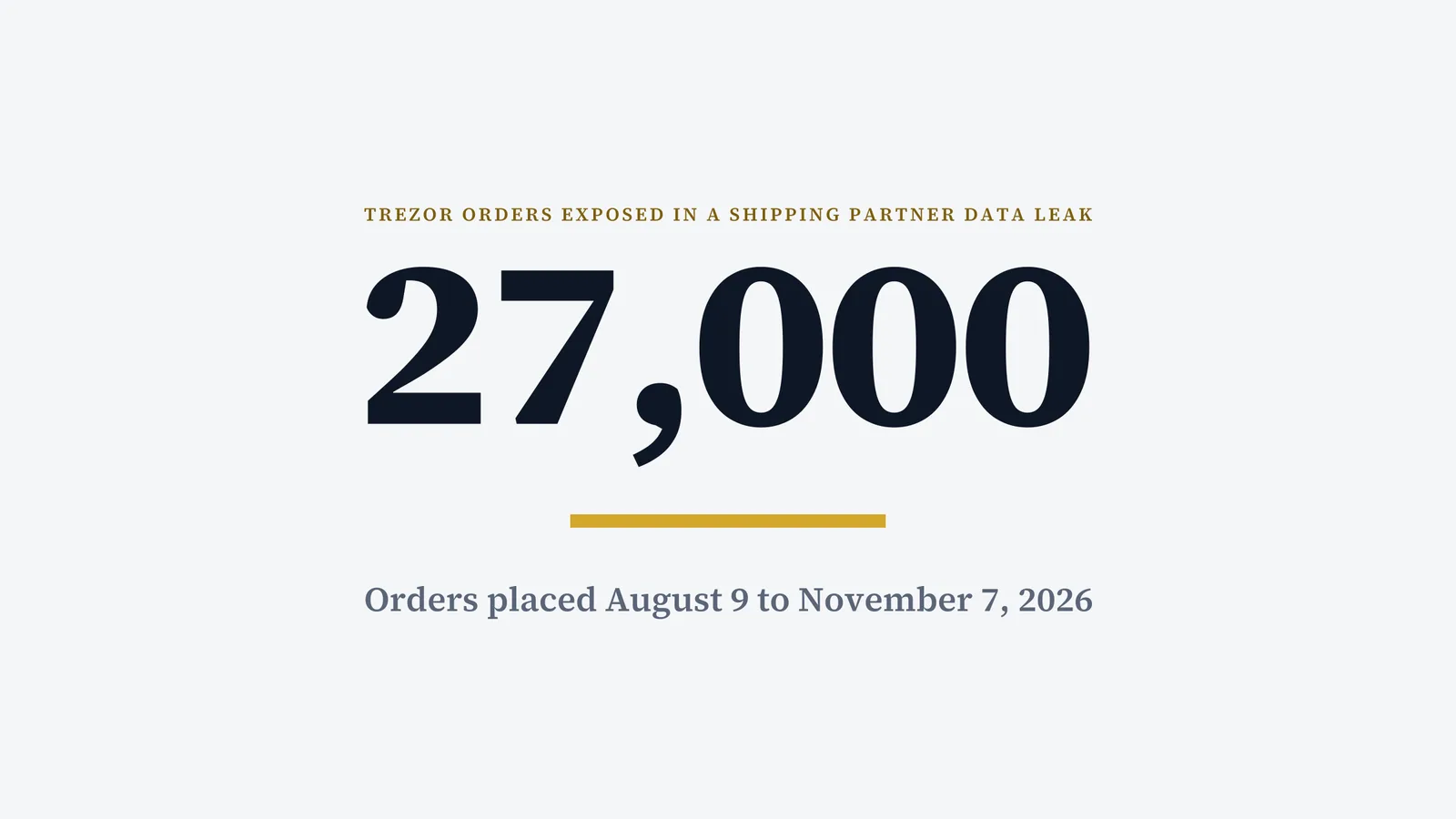
Hardware wallet maker Trezor said on Monday, November 16, 2026, that it believes an attacker exported customer data for about 27,000 orders from the systems of Skladon, one of its shipping partners. The data covers orders placed between August 9 and November 7, 2026, and includes names, phone numbers, delivery addresses, email addresses and order details, according to Trezor's statement. Trezor said its own systems were not compromised and that no wallet backups, PINs or passphrases were involved.
What Trezor says was exposed
Skladon notified Trezor on November 15 of unauthorized access to systems holding Trezor customer shipping data, the company said. It dated the breach itself to November 7, eight days earlier, and said the investigation with Skladon is ongoing.
According to the statement's FAQ, the exported data includes each customer's name, phone number, delivery address and email address, plus the order date, the product name and its price. Trezor said neither it nor Skladon ever holds wallet backups, PINs or passphrases. In a post on X at 16:18 UTC, the company told customers that "your device is secure."
A wallet backup, also called a recovery seed, is the list of words that can restore a wallet and move its funds. Anyone who learns it can take the funds, which is why Trezor's warnings center on never sharing it.
Who is affected
Trezor said it emailed every affected customer it can still reach. A small number of customers who ordered between August 9 and 14 may also be affected but cannot be emailed, because their details had already been anonymized under its 90-day retention policy, the company said. Skladon delivers to many countries, so the incident is not limited to one region, but it does not ship to the US and customers there are not affected, according to the X post.
Some customers have already reported scam calls, Trezor said. It warned that scammers may quote real order details, including what a customer bought and paid, and told customers to "be alert to potential risks to your physical security." The company said it will never cold-call customers or ask for a wallet backup, and that support should be reached through its website rather than through links, QR codes or numbers in a message.
Trezor said it has informed the data protection authority. Neither its statement nor its X post says how the attacker got into Skladon's systems. Skladon's homepage showed no statement on the incident when we checked at about 02:30 UTC on November 17.
What Trezor is changing
Customers in 18 European countries can now order with anonymous pickup at a parcel locker or pickup point, so their name and home address never reach the company, Trezor said. It said it is working to launch the option in the US "as soon as possible."
The company also said it is cutting how long it keeps order data from 90 days to 45, and in the X post it said shipping partners must follow the same policy. It said it is reviewing its relationships with third-party partners and the security requirements it places on them.
"We know this is not the first time customer contact details and addresses have been exposed in an incident involving one of our partners," Trezor wrote. Asked on X why an outside company handled its orders, Trezor replied that doing every part of the business in-house "isn't realistic" and that Skladon holds only what is needed to deliver a parcel.
Earlier incidents at Trezor partners
The Skladon breach is the third incident at a Trezor partner that the company has disclosed since August:
| Disclosed | Partner | What Trezor said was exposed |
|---|---|---|
| August 13, 2026 | ShipMonk (shipping) | 11,742 customers with name, email, phone and address; 1,947 with name, city and email |
| September 4, 2026 | ShipMonk (update) | About 67,000 more US customers from orders placed November 2019 to August 2021 |
| September 10, 2026 | Brevo (email) | 347,149 newsletter email addresses exported |
| November 16, 2026 | Skladon (shipping) | About 27,000 orders placed August 9 to November 7, 2026 |
In the ShipMonk update, Trezor said it had repeatedly received written assurance that the older data had been deleted. In the Brevo incident, an attacker used Trezor's newsletter account to send a phishing email that pushed recipients to an app asking for their wallet backup. Trezor said it took the link's domain down within 20 minutes, after about 2,500 people had clicked it.
Decrypt reported that older incidents include a 2022 attack involving Mailchimp and a 2024 breach of an external support portal that it said put contact details of up to 66,000 people at risk. The Block also reported the Skladon incident on November 16.
Leaks and attacks at outside providers have hit other crypto firms this month. South Korean exchange Coinone said on November 15 that customer data leaked after an attack on its customer-support contractor, and Across Protocol said an attacker hijacked its website domain through its registrar.
In our assessment
The leaked records do not give anyone access to a wallet, according to Trezor, but they link real names and home addresses to the purchase of a crypto storage device. The risks Trezor itself names are targeted phishing by phone, text, email and letter, and physical security. Because each incident Trezor has disclosed since August involved an outside provider rather than its devices, the questions they raise concern partner controls and how long order data is kept. The open points are how the attacker got into Skladon's systems and whether the investigation changes the number of affected orders.
Sources
- Trezor — Data breach at Trezor shipping partner, Skladon (November 16, 2026)
- Trezor on X — Data breach involving Skladon (November 16, 2026)
- Trezor on X — Reply on the use of third-party service providers (November 16, 2026)
- Trezor — Recent customer data exposed in shipping provider incident (August 13, 2026)
- Trezor — Security incident at Brevo, our third-party email provider (September 10, 2026)
- The Block — Trezor hit by another shipping partner data leak affecting 27,000 Skladon orders (November 16, 2026)
- Decrypt — Bitcoin Wallet Maker Trezor Says Customer Data Was Exposed Again (November 16, 2026)
This article was researched and drafted with the help of AI tools, checked against its sources in a separate AI fact-check and edit, and approved for publication by Trading Metrics. Read our AI use policy.