
Sky disputes CoinDesk's report on illicit flows through its PSM after more than $2 billion in USDS redemptions
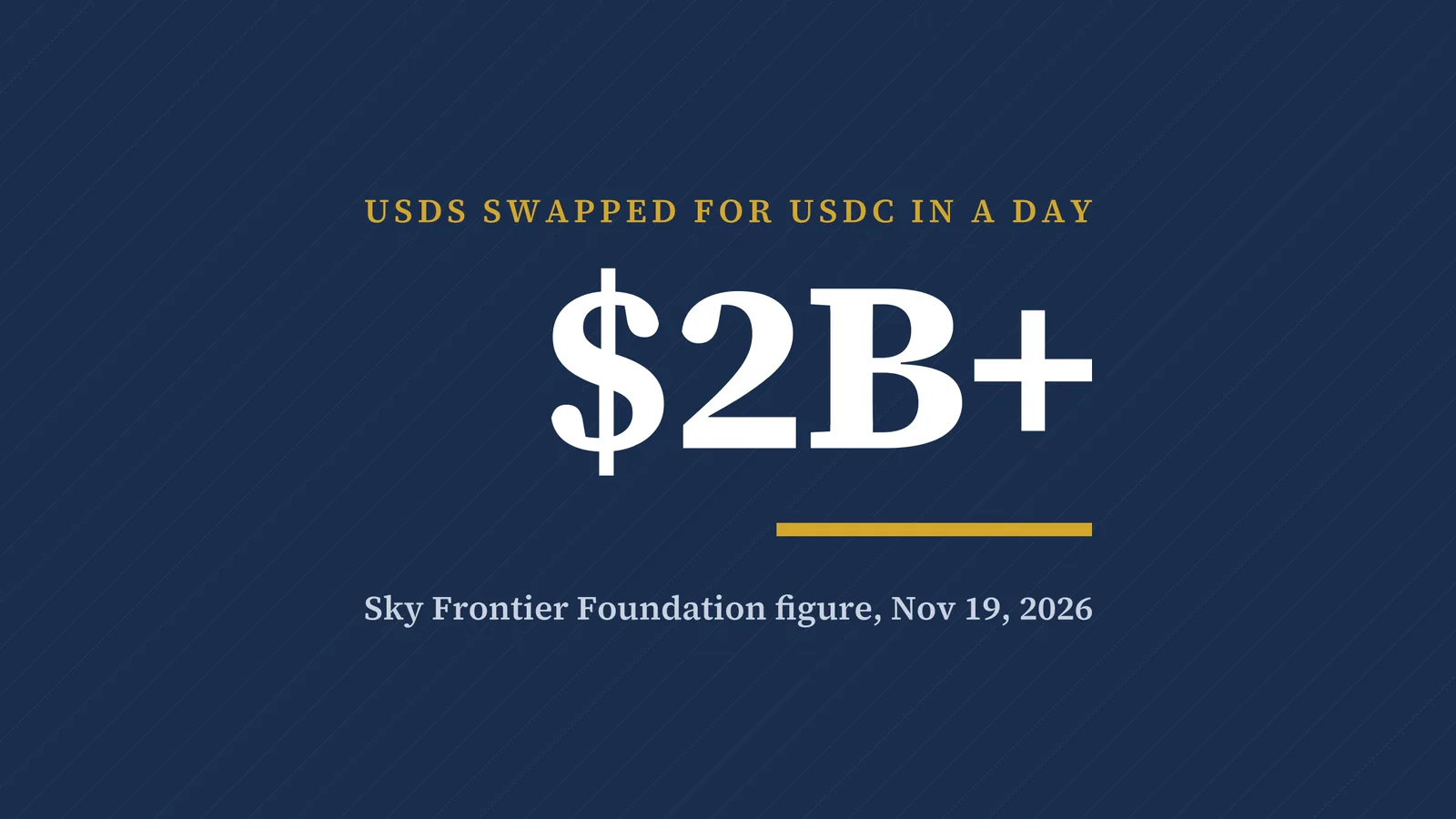
The Sky Frontier Foundation says a review by its risk advisor Block Analitica found the report's central claims misleading or lacking context. It puts the November 19 swaps of USDS for USDC at more than $2 billion.
Contents
The Sky Frontier Foundation said on Friday, November 20, 2026, that a review of CoinDesk's report on North Korea-linked flows through Sky's Peg Stability Module (PSM) found several of its central claims "misleading" or lacking context. In the same statement, released through PR Newswire at 15:22 UTC, the foundation said users swapped more than $2 billion of USDS for USDC through the module on November 19.
The review was carried out by Block Analitica, which the foundation's statement describes as the Core Council Risk Advisor in the Sky ecosystem. CoinDesk's article carried no correction or editor's note when we checked on November 21, and we found no public reply from CoinDesk or Inca Digital, the analytics firm behind the original findings.
What Sky disputes
CoinDesk reported on November 19 that Inca Digital traced $518 million in transactions from wallets linked to hackers, phishing operations and sanctioned entities through the PSM, and that about $101.9 million of it was "directly linked" to North Korean actors. Most of the North Korea-linked flows the report details followed the February 2025 Bybit hack, which the FBI attributed to North Korea.
The foundation's statement, citing Block Analitica, makes these points:
- Timing. About two-thirds of the flagged activity went through the original MakerDAO PSM between 2021 and mid-2024, before the newer LitePSM came into use. On the LitePSM, the flagged activity is less than 0.03% of volume.
- Scale. The $518 million spans five years and is less than 0.06% of the more than $960 billion the PSMs have processed.
- The Bybit-linked flows. Of the $91.5 million the report ties to the Bybit hack, only about $0.56 million involved a wallet swapping USDC it held for DAI, the statement says. The rest, it says, came from sales of ETH that the wallets' aggregator routed partly through the PSM.
- The North Korea link. The statement says the $101.9 million figure appears to rest on fund tracing in which many wallets sit two or more transfers from a listed address, a distance at which a wallet "may belong to an unrelated party."
- Sanctions. In the data CoinDesk shared with the foundation, the "sanctioned entities" appear to be a few wallets that traded before they were sanctioned, according to the statement.
- Routing. CoinDesk's report itself found that most flagged transactions reached the PSM through aggregators such as 1inch, ParaSwap and MetaMask Swaps. The foundation argues that the aggregators, not the wallets, chose the PSM as the route.
The statement also takes issue with CoinDesk's description, attributed to Inca Digital, of the PSM as an "exit from freezable USDC," saying the data do not appear to support it. It says the flagged transactions do not appear to have come through the sky.money or spark.fi front ends.
These are the foundation's and Block Analitica's readings of the data. We could not find the transaction-level review published in full, and we have not seen Inca Digital's underlying data, so we cannot check either side's figures.
The redemptions, by Sky's count and ours
The foundation called November 19 one of the largest single days of PSM outflows to date. It said the module kept swapping USDS for USDC at one to one throughout, that its USDC never fell below $800 million, and that it had risen above $1.1 billion on November 20.
Those figures fit the readings in our earlier report on the November 19 outflow, which found a low of about $800 million in the PSM's USDC pocket that afternoon. Sky's "more than $2 billion" is larger than the roughly $1.47 billion net fall in the pocket's USDC over that day because the reserve partly refilled after the big swaps; a net change does not show the gross amount redeemed.
The outflow did not stop on November 19. Reading the contracts directly at 06:32 UTC on Saturday, November 21, we found:
| Measure | Nov 18, 23:56 UTC | Nov 21, 06:32 UTC |
|---|---|---|
| USDS supply on Ethereum | $5.23 billion | $3.09 billion |
| USDC in the PSM pocket | $2.54 billion | $1.35 billion |
| DAI supply on Ethereum | $4.41 billion | $4.36 billion |
That is a fall of about $2.14 billion, or about 41%, in USDS supply since late on November 18. DefiLlama's data show the same trend across all chains: USDS circulating supply of about $5.24 billion on its November 19 daily reading, $3.21 billion on November 20 and $3.11 billion on November 21, with a price of $0.9997 at our check. The PSM pocket's USDC, held in the address that Etherscan labels "Sky: PSM", has risen since its November 19 low.
Sky's figures on backing
The statement says all USDS, sUSDS and DAI in circulation are backed by about $9.3 billion of collateral, and that this exceeded the stablecoins in circulation throughout the outflow. It puts stablecoins held across the PSM and Sky Agents at $2.3 billion, with $5.4 billion allocated through the Sky Agents to strategies that earn revenue, and Sky Reserves at $93.2 million to absorb losses. These are Sky's own figures from its dashboard, which we have not audited.
Cointelegraph, which reported the statement, noted Block Analitica's role as a risk adviser to Sky and said the foundation had not responded to its request for comment by publication.
What the dispute leaves open
The foundation's statement does not address the point behind the "freeze risk" in CoinDesk's headline: the PSM's USDC sits in a single address that Circle, USDC's issuer, could block. Circle has used that power before: it froze about $1.1 billion in USDC tied to the Binance hack. We have seen no block of the PSM address and no halt of the module, and CoinDesk's report included no comment from Circle.
What it could mean for USDS and DAI holders
In our assessment, the dispute is over how to read the same flows, not over whether they happened: Inca Digital and CoinDesk see a channel that illicit-linked wallets used, while Sky and its risk advisor see a small, mostly older share of volume that aggregators routed there. Block Analitica's ties to Sky and the lack of published transaction-level data from either side mean readers cannot yet check it independently. Meanwhile, USDS supply has kept shrinking while DAI has held roughly steady. Points to watch are whether CoinDesk or Inca Digital responds, whether either side publishes its underlying data, the PSM's USDC balance, and any Sky governance change to the module.
Sources
- Sky Frontier Foundation (PR Newswire) — Sky Protocol Shows Resilience Through Record $2 Billion Day as Review Finds CoinDesk Report Misleading (November 20, 2026)
- Ethereum (on-chain data) — USDS and DAI totalSupply and the PSM pocket's USDC balance, read via a public RPC node
- Etherscan — Sky: PSM address page (USDC pocket)
- CoinDesk — North Korean hackers used Sky's stablecoin system, putting billions at freeze risk (November 19, 2026)
- Cointelegraph — Sky Protocol sees $2 billion in stablecoin withdrawals, disputes illicit fund claims (November 20, 2026)
- DefiLlama — Stablecoins API: Sky Dollar (USDS) circulating supply
This article was researched and drafted with the help of AI tools, checked against its sources in a separate AI fact-check and edit, and approved for publication by Trading Metrics. Read our AI use policy.
This article is for information only and is not financial advice. Crypto assets and leveraged products are volatile and you can lose money. Do your own research and consider your circumstances before trading.