
Coinbase says its AI scam defenses stopped $4.7 million headed to a deepfake Elon Musk giveaway
The exchange says hundreds of customers tried to send funds to addresses shown in a fake Tesla livestream, and that its automated agent held back about 91% of the money with no human review.
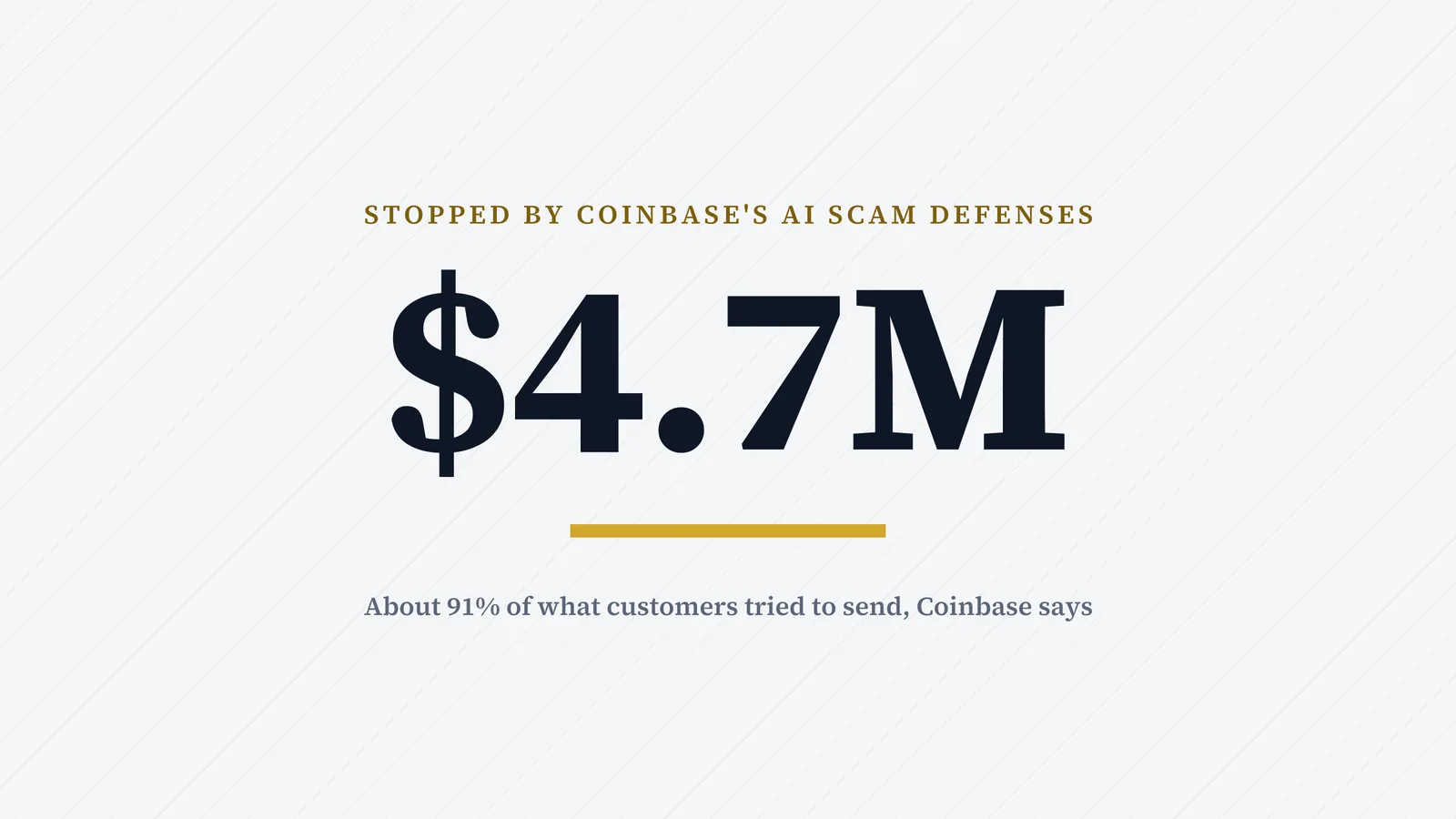
Coinbase said its AI-powered scam defenses stopped $4.7 million that customers tried to send to scammers who used a deepfake of Elon Musk to promote a fake Tesla crypto giveaway. In a blog post published on Tuesday, November 17, 2026, the exchange said that amount was about 91% of the money customers attempted to send, and that its system worked "with no humans in the loop."
What Coinbase says happened
According to Coinbase, scammers ran a YouTube livestream during Tesla's "flying car" demonstration that looked like the real broadcast. It showed a deepfake of Musk, wallet addresses and a QR code on screen, and promised to double any crypto sent to it. The company said more than 500,000 people watched. The post does not give a date for the scam. Tesla held its Roadster demonstration, at which Musk presented the car as able to fly, on Thursday, October 15, 2026, CNN reported.
Within about two hours, hundreds of Coinbase customers tried to send millions of dollars to the scammers, the company said. It did not give the exact number of customers, the total they attempted to send, or the assets involved. If $4.7 million is about 91% of the attempted transfers, the total would be a little over $5 million, by our calculation. Coinbase also did not say what happened to the remaining roughly 9%.
The exchange stressed that no accounts were compromised. "The part that makes this hard: nobody was hacked," it wrote, adding that no password was stolen and no credential phished. The customers, many of them long-time users, were logged in and approved the transfers themselves. Coinbase said its systems can see risk signals in real time but not intent, and cannot tell a bad decision from a deception by looking at the transaction alone.
How the system works, according to Coinbase
Coinbase described a scam prevention agent with three parts:
- Machine learning models that score risky sends in real time, including those tied to giveaway patterns, brand impersonation and newly created wallet addresses.
- An intervention system built for scams that takes over once a send is flagged, looks up context and holds a short conversation with the customer that names the scam pattern and explains how giveaway schemes work.
- A confidence score on each reply the agent produces before the customer sees it, which the company said tells the system when a case needs more friction.
The company said the agent had not been trained on deepfake giveaways tied to a live product launch, but recognized the pattern anyway: a promise to multiply funds, time pressure and a transfer that could not be reversed. It said the agent handled every flagged send from the first to the last without staff stepping in. These are Coinbase's own descriptions; it has not published independent data on how the figures were measured.
Earlier this month, Crypto Briefing reported that two Coinbase specialists had described the agent as 99% effective at keeping users away from the same giveaway in a demonstration video. That figure measured engagement with the scam, according to the report, while the blog post's 91% refers to the share of money stopped.
The wider context
Coinbase said deepfakes make convincing scams cheap and quick to relaunch, and that it is investing in AI models, agents that review risky sends across scam types, and AI labeling of new scam cases so its models learn from attacks within hours rather than weeks. The post also advises users that no legitimate party will double crypto sent to it, and users should not send funds to an address or QR code shown in a video or livestream.
The post comes days after other security incidents in crypto, including an attack on Luxor's Commander software that Luxor said was AI-enabled, and malware planted in Optimizely scripts that swapped crypto addresses on websites.
What it could mean for Coinbase customers
The case points to a problem Coinbase itself describes: in scams like this the customer authorizes the transfer, while most fraud defenses, the company said, are built to spot activity the customer did not authorize. Coinbase's figures are its own and have not been independently checked, and the post leaves open how many customers still lost money and how much. For users, the practical point is the one Coinbase makes itself: a flagged transfer is a reason to stop and check the offer through official channels before confirming.
Sources
- Coinbase — Consumer Protection Tuesday: How we leveraged AI to stop a popular Tesla Scam (November 17, 2026)
- The Block — Coinbase AI defense blocks $4.7 million from being sent to deepfake Elon Musk scam (November 17, 2026)
- CNN via ABC13 Houston — Elon Musk unveils the Roadster, a new Tesla he says is a flying car (October 16, 2026)
- Crypto Briefing — Coinbase's scam-prevention chat agent stops deepfake Musk giveaway during Tesla demo (November 4, 2026)
This article was researched and drafted with the help of AI tools, checked against its sources in a separate AI fact-check and edit, and approved for publication by Trading Metrics. Read our AI use policy.
This article is for information only and is not financial advice. Crypto assets and leveraged products are volatile and you can lose money. Do your own research and consider your circumstances before trading.