
Fed's Bowman sees 'still work to do' on inflation but says more tightening must be weighed against its costs
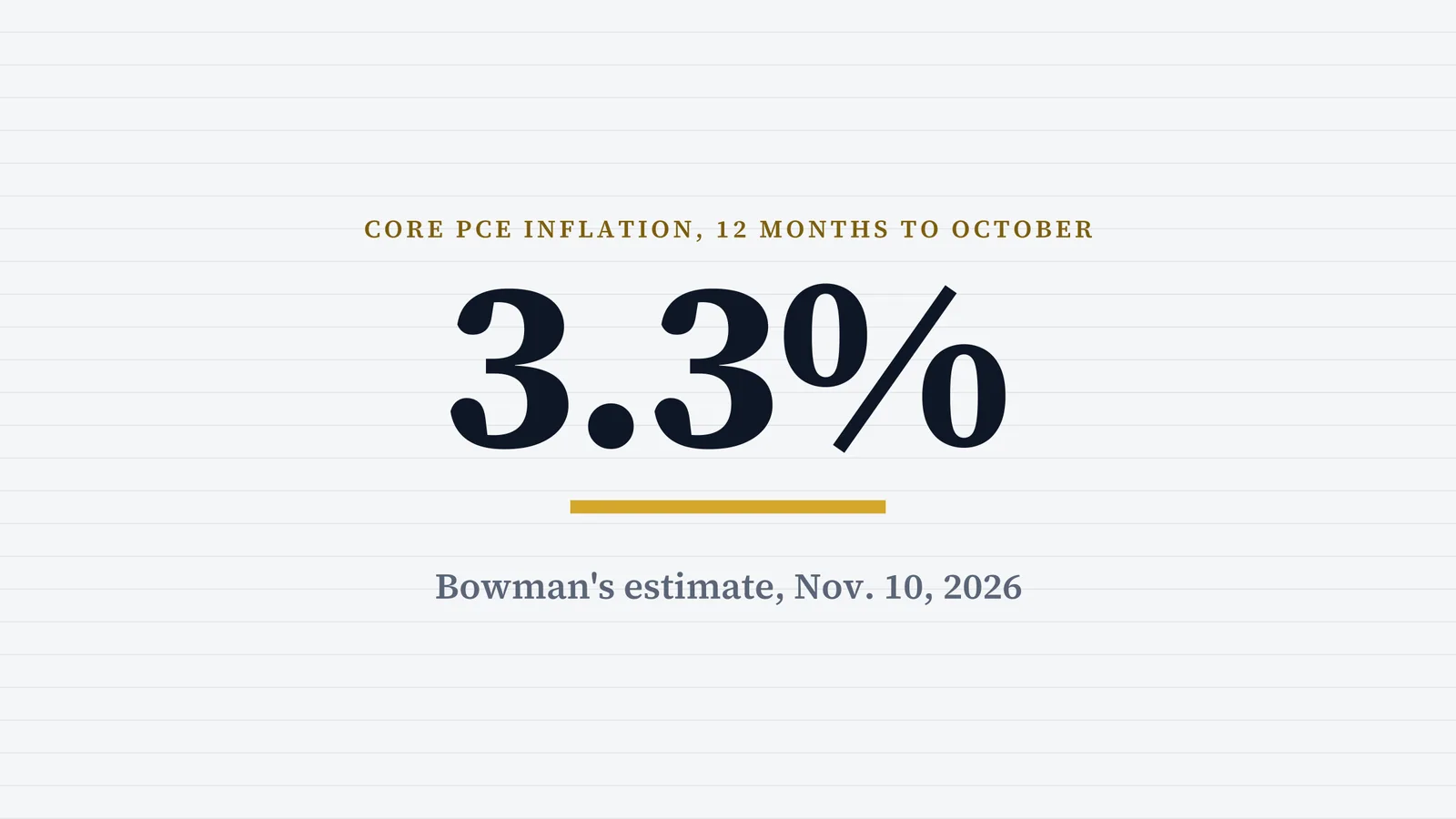
Speaking after the October CPI, the Fed's vice chair for supervision estimated core PCE inflation rose to 3.3% and stopped short of backing a December hike.
Federal Reserve Vice Chair for Supervision Michelle Bowman said on November 10 that inflation pressures could last longer and that there is "still work to do," but that "the benefit of additional policy tightening has to be carefully weighed against its costs," according to the text of her speech at the Council on Foreign Relations in Washington. Unlike Governor Christopher Waller, who earlier that day said he was leaning toward supporting an increase in December, she did not say how she would vote.
What Bowman said in her November 10 speech
Bowman spoke after the Bureau of Labor Statistics released the October consumer price index. She said the CPI data suggested that inflation pressures "may persist for longer" and that core inflation as measured by the personal consumption expenditures (PCE) price index, which leaves out food and energy, likely rose to 3.3% over the 12 months to October.
She described a stronger economy: growth "has stepped up this year," with gross domestic product likely rising more than 3% in the third quarter, and an unemployment rate of 4.1% in October. Progress on lowering inflation "has stalled over the past two years or so," she said, attributing roughly equal shares of above-target core inflation over the year to September to tariffs, energy, the AI investment boom and lingering effects of earlier shocks. She said she expects core PCE inflation to move closer to 2% next year as tariff, energy and AI-related pressures wane, provided the labor market adds no inflation pressure of its own.
On policy, Bowman said she supported holding rates in October so the committee could see how conditions and the earlier increase played out. She said financial conditions had tightened somewhat recently as stock prices fell, private borrowing costs rose and the dollar strengthened, and that with conditions tighter, any further rate increase has to be judged against the toll it could take on the parts of the economy most sensitive to interest rates, such as housing and small business investment. She added that "monetary policy is not on a preset course."
Why it matters
The Fed held its target range at 3.75% to 4% on October 28, with two officials dissenting in favor of an increase. Waller, speaking in London hours before the CPI, said a half-point increase should be considered if core CPI came in around 0.3% or higher; it did. In our reading, Bowman's speech, given after the data, set out a more cautious case, pointing to tighter financial conditions and to risks from energy markets and financing of the AI boom.
Both officials said the views were their own. The Fed's next decision comes at the end of its December 8–9 meeting.
What it could mean for traders
In our assessment, the two speeches show that the committee is not of one mind on how fast to tighten. Rate expectations feed into the dollar, borrowing costs and the appetite for risk assets, including crypto. Bowman named the data she will watch before December: the October PCE price index and the November employment report.
Sources
- Federal Reserve — The U.S. Economy and Considerations for Monetary Policy (speech by Vice Chair for Supervision Michelle W. Bowman) (November 10, 2026)
- Federal Reserve — The Economic Outlook and Some Thoughts on Labor Market Dynamism (speech by Governor Christopher J. Waller) (November 10, 2026)
- US Bureau of Labor Statistics — Consumer Price Index – October 2026 (USDL-26-1685) (November 10, 2026)
- Federal Reserve — Federal Reserve issues FOMC statement (October 28, 2026) (October 28, 2026)
- Federal Reserve — Meeting calendars and information
This article was researched and drafted with the help of AI tools, checked against its sources in a separate AI fact-check and edit, and approved for publication by Trading Metrics. Read our AI use policy.
This article is for information only and is not financial advice. Crypto assets and leveraged products are volatile and you can lose money. Do your own research and consider your circumstances before trading.