
US PCE inflation rises to 3.8% in October; core prices up 3.3%, highest since 2023
The Fed's preferred inflation gauge rose 0.3% on the month, the BEA said, two weeks before the December 8–9 meeting. Personal income jumped 0.7%, helped by a one-time Medicare rebate, while inflation-adjusted spending was flat.
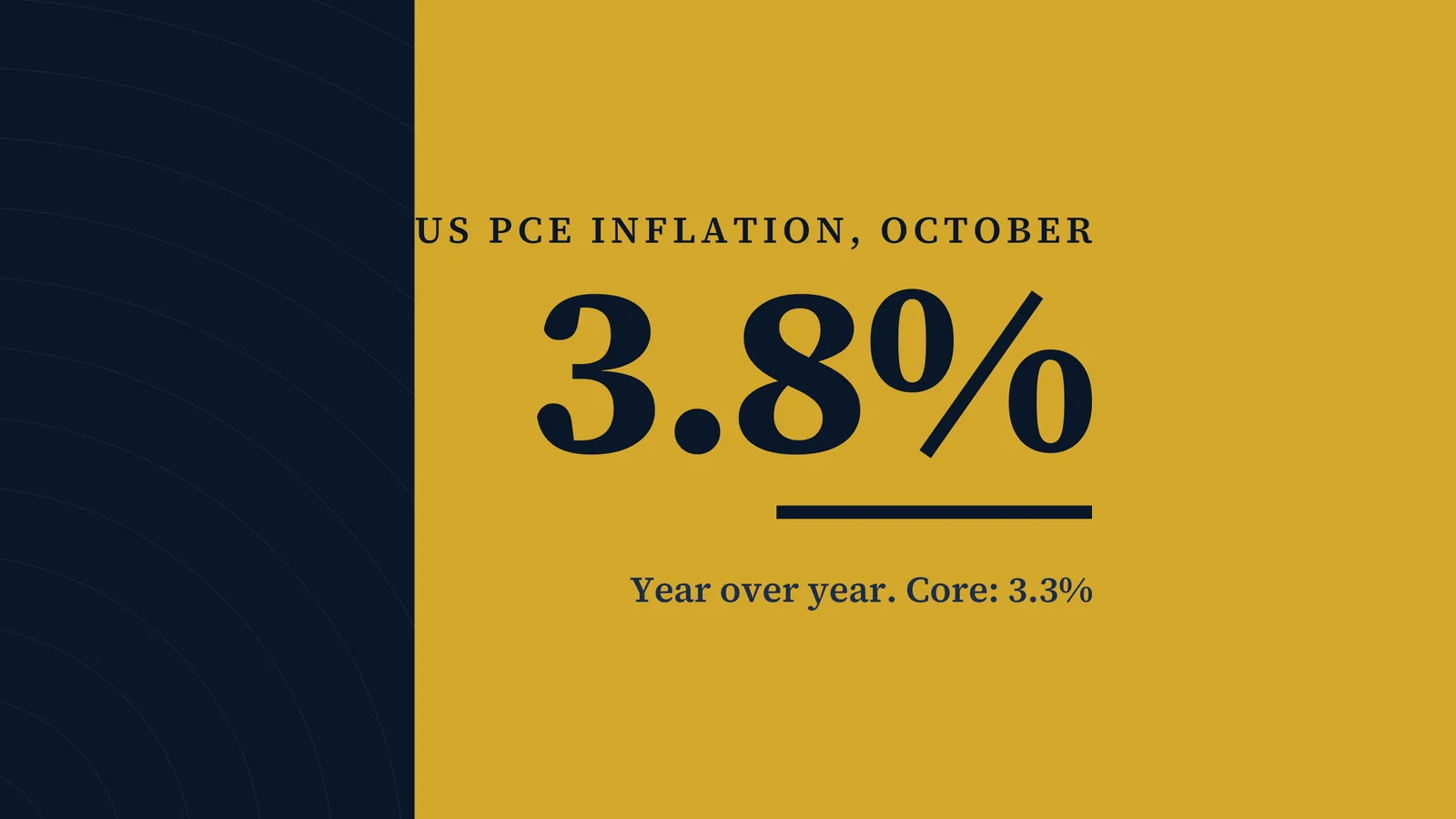
The personal consumption expenditures (PCE) price index, the Federal Reserve's preferred measure of inflation, rose 3.8% in the 12 months to October 2026, up from 3.7% in September, the US Bureau of Economic Analysis (BEA) said on Wednesday, November 25. Core PCE, which leaves out food and energy, rose 3.3% from a year earlier, its highest annual rate since November 2023, according to the BEA's historical comparisons.
What the October PCE report showed
Prices rose 0.3% from September on both the headline and the core measure, the BEA said. In September, the headline index had risen 0.5% and core 0.3%. The data were released at 08:30 ET (13:30 UTC).
| Measure | September | October |
|---|---|---|
| PCE prices, monthly | +0.5% | +0.3% |
| Core PCE prices, monthly | +0.3% | +0.3% |
| PCE prices, 12-month | +3.7% | +3.8% |
| Core PCE prices, 12-month | +3.1% | +3.3% |
Seasonally adjusted monthly changes; September figures as revised in the October release and its historical comparisons. Source: BEA.
The headline 12-month rate matched its May 2026 level, according to the historical comparisons that accompany the release. September's 12-month rate is now 3.7%; the BEA had first reported it as 3.6% on October 29.
Core PCE's annual rate came in above what economists had expected, Cointelegraph reported, putting the consensus at 3.2%. It said the headline figure was in line with forecasts.
The BEA release does not flag any data gap and gives 12-month rates for October. The consumer price index (CPI), which rose 0.4% in October, had no all-items annual rate for that month, because the Bureau of Labor Statistics did not collect most of its October 2025 prices.
Income, spending and saving
Personal income rose $201.8 billion, or 0.7%, in October, after 0.3% in September. The BEA said the gain mainly came from higher compensation, government social benefits and income from assets, led by dividends. The rise in social benefits mostly reflected one-time payments tied to the Medicare Improvement Fund premium rebate, it said.
Disposable personal income, which is income after taxes, rose 0.8%. Spending rose $63.8 billion, or 0.3%, with $52.1 billion of the increase on services and $11.8 billion on goods. After adjusting for inflation, spending fell $5.8 billion, a change of less than 0.1%.
The personal saving rate, saving as a share of disposable income, rose to 4.1% from 3.6% in September. The BEA also revised its income estimates for April through September.
Separately, the BEA said the same morning that real gross domestic product (GDP) grew at an annual rate of 4.3% in the third quarter, revised up by 0.9 percentage point from its first estimate.
The Fed's December decision
The Fed held its target range for the federal funds rate at 3.75% to 4% on October 28, and its next decision comes at the end of the December 8–9 meeting. As of 16:01 UTC on November 25, futures traders were pricing a 94.4% chance of a quarter-point increase in December, to 4% to 4.25%, according to CME Group's FedWatch tool as cited by Cointelegraph. On November 23, prediction markets had largely dropped bets on a half-point move.
Fed officials have spoken ahead of the meeting. New York Fed President John Williams said on November 23 that inflation is too high and that the Fed must act "over time." Governor Christopher Waller said on November 10 he was leaning toward a quarter-point hike in December and that a half-point move should be considered if October's core CPI came in at around 0.3% or higher.
Bitcoin (BTC) was little changed on the day, trading at about $60,230 at 21:28 UTC, up 0.6% over 24 hours, according to CoinGecko data.
What it could mean for traders and the Fed
In our assessment, the October report is consistent with the concern about inflation that Fed officials voiced before the meeting: core prices rose 0.3% for another month and the core annual rate climbed. The jump in income rests partly on one-time Medicare payments, while inflation-adjusted spending was flat. Interest-rate expectations feed into the dollar, borrowing costs and demand for risk assets, including crypto. Points to watch are the Fed's statement and projections at the end of the December 8–9 meeting, the November CPI report on December 10, and the November PCE report on December 23.
Sources
- US Bureau of Economic Analysis — Personal Income and Outlays, October 2026 (BEA 26-51) (November 25, 2026)
- US Bureau of Economic Analysis — Personal Income and Outlays, September 2026 (BEA 26-46) (October 29, 2026)
- US Bureau of Economic Analysis — GDP (Second Estimate) and Corporate Profits, 3rd Quarter 2026 (BEA 26-50) (November 25, 2026)
- Cointelegraph — US inflation rises to 3.8% ahead of December Fed meeting, clouding crypto outlook (November 25, 2026)
- CoinGecko — Bitcoin price, simple price API
This article was researched and drafted with the help of AI tools, checked against its sources in a separate AI fact-check and edit, and approved for publication by Trading Metrics. Read our AI use policy.
This article is for information only and is not financial advice. Crypto assets and leveraged products are volatile and you can lose money. Do your own research and consider your circumstances before trading.