
Traders drop bets on a half-point Fed hike in December after last week's market rout
Prediction markets that gave a 50 basis point increase about a 10% chance on November 12 now put it at about 1% to 2%. A quarter-point hike on December 9 is still the main expectation, and the odds of a hold have edged up.
Contents
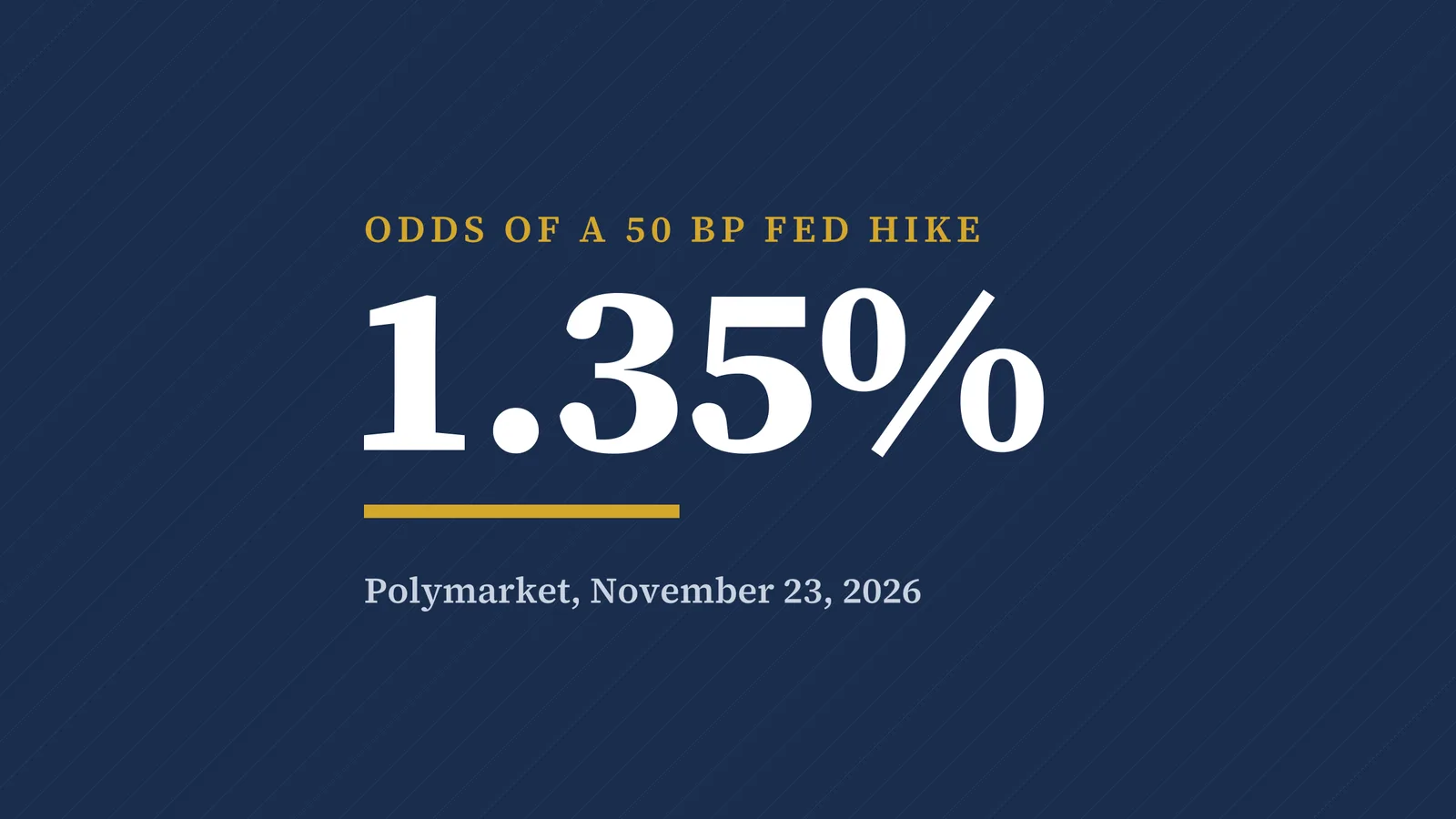
Traders have largely given up on a half-point Federal Reserve rate increase in December after last week's sell-off in stocks. On Polymarket, a prediction market, the price of a 50 basis point (bp) or larger hike at the December 8–9 meeting was 1.35% at about 10:40 UTC on Monday, November 23, 2026, down from about 10% on November 12, according to the market's data. CoinDesk reported that CME Group's FedWatch tool, based on fed funds futures, no longer prices in a 50 bp move.
How the odds moved
A basis point is one hundredth of a percentage point. The Fed's target range for the federal funds rate is 3.75% to 4%, so a 25 bp hike would lift it to 4% to 4.25% and a 50 bp hike to 4.25% to 4.5%. Prediction market prices can be read as rough probabilities set by traders; they are not forecasts by the Fed.
| December outcome | Polymarket, Nov 12 (12:00 UTC) | Polymarket, Nov 23 (10:40 UTC) | Kalshi, Nov 12 | Kalshi, Nov 23 |
|---|---|---|---|---|
| Hike of 50 bp or more | 9.95% | 1.35% | 11% | 2% |
| Hike of 25 bp | 86.5% | 92.5% | not checked | 90% |
| No change | 3.4% | 5.7% | 5% | 7% |
The Polymarket figures come from its price history and its current market prices. The Kalshi figures are the last traded prices: for November 12 from its daily candle ending at 05:00 UTC on November 12, and for November 23 from its market data at about 10:43 UTC. Both venues show the half-point odds rising around November 10, the day of a Waller speech and the October consumer price data, then falling in two steps, around November 16–17 and again between November 20 and 21.
CoinDesk said the FedWatch probability of a 50 bp hike had been 10% about 10 days earlier. It also cited a post on X by The Macro Paper saying markets had seen "a 15% chance" of a 50 bp hike 11 days ago and that the chance of no hike had risen to 12%. We could not open FedWatch and have not checked those figures.
What fed funds futures show
Thirty-day fed funds futures settle on the average effective federal funds rate in their month, so 100 minus the price gives the rate traders expect. The December 2026 contract traded at 95.945 on November 23, an implied average of 4.055%, compared with a close of 95.91, or 4.09%, on November 12, according to Yahoo Finance data.
The effective rate was 3.88% on November 19, according to the New York Fed. In our own calculation, if it stays there until the decision on December 9, the November 23 price implies a rate of about 4.13% for the rest of December, roughly one quarter-point hike. The November 12 price implied about 4.18%, which left room for some chance of a larger move. This is a simplified reading; FedWatch uses its own method.
The rout behind the shift
Stocks fell sharply in the week to Friday, November 20. Yahoo Finance data show the Nasdaq-100 closed at 25,028.98, down 10.4% from 27,943.74 a week earlier, and the Nasdaq Composite down 10.0%. The S&P 500 lost 8.6%, and the Cboe Volatility Index (VIX) rose 86% to 35.89. CoinDesk called the Nasdaq's drop the largest since the March 2020 COVID crash; we have not checked that comparison.
Treasury yields fell. The 2-year yield ended Friday at 4.63%, down from 4.88% on November 13, and the 10-year at 4.92%, down from 5.15%, according to the Treasury. The 3-month bill yield was unchanged at 4.32%. A falling 2-year yield is consistent with traders expecting a lower path for the policy rate.
Bitcoin (BTC) fell to $55,106 on Coinbase early on Saturday, November 21, its lowest price since September 2024, before climbing back above $60,000 later that day.
Why a half-point move had been on the table
Fed Governor Christopher Waller said on November 10 that a 50 bp increase should be considered if core inflation came in around 0.3% or higher, and core consumer prices rose 0.3% in October. He then told CNBC on November 18 that the Fed may need to "shock people" with a half-point hike. The minutes of the October 27–28 meeting showed that a couple of officials thought a hike larger than 25 bp could warrant consideration in December if inflation data were unfavorable.
The Fed raised its target range by a quarter point in September and held it in October. The December meeting comes with new economic projections from officials, according to the Fed's calendar.
Inflation data still to come
The next major inflation release is the Personal Income and Outlays report for October, which includes the personal consumption expenditures (PCE) price index, the inflation measure the Fed targets. The Bureau of Economic Analysis schedules it for Wednesday, November 25, at 08:30 ET (13:30 UTC).
According to CoinDesk, Royal Bank of Canada analysts expect headline and core PCE prices to rise 0.3% in October, lifting the annual rates to 3.8% and 3.3%. The bank wrote that it expects the data to confirm that "inflation is re-accelerating," CoinDesk reported. CoinDesk also reported that JPMorgan expects another hike in March 2027, and that markets put the chance of a further quarter-point hike at the January 26–27 meeting at nearly 60%. Josh Gilbert, an analyst at eToro, told CoinDesk that a softer reading would help cool expectations of an outsized hike.
What it could mean for rate expectations
In our assessment, the move shows how quickly market pricing of the Fed's pace can shift, in this case during a sharp fall in stocks. The pricing still points to a quarter-point increase in December; what has faded is the tail of a larger move, while a small share of bets has shifted toward a pause. These prices reflect traders' positions, not a Fed decision, and they have moved by several percentage points in a single day this month. Points to watch before the December 9 decision are the October PCE data on November 25, comments from Fed officials, and whether the stock market stabilizes.
Sources
- Federal Reserve — Meeting calendars and information (November 18, 2026)
- Federal Reserve Bank of New York — Effective Federal Funds Rate (November 20, 2026)
- US Department of the Treasury — Daily Treasury Par Yield Curve Rates, November 2026 (November 20, 2026)
- US Bureau of Economic Analysis — Release schedule
- CoinDesk — Market rout kills 50 basis points December Fed rate hike bets (November 23, 2026)
- Polymarket — Fed Decision in December? (market prices and price history)
- Kalshi — Fed decision, December 2026 meeting (market prices and daily candles)
- Yahoo Finance — Chart data: 30-day fed funds futures, Nasdaq indexes, S&P 500, VIX
This article was researched and drafted with the help of AI tools, checked against its sources in a separate AI fact-check and edit, and approved for publication by Trading Metrics. Read our AI use policy.
This article is for information only and is not financial advice. Crypto assets and leveraged products are volatile and you can lose money. Do your own research and consider your circumstances before trading.