
Crypto basis trade yields have shrunk to about 3–5% while equity perps pay more, Talos research finds
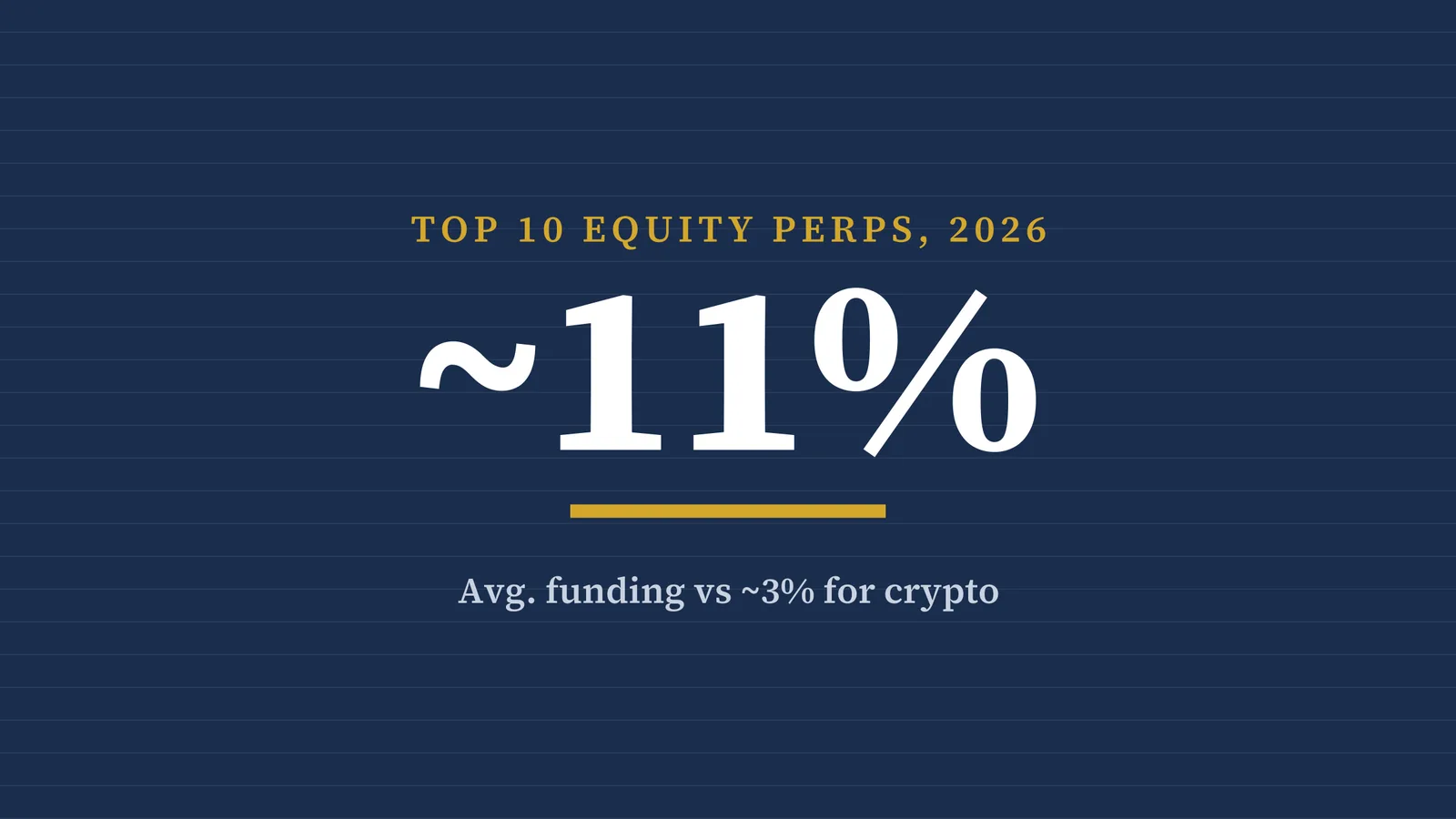
The top 10 equity perpetual futures averaged about 11% annualized funding in 2026, against about 3% for the top crypto contracts, Talos said. The gap has narrowed since August.
Contents
The crypto basis trade, a hedged strategy that collects the premium paid on futures, now earns about 3–5% a year, down from a peak of 20–40% annualized in early 2024, according to research published on November 17 by Talos, which provides trading software to institutional clients. Perpetual futures on individual stocks now pay holders of short positions more: the top 10 equity perps by open interest averaged about 11% annualized funding in 2026, against about 3% for the top 10 crypto perps, Talos said.
At 3–5%, the crypto trade is near or below US Treasury yields, the report says, which leaves little reward for a hedged crypto position.
What the basis trade is
In its classic form, the basis trade, also called "cash and carry," means buying an asset such as Bitcoin (BTC), or a spot Bitcoin exchange-traded fund (ETF), and selling an equal amount of futures on it. The two positions offset each other's price moves, so the trader earns the gap between the futures price and the spot price, the basis, rather than betting on direction. Talos says the trade became popular with the launch of spot Bitcoin ETFs in 2024.
Perpetual futures, or perps, have no expiry date. They stay close to the underlying price through regular funding payments between buyers and sellers of the contract. When funding is positive, holders of long positions pay holders of short positions, so a trader who owns the asset and is short the perp collects those payments. Funding rates are usually quoted as an annualized percentage.
How far the crypto trade has compressed
According to Talos, both the Bitcoin perp funding rate and the 30-day futures basis peaked at 20–40% annualized in early 2024 and have settled at about 3–5% in 2026. Funding briefly turned negative in the second quarter of 2026, the report says. Talos links the compression to institutional participation maturing in 2025 and 2026.
The report points to Ethena's USDe, a dollar-pegged token launched in February 2024 that pairs crypto holdings with offsetting short futures positions, as a way the trade was packaged on-chain. Talos says Ethena's crypto basis allocation peaked at more than $8 billion and that USDe's market capitalization has dropped from a peak of more than $14 billion to $4.5 billion.
Equity perps pay a larger premium
The roughly 11% equity figure was led by memory chip stocks such as SK Hynix, Micron and SanDisk, according to Talos, where demand for leveraged exposure that trades around the clock has been strongest. Excluding SK Hynix, the top equity perps averaged about 8%, which Talos says is still more than double the crypto figure.
The gap was widest and most volatile in the first half of 2026, when equity funding often exceeded 20% while crypto funding stayed near zero, the report says. Since August the two have moved closer, as equity funding cooled and crypto funding recovered.
| Measure (Talos, 2026) | Top 10 equity perps | Top 10 crypto perps |
|---|---|---|
| Average annualized funding | about 11% | about 3% |
| Average funding spread between venues | 23% | 12% |
The spread row shows how much the funding on the same contract differed from one exchange to another. Talos says the wider equity spread means the funding earned can vary significantly depending on the venue. The report does not give the exact start and end dates used for its 2026 averages.
A same-venue test on Binance
Talos also tested the trade on Binance, which offers both tokenized stocks, which it calls bStocks, and perps on the same shares. In that setup a trader holds the tokenized stock and is short the perp on one exchange. Talos says Binance's bStocks have traded more than $13 billion in spot volume over the past three months.
The method counts gross funding as the annualized funding collected on the short perp. Net carry then adjusts for changes in the price gap between the bStock and the perp and for an assumed round-trip trading cost of 20 basis points; financing costs are left out. On that basis, single names including Circle (CRCL), SanDisk (SNDK), Micron (MU) and Nvidia (NVDA) would have earned roughly 7–10% annualized, Talos said, while SK Hynix turned negative when its funding reversed.
The growth behind the shift
Perps tied to real-world assets, such as stocks, indexes and commodities, have grown from almost nothing to about 18% of perp open interest across major venues since October 2025, reaching more than $11 billion in November 2026, according to Talos. Binance holds 39% of that open interest, or $4.3 billion across the top five exchanges, and the on-chain exchange Hyperliquid holds 38%, the report says.
In the US, Talos says the Commodity Futures Trading Commission (CFTC) confirmed on November 3 that perps on individual stocks can trade on regulated exchanges. That approval is being challenged in federal court by a trade group that argues the products fall under the Securities and Exchange Commission's jurisdiction; the CFTC disputes that. Talos says Kalshi has recorded $3 billion in cumulative volume across 58 single stocks since launching equity perps in early November. On weekdays since launch, Kalshi traded about $2.4 billion in single-stock perps against $31 billion on Hyperliquid, about 8% of Hyperliquid's volume, with a peak of 19% on November 16, according to the report.
The risks Talos lists
Talos concludes that the trade "hasn't disappeared, but has broadened into a new asset class." It says the premium reflects structural frictions, fragmented liquidity and demand for leveraged stock exposure around the clock.
The report also names the risks: prices can drift while US stock markets are closed, funding rates can turn quickly, and financing costs can reduce headline yields. Liquidity in tokenized stocks thins out outside US trading hours, it adds. Platforms can also change contract terms around company events: Trade.xyz, which runs stock perps on Hyperliquid, said on November 15 that it would halve the maximum leverage on its Nvidia perpetual to 10x before the chipmaker's quarterly results.
Talos's data comes from its own market data product, Talos CM Market Data Pro, with Kalshi also cited for the Kalshi volume figures. The report carries a disclaimer that it is not investment advice or a recommendation of any strategy.
What it could mean for basis traders
In our assessment, the report describes a shift in where funding premiums are paid rather than the end of the trade. Its own figures show the equity premium narrowing since August, and its 7–10% net carry estimates exclude financing costs, so they are not the same as a return a trader would have earned. The numbers rest on Talos's selection of the top 10 contracts by open interest, on venues it tracks, and on a 2026 period it does not date precisely. Readers comparing crypto and equity perps would also need to weigh the open legal case over US single-stock perps and the differences in rules and trading hours between venues.
Sources
- Talos — Following the Funding: The Shift Towards the Equity Basis Trade (State of the Network, issue 390) (November 17, 2026)
This article was researched and drafted with the help of AI tools, checked against its sources in a separate AI fact-check and edit, and approved for publication by Trading Metrics. Read our AI use policy.
This article is educational and not financial advice. Trading derivatives and leveraged products carries a high risk of losing money quickly, and losses can exceed deposits on some platforms. Only trade with money you can afford to lose.