
Coinbase, Kalshi and four other firms ask to back the CFTC in a lawsuit over stock perpetual futures
A trade group that says Cboe and Citadel Securities are among its members is suing to overturn the CFTC's approval of the products. The SEC has also asked to file a brief.
Contents
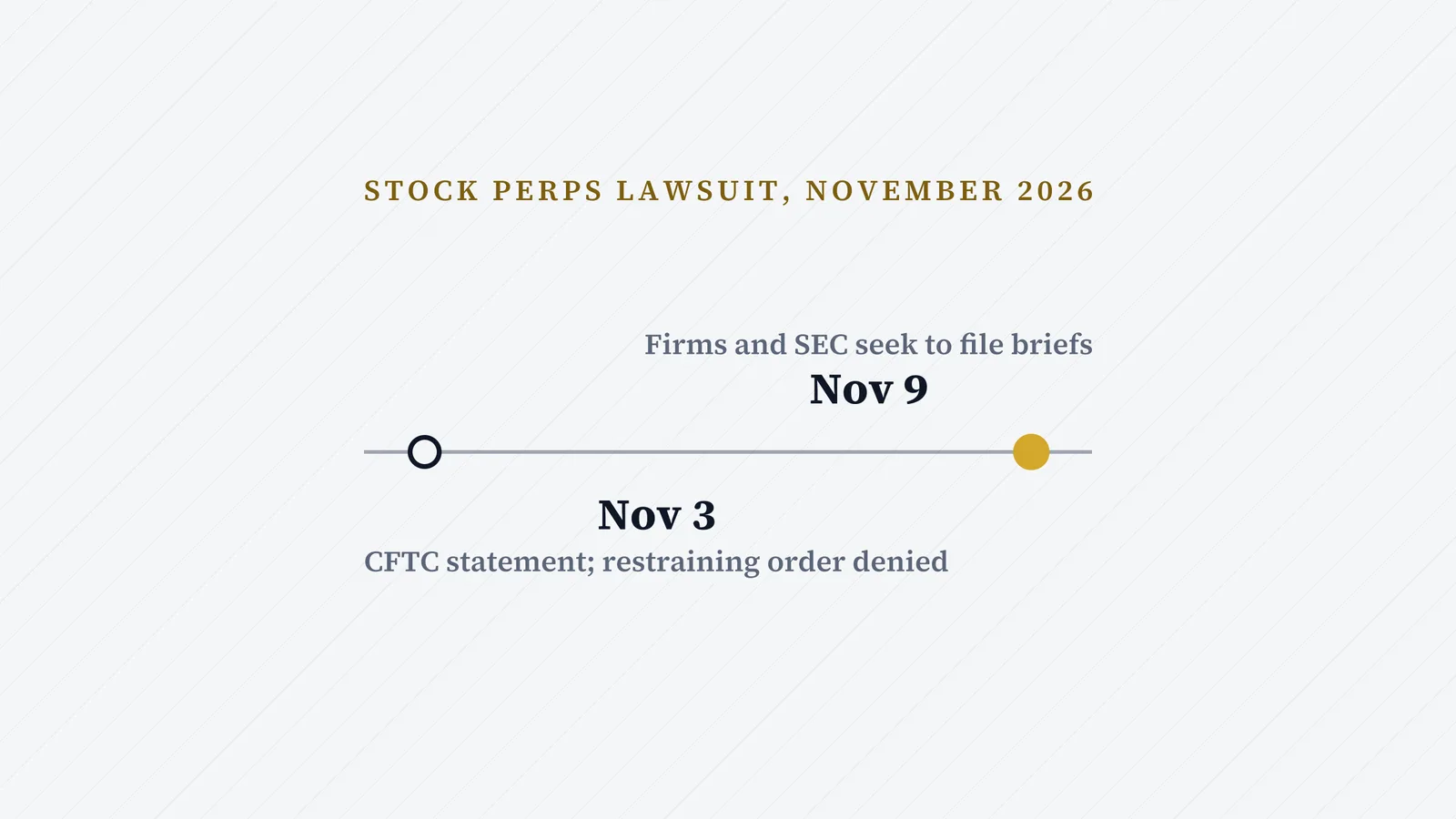
Coinbase, prediction-market operator Kalshi, Kraken parent Payward, DRW Holdings, Jump Trading and Paradigm asked a federal court in New York on November 9 for permission to file a brief supporting the Commodity Futures Trading Commission (CFTC), which is being sued over its approval of perpetual futures on individual US stocks, according to the court docket and The Block. The Securities and Exchange Commission (SEC) filed its own request to submit a brief the same evening, the docket shows.
What the CFTC approved
Perpetual futures, or "perps," are derivatives that track an asset's price but, unlike ordinary futures, have no expiry date. On November 3, CFTC Chairman Michael Selig said in a statement that perpetual futures on individual stocks could begin trading on CFTC-registered exchanges for the first time. He said the contracts had been "deemed approved" as security futures products, subject to oversight by both the CFTC and the SEC.
The applications came from three CFTC-regulated platforms, KalshiEX, Coinbase Derivatives and Bitnomial Exchange, according to the court's November 3 order. The CFTC let the 45-day review period expire, after which the filings were treated as approved, the complaint says.
What the lawsuit claims
The Capital Markets Alliance Association, a nonprofit trade group based in New York, says its members operate equity and options exchanges, handle customer orders and make markets. The group says its members include Cboe Global Markets, Citadel Securities and the Healthy Markets Association, and its filings include declarations from all three; the CFTC argues the group has not shown it is a genuine membership organization.
The group argues that single-stock perps are not security futures, because they involve no future delivery of shares, but security-based swaps, which fall under the SEC's jurisdiction and may be offered to retail investors only on SEC-regulated national securities exchanges. It accuses the CFTC of approving the products "without a word explaining" how that fits the law, and asks the court to set the approvals aside.
The CFTC opposes the request. In a November 6 filing, it argued that the contracts are futures because neither delivery of the underlying asset nor a fixed expiry date is required, that the group lacks standing and has not shown it is a genuine membership organization, that letting the review period lapse was not a "final agency action" a court can review, and that the group's members face no irreparable harm. In a separate letter the same day, it opposed the group's request to add two more declarations to the record, calling them "last-minute."
What the judge found so far
Judge Valerie Caproni, hearing the emergency request on November 3, denied a temporary restraining order because the group had not shown that its members were likely to suffer irreparable harm. But she found the group "likely to succeed on the merits" of its claim that the CFTC exceeded its authority, writing that the contracts "do not appear to satisfy the definition" of a security future and appear instead to meet the definition of a swap.
The case is now before Judge Lorna Schofield, who is considering the group's request for a preliminary injunction and a stay. The group's reply is due November 10 under the November 3 order, which said the assigned judge could change the schedule; a November 4 order said oral argument, and possibly an evidentiary hearing, will be scheduled later.
The firms backing the CFTC
The six firms' request, entered on the docket as filed by Coinbase, includes a proposed brief, according to the docket. The brief itself was not publicly available when we checked. According to The Block, the firms argue in the filing that the SEC was "at the table from the very start" of the process.
What it could mean for traders
The dispute over which agency oversees which product echoes the debate over the CLARITY Act, a stalled market-structure bill that would divide crypto oversight between the two agencies.
For traders, the case bears on whether perpetual contracts on individual stocks can stay available on CFTC-regulated platforms. The group told the court on November 5 that trading "began and has expanded dramatically" after it filed its motion, and the CFTC's November 6 letter also refers to trading having commenced. A preliminary injunction or stay would put the approvals on hold while the case continues; if the request is denied, they stay in place for now. The group argues the products are security-based swaps that may be offered to retail investors only on national securities exchanges under full SEC oversight; the CFTC argues they are security futures, which the two agencies oversee jointly. Judge Caproni's finding was a preliminary assessment of an emergency request, made before the CFTC filed its written opposition, and is not a ruling on the merits.
Sources
- CourtListener (RECAP), US District Court for the Southern District of New York — Capital Markets Alliance Association v. Commodity Futures Trading Commission, No. 1:26-cv-09608 (docket)
- US District Court for the Southern District of New York — Order denying the motion for a temporary restraining order (ECF No. 11, November 3, 2026) (November 3, 2026)
- US District Court for the Southern District of New York — Complaint, Capital Markets Alliance Association v. CFTC (ECF No. 1) (November 3, 2026)
- Commodity Futures Trading Commission — Statement on Equity Perpetual Futures, Chairman Michael S. Selig (November 3, 2026; ECF No. 1-1) (November 3, 2026)
- Commodity Futures Trading Commission (S.D.N.Y. filing) — Letter opposing motion to supplement the record (ECF No. 22, November 6, 2026) (November 6, 2026)
- Commodity Futures Trading Commission (S.D.N.Y. filing) — Memorandum of law in opposition to the motion for a TRO and preliminary injunction (ECF No. 31, November 6, 2026) (November 6, 2026)
- US District Court for the Southern District of New York — Plaintiff's letter motion to supplement the record (ECF No. 17, November 5, 2026) (November 5, 2026)
- The Block — Coinbase, Kalshi and Payward backs CFTC in lawsuit over single-stock perp futures (November 10, 2026)
This article was researched and drafted with the help of AI tools, checked against its sources in a separate AI fact-check and edit, and approved for publication by Trading Metrics. Read our AI use policy.
This article is for information only and is not financial advice. Crypto assets and leveraged products are volatile and you can lose money. Do your own research and consider your circumstances before trading.