
India's Enforcement Directorate searches premises linked to CoinDCX and Delta Exchange India, alleging unauthorized cross-border trades
The agency alleges in a November 6 release that customer orders were filled abroad in breach of foreign exchange law. CoinDCX says it complies with the law; Delta Exchange India says it is not involved in cross-border crypto transfers. No charges are reported.
Contents
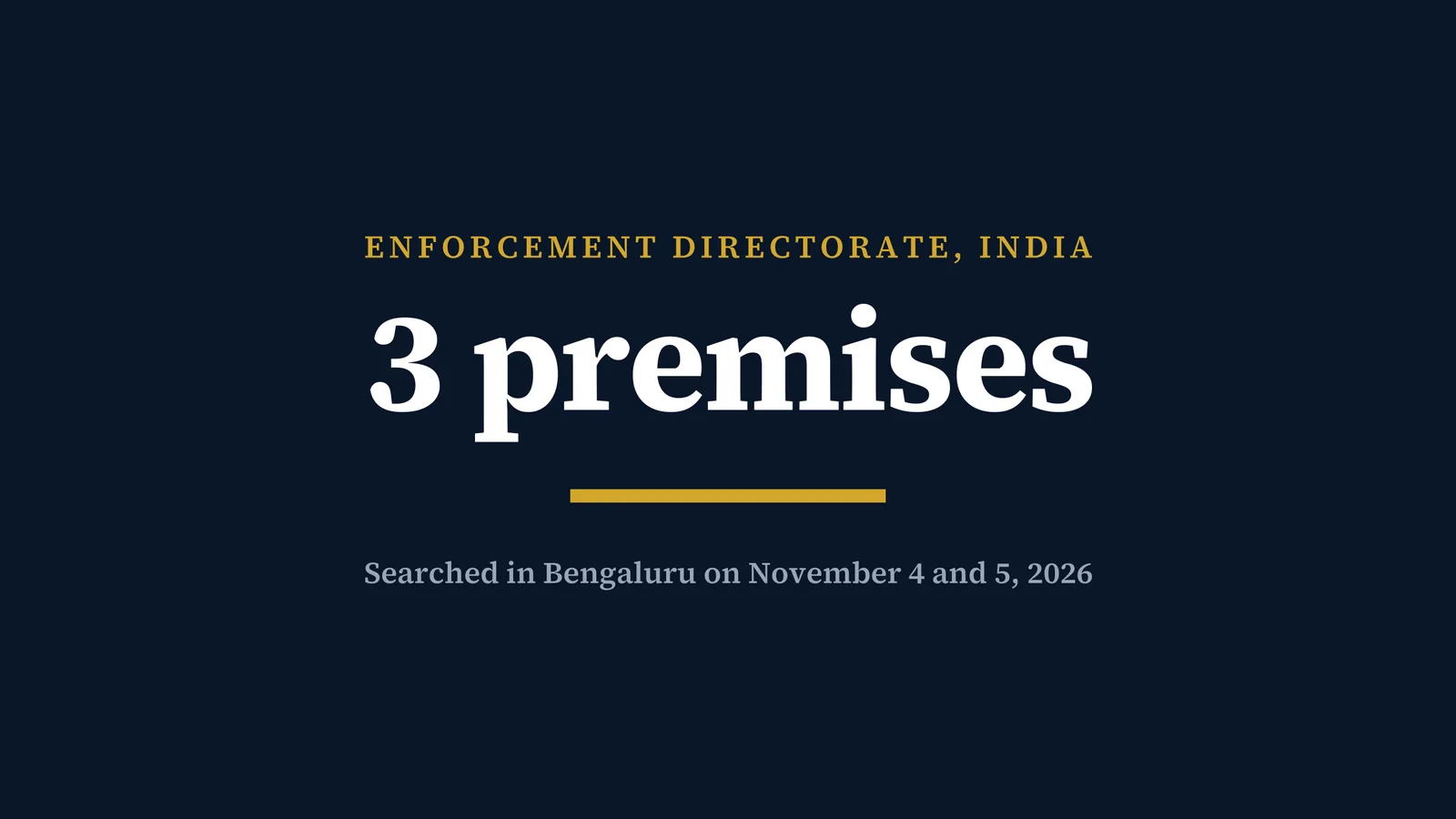
India's Enforcement Directorate (ED) searched three premises in Bengaluru linked to the crypto exchanges CoinDCX and Delta Exchange India on November 4 and 5, 2026, in an investigation under the Foreign Exchange Management Act (FEMA), the agency said in a press release dated November 6. The ED alleges that the two platforms carried out unauthorized cross-border transactions in crypto derivatives and tokenized foreign stocks. Both companies said in statements reported on November 7 that they cooperated with the agency and that trading, deposits, and withdrawals were working normally. CoinDCX said it complies with FEMA, and Delta Exchange India said it is not involved in any cross-border transfer of crypto assets.
The release says the investigation is continuing. It mentions no charges, penalty, or order against either company, and neither do the reports we read in Business Today, The Free Press Journal, and Inc42.
What the ED alleges
The searches were carried out under Section 37 of FEMA by the ED's Bengaluru Zonal Office, after the agency received information alleging large-scale violations by the two companies, the release says.
According to the release, both platforms offered customers spot crypto trading, futures and options on crypto tokens, and trading in tokenized stocks of foreign companies, and advertised tokenized stocks without being authorized to offer them. In its section on CoinDCX, the release gives Apple, Google, and Tesla as examples of the stocks.
The agency's account of how CoinDCX handled orders is as follows:
- Spot trading. Money that customers deposited in rupees was allegedly converted into USDT, a dollar stablecoin, and sent to overseas exchanges to execute orders in certain crypto tokens. The release names Binance, KuCoin, and Gate.io among the venues.
- Futures and options. For each customer order, CoinDCX allegedly took the same position on a foreign platform, and the trade was settled there when the customer closed it. Here the release also names Bybit.
- Tokenized stocks. These trades were allegedly carried out on Hyperliquid, which the release describes as a decentralized crypto trading platform based outside India.
The ED alleges that the spot and derivatives trades went through an account in the name of a Costa Rica-based entity, which the release calls a paper entity, and that the trades were in fact executed directly by CoinDCX through its software interfaces.
The ED put the volume of each of the three kinds of transaction in the thousands of crores of rupees, and alleges that CoinDCX paid hundreds of crores of rupees in transaction fees to foreign platforms in stablecoins such as USDT. One crore is 10 million, so a thousand crore rupees is 10 billion rupees.
For Delta Exchange India, the agency alleges that a large volume of its derivatives and tokenized-stock trades was routed through CoinDCX, which then executed them on overseas platforms, and that Delta Exchange India transferred hundreds of crores of rupees to associated entities abroad. Those transfers are under investigation, the release says. In its section on Delta Exchange India, the release refers to searches at "the two premises belonging to the group."
The release names Binance, KuCoin, Gate.io, Bybit, and Hyperliquid as the venues where the trades were allegedly executed. Neither it nor the three reports describes any allegation by the ED against those platforms themselves.
The ED also said the products offered by both companies appear, on a first assessment, to conflict with the Securities Contracts (Regulation) Act of 1956, the Securities and Exchange Board of India (SEBI) Act of 1992, and the Reserve Bank of India Act of 1934, and that this is being examined further.
The release presents these points as what the agency's searches showed. They are allegations made by an investigating agency: neither the release nor the reports mentions a show-cause notice, a penalty, or a ruling by any court or tribunal.
What the companies say
CoinDCX said in a statement carried by Business Today that ED officials visited its Bengaluru office on November 4 "as part of a routine enquiry" and that it "fully cooperated with the authorities." The company said it is registered with FIU-IND, India's financial intelligence unit, operates in compliance with Indian law including FEMA, and that trading, deposits, and withdrawals on its platform remained fully operational.
Delta Exchange India said, in a statement also carried by Business Today, that it is "operating business as usual with no disruptions," that user funds "remain secure in Indian banks," and that it cooperated fully with officials. In a post on X, the exchange said it is not involved in any cross-border transfer of virtual digital assets, Inc42 reported.
We have not seen a statement from either company later than those reported on November 7.
Other ED actions and tokenized stocks elsewhere
The searches follow other ED actions in 2026 against crypto platforms over cross-border transfers, including searches in June, according to Inc42.
Tokenized stocks and stock-linked derivatives are also in the news in other markets. Kraken's parent expanded its xStocks range of tokenized shares on November 11, adding UK and European stocks; OKX and NYSE owner ICE have set November 23 for a tokenized stock venue in the United States; and a lawsuit over stock perpetual futures is before a US federal court.
What it could mean for traders
Both exchanges said in the statements reported on November 7 that their services were running normally, and nothing in the release or the reports describes a freeze of accounts or funds.
The products the ED is questioning are the ones its release alleges were filled abroad: spot orders in certain crypto tokens, crypto futures and options, and tokenized foreign stocks. If the agency's view prevails, the question for users of Indian platforms is whether those products can continue in their present form, since the allegations concern where and how orders are executed. If it does not, this investigation would leave the products as they are. Neither outcome has been decided, and we do not know how long the investigation will take.
The reference to securities and central bank laws matters because it points beyond the foreign exchange law under which the searches were carried out. Neither the release nor the reports says that the securities regulator or the central bank has taken any step.
What happens next
The release says only that further investigation is in progress. The points to watch are any further statement from the agency, any action by the securities or banking regulators, and any change the two exchanges make to their derivatives or tokenized-stock products.
Sources
- Directorate of Enforcement, Government of India — Press Release 06-11-2026 (searches related to CoinDCX and Delta Exchange under FEMA) (November 6, 2026)
- Business Today — Foreign exchange violations: ED searches offices of CoinDCX, Delta Exchange (November 7, 2026)
- The Free Press Journal — ED Searches CoinDCX, Delta Exchange Over Alleged FEMA Violations In Crypto Trading (November 7, 2026)
- Inc42 — ED Searches CoinDCX & Delta Exchange Over Alleged Illegal Cross-Border Transfers (November 7, 2026)
This article was researched and drafted with the help of AI tools, checked against its sources in a separate AI fact-check and edit, and approved for publication by Trading Metrics. Read our AI use policy.
This article is for information only and is not financial advice. Crypto assets and leveraged products are volatile and you can lose money. Do your own research and consider your circumstances before trading.