
Democrats projected to win Congress; the stalled CLARITY Act must pass this Congress or start over
The CLARITY Act stalled in the Senate in September. If it is not revived before the current Congress ends, the process would start again in January.
Democrats won control of both the House and the Senate in the November 3 midterm elections, according to projections by the Associated Press, NBC News and CBS News. The new Congress takes office in January 2027. The result makes it harder for the crypto industry to revive the market-structure bill it pushed for this year, according to Decrypt's analysis.
What happened
The Associated Press projected Democratic control of the Senate and the House, ending Republican control of both chambers. "Democrats have seized control of both chambers of Congress," CoinDesk reported at 07:31 UTC (02:31 ET) on November 4.
These are media projections, not certified results. The Senate races in Alaska and Mississippi were still uncalled as of November 7, CBS News reported. Final seat counts are not yet confirmed.
What it means for the CLARITY Act
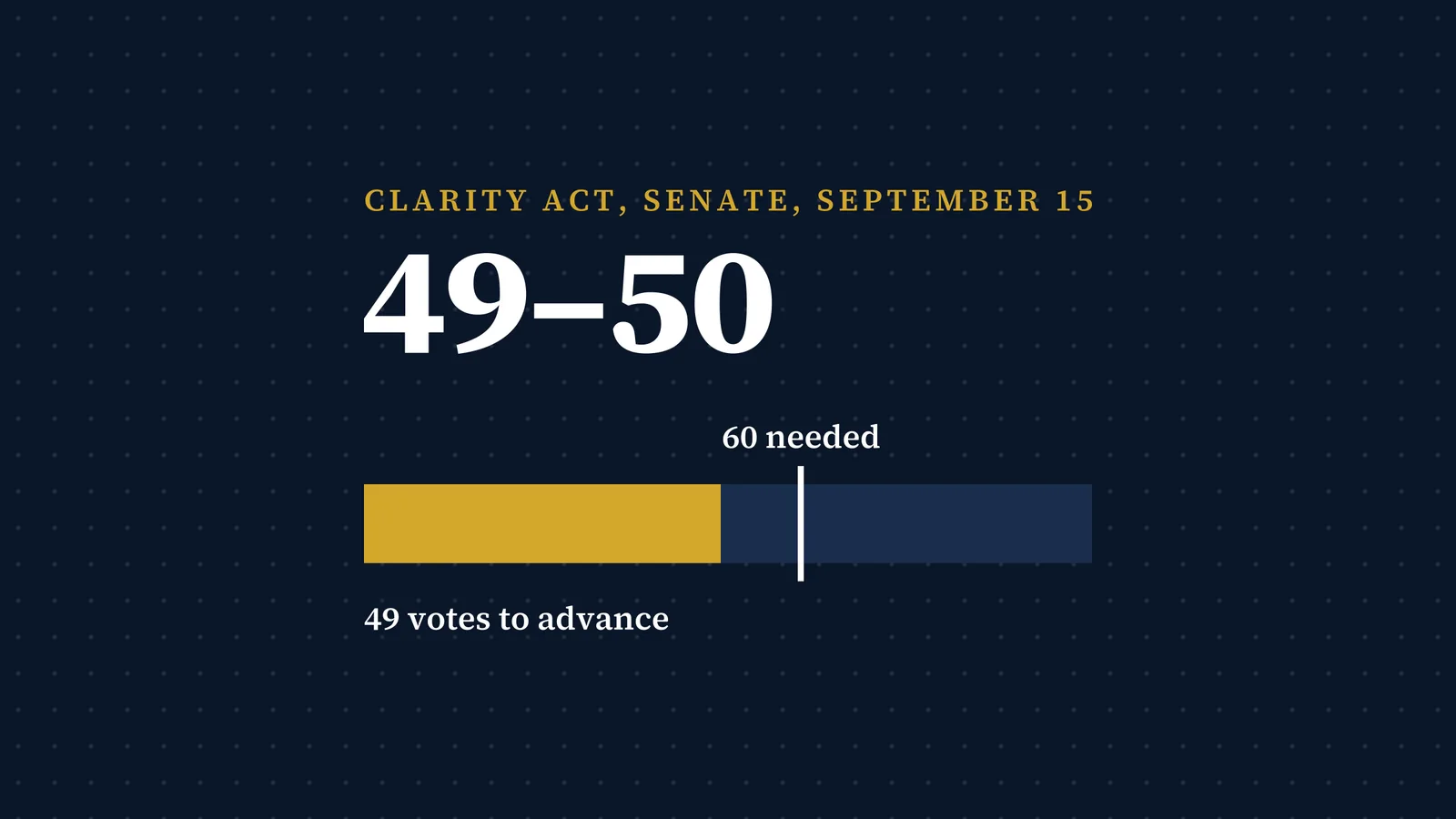
The CLARITY Act is a bill to set federal rules for crypto markets and divide oversight between the US Securities and Exchange Commission (SEC) and the Commodity Futures Trading Commission (CFTC), Decrypt reported. On September 15, a procedural motion to advance it failed 49–50 in the Senate, short of the 60 votes needed, according to Decrypt and American Banker, so the bill never reached a full Senate debate. Negotiations had run into disputes over rules for crypto businesses linked to public officials and over how rewards paid on stablecoins should be treated, Decrypt reported.
Decrypt wrote that Democratic control "makes a quick return to the same legislative deal less likely." If the bill does not pass before the current Congress ends, its supporters would have to start over in the new Congress in January 2027. The crypto industry spent about $176 million on more than 100 races in 2026, Decrypt reported.
How the market reacted
CoinDesk's live coverage put Bitcoin at $77,400 at 05:22 UTC (00:22 ET) on November 4, after a sharp bounce. Bitcoin had briefly hit a six-week low before climbing back above $80,000 on Wednesday, November 4, Decrypt reported, while ether rose about 7% to $2,434.
The rebound did not hold. On CoinGecko hourly data, Bitcoin traded above $80,000 late on November 4 (about $80,670 at 23:00 UTC) and was at about $73,980 at 22:00 UTC on Sunday, November 8; our report on the slide and spot ETF outflows covers the move.
Why it matters
Market-structure legislation would decide how oversight of crypto markets is split between the SEC and the CFTC. In our assessment, without it, rules continue to come from agency guidance and individual rulemaking, which can change with each administration.
What it could mean for traders
Regulatory timelines affect the outlook for US-listed crypto businesses and for products that depend on clear rules. A slower legislative path would not change existing rules, but if the bill is not revived, the period of uncertainty would last longer. The final weeks of the current Congress are the window to watch for any last attempt to pass the bill.
Sources
- PBS NewsHour (Associated Press) — Democrats take control of the Senate after winning key midterm races (November 3, 2026)
- Scripps News Group (Associated Press) — Democrats will win control of US House, retaking control from Republicans
- NBC News — Midterms 2026 highlights: Democrats win control of Congress (November 4, 2026)
- CBS News — 2026 Senate midterm election results as Democrats win control, Schumer vows 'legislative razor wire' against Trump (November 7, 2026)
- CoinDesk — Live updates: Crypto's election gamble falters as Democratic victories usher in a 'blue wave' (November 3, 2026)
- Decrypt via Yahoo Finance — Bitcoin Rebounds After Democratic Midterm Sweep, But Crypto Faces Tougher Fight in Washington (November 4, 2026)
- Decrypt — Clarity Act Stalls in Senate as Crypto Bill Fails to Clear Key Vote (September 15, 2026)
- American Banker — Crypto market structure bill fails in Senate vote 49-50 (September 15, 2026)
- CoinGecko — Bitcoin price (USD), hourly data
This article was researched and drafted with the help of AI tools, checked against its sources in a separate AI fact-check and edit, and approved for publication by Trading Metrics. Read our AI use policy.
This article is for information only and is not financial advice. Crypto assets and leveraged products are volatile and you can lose money. Do your own research and consider your circumstances before trading.