
Thailand's SEC proposes a 5 million baht daily cap on stablecoin transfers and a ban on sending to other people's wallets
The draft rules apply to transfers through licensed crypto firms. Public comments are open until November 26.
Contents
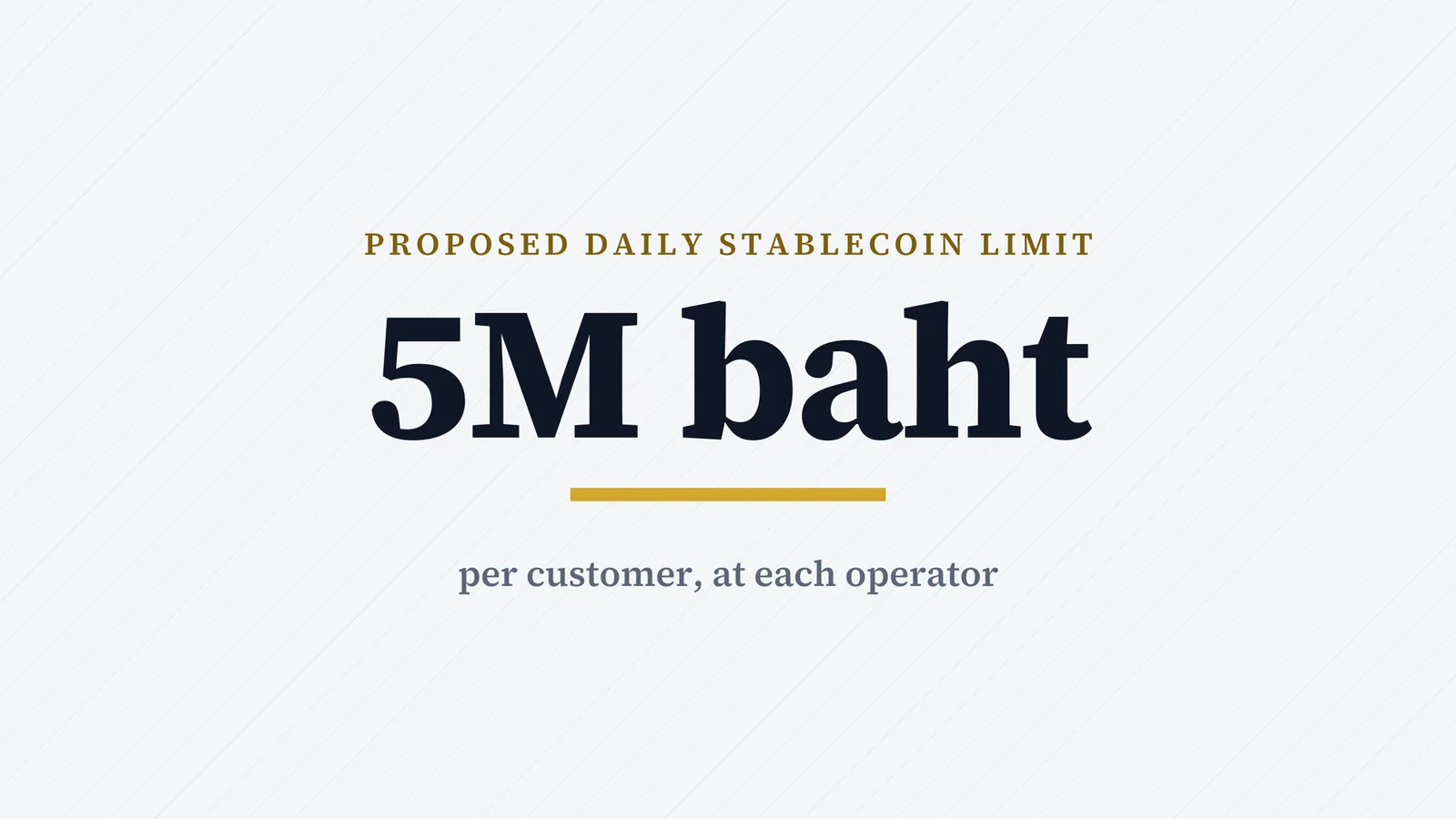
Thailand's Securities and Exchange Commission (SEC) proposed on Thursday, November 12, 2026, to cap stablecoin transfers through licensed crypto firms at 5 million baht per customer per day at each firm. The draft notification would also ban transfers of stablecoins to or from wallets that belong to someone else. Public comments close on November 26.
What the draft says about stablecoin transfers
A stablecoin is a crypto token designed to hold a fixed value, usually one US dollar. The draft covers transfers that pass through what the SEC calls digital asset business operators: licensed firms such as exchanges, brokers and dealers.
Under the draft, the wallet a customer sends stablecoins from, and the wallet a customer withdraws them to, must be verified as belonging to that same customer. The SEC's release says: "Transfers of stablecoins from or to an account or wallet belonging to another person are prohibited."
Operators would have to apply the Travel Rule, a standard that requires firms to pass on information about the sender and the receiver of a transfer. In the United States, FinCEN and the Federal Reserve said on November 6 that they are withdrawing a 2020 proposal to lower the US travel rule threshold from $3,000 to $250 for transfers that start or end outside the US. Thai operators would also have to screen customers and use blockchain analytics tools to check for links to high-risk wallets.
The amount a customer moves "must be commensurate with the customer's source of income and financial position," the SEC said. On top of that sits the daily cap of 5 million baht per customer with each operator, counted separately for inbound and outbound transfers.
The rules apply to licensed platforms. They do not cover transfers made directly between private wallets with no licensed firm involved, The Block noted. The outlet put the 5 million baht cap at about $148,000.
Who would be exempt from the cap
The SEC lists several exemptions from the 5 million baht limit:
- transfers between a customer's accounts at two SEC-supervised operators, if both follow the Travel Rule;
- operators moving stablecoins on their own accounts for business purposes;
- businesses supervised by the Bank of Thailand that have its approval to use stablecoins;
- market makers for stablecoin and baht trading pairs;
- payments and refunds for digital token offerings approved by the SEC.
Other changes in the draft
The proposal goes beyond transfers. Exchanges would have to publish the names of their market makers and the assets they provide liquidity for. Brokers could not use outside liquidity providers for stablecoin and baht pairs.
Off-platform trades, deals arranged by a broker or dealer away from the exchange's order book, would need a minimum size of 3 million baht, and the firm would have to publish its prices. Brokers could not arrange off-platform trades between customers.
Why it matters
The SEC said the aim is to stop digital assets being used for "money laundering, cybercrime, or circumvention of regulations governing international money transfers." It held a hearing on the principles in September and said it took those comments into account in the draft.
Other regulators are working on stablecoin rules as well. On November 11 the Financial Stability Board urged Türkiye to set stablecoin rules. Thailand's draft is more specific: it would limit how much a customer can move in a day through a licensed firm. Russia chose a limit of a different kind: from November 17, non-qualified investors there can buy Bitcoin, ether, and USDT up to 300,000 rubles a year through a single intermediary, the Bank of Russia said on November 6.
What it could mean for traders
Nothing changes yet, and the SEC's announcement gives no date for the rules to take effect. The SEC is taking comments on its website, on Thailand's Legal Hub and by email until November 26, and the final rules may differ from the draft.
If the draft is adopted as written, users of Thai platforms would not be able to send stablecoins straight from an exchange to another person, or receive them from one. In our assessment, people who use stablecoins for payments to others would be affected more than those who only trade, because moving funds between a customer's own accounts at licensed Thai firms is exempt from the cap.
Sources
- Securities and Exchange Commission, Thailand — SEC seeks public comments on draft notification governing stablecoin transactions conducted through digital asset business operators (No. 253/2026) (November 12, 2026)
- The Block — Thailand seeks $148,000 daily cap on certain stablecoin transfers to curb money laundering (November 13, 2026)
This article was researched and drafted with the help of AI tools, checked against its sources in a separate AI fact-check and edit, and approved for publication by Trading Metrics. Read our AI use policy.
This article is for information only and is not financial advice. Crypto assets and leveraged products are volatile and you can lose money. Do your own research and consider your circumstances before trading.