
Nvidia's revenue rises 103% to $115.8 billion in its first results since Jensen Huang's exit
Sales beat the company's own forecast of $108 billion and the analyst consensus, and Nvidia guided to $130 billion for a fourth quarter that has an extra week. It again assumes no data center compute revenue from China.
Contents
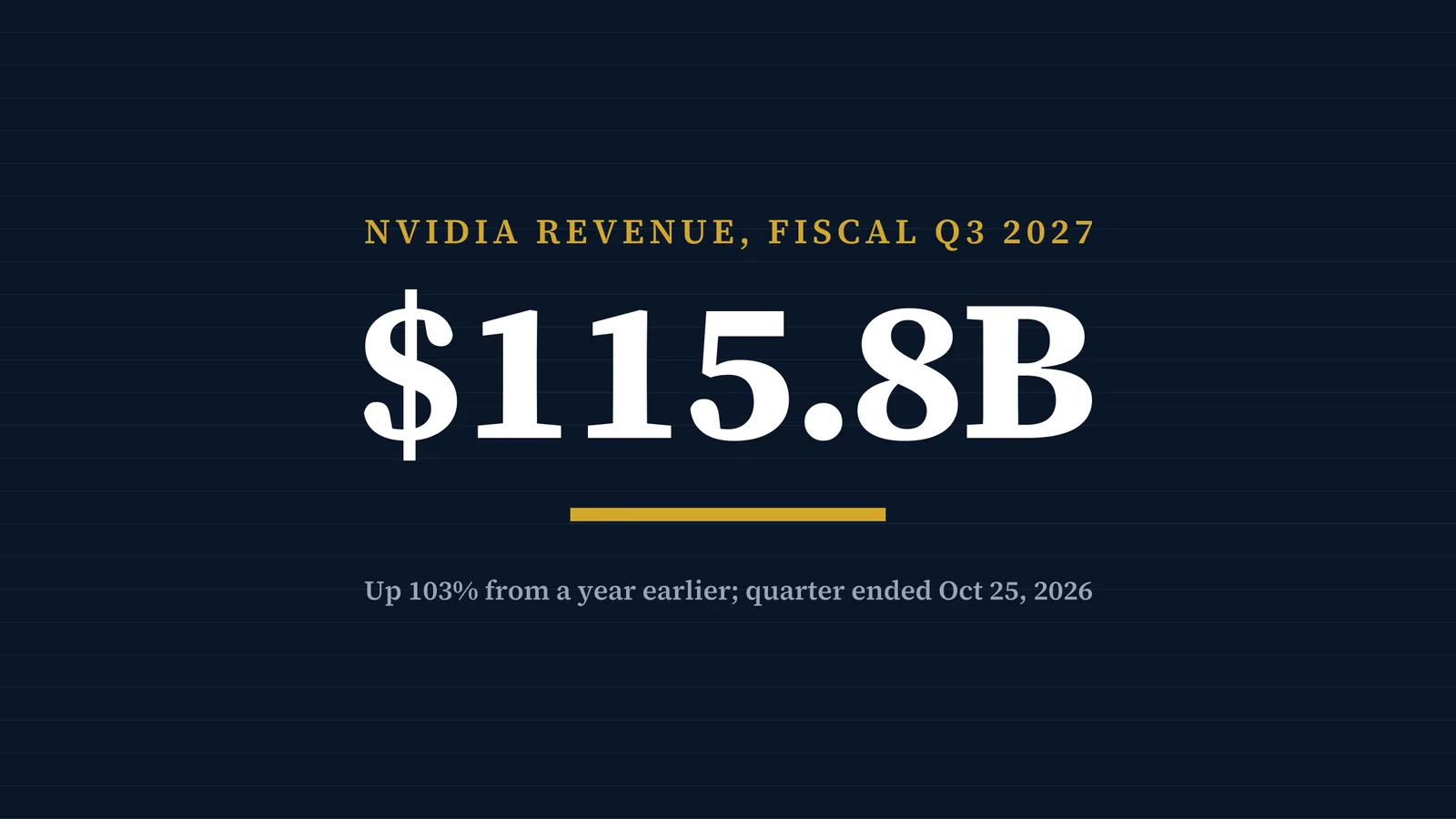
Nvidia reported revenue of $115.8 billion for its fiscal third quarter, which ended on October 25, 2026, up 103% from a year earlier and 20% from the previous quarter, according to the company's press release issued after the US market close on Tuesday, November 17. The figure is above the $108.0 billion, plus or minus 2%, that Nvidia had forecast in August. These are the company's first results since Jensen Huang resigned as chief executive on November 11.
Results against the forecasts
Nvidia published the release at about 21:20 UTC and attached it, together with commentary by interim CEO and Chief Financial Officer Colette Kress, to a Form 8-K filed with the US Securities and Exchange Commission (SEC).
| Measure | Reported | Nvidia's August forecast | Analyst consensus |
|---|---|---|---|
| Revenue | $115.8bn | $108.0bn ±2% | $109.3bn |
| Data center revenue | $107.6bn | not given | $101.8bn |
| Gross margin, GAAP / non-GAAP | 74.8% / 74.9% | 74.0% ±0.5 point | not available |
The forecast comes from Nvidia's second-quarter release. The consensus is the Visible Alpha estimate published by S&P Global Market Intelligence on November 12. By our calculation, revenue came in about $5.7 billion above the top of Nvidia's own range and about 6% above the consensus, and data center revenue about 5.7% above its consensus.
GAAP net income was $65.3 billion, up 105% from a year earlier, and non-GAAP net income was $64.9 billion. GAAP earnings per diluted share were $2.70, against $1.30 a year earlier. Non-GAAP earnings, which no longer exclude stock-based compensation since the start of this fiscal year, were $2.68 a share. The GAAP figure includes $1.8 billion of net gains on equity investments, according to the CFO commentary.
Where the revenue came from
Of the $107.6 billion in data center revenue, $60.1 billion came from what Nvidia calls hyperscale customers and $47.5 billion from AI clouds, industrial and enterprise customers, the commentary shows. Kress attributed the growth to the start of the company's Rubin chip generation, which she called its fastest architecture ramp ever, standalone Vera processors and continued sales of Blackwell Ultra. Edge computing, Nvidia's other market platform, brought in $8.2 billion, up 42%.
Gross margins rose from a year earlier on a better product mix and slipped slightly from the previous quarter, which the commentary linked to the initial Rubin ramp. Free cash flow was $43.8 billion.
On China, the commentary says Nvidia shipped $2.4 billion of Hopper data center products there during the quarter. The August forecast had assumed no data center compute revenue from China.
The outlook for the fourth quarter
Nvidia expects revenue of $130.0 billion, plus or minus 3%, for the quarter that ends in January, which includes an additional week. At the midpoint, that is about 12% above third-quarter revenue, by our calculation. The company again said it is not assuming any data center compute revenue from China. It expects GAAP and non-GAAP gross margins of 71.0% to 72.0%, below the 74.8% and 74.9% just reported.
The commentary also shows supply commitments of $390 billion, up from $279 billion a quarter earlier, mainly for multi-year memory purchases. Nvidia's maximum exposure under guarantees is $118.0 billion, of which $105.0 billion is credit support for a data center campus in Ohio that is to host Nvidia infrastructure leased to OpenAI. The company said it has made no payments under its guarantees so far.
Buybacks and the dividend
Nvidia returned $28.1 billion to shareholders in the quarter through share repurchases and cash dividends, compared with about $26.0 billion in the previous quarter. The board added $150 billion to the buyback authorization in September, leaving about $227.3 billion available at the end of the quarter, which the commentary says the company plans to use through fiscal 2028. The next quarterly dividend of $0.25 a share is payable on December 23 to holders of record on December 2.
Share reaction and the leadership backdrop
Nvidia closed the regular session at $155.46, down 0.4% from Monday's close, according to Yahoo Finance data. After the release, the 5-minute bars closed between $155.74 and $160.97, and the stock stood at $158.20 at 22:20 UTC, about 1.8% above the close. Extended-hours trading is usually thinner than the regular session, and early moves can reverse.
The release does not mention Huang. The CFO commentary refers to the leadership transition, the search for a new chief executive and an investigation by an independent board committee only in its list of forward-looking statements. Earlier on Tuesday, Huang said he would be honored to return if the board asked him. The same day, the board created a standing committee to oversee national security policies, export control compliance and global trade risk, chaired by director Suzanne Nora Johnson. Nvidia held a call with analysts at 22:00 UTC; this article does not cover it.
What it could mean for Nvidia shareholders
In our assessment, the report shows the business still growing through the leadership change: sales in the quarter came in above both the company's forecast and the analyst consensus, and the company's outlook calls for higher revenue next quarter. It does not settle who will lead Nvidia permanently or what the board's investigation will find, and the filing gives no timetable for either. The lower margin outlook, the larger supply and guarantee commitments and the China shipments are the details the results leave open to scrutiny. On Monday, Asian chip stocks fell ahead of the report; Wednesday's sessions in Tokyo, Seoul and Taipei will be the first in which they can trade on the actual figures.
Sources
- Nvidia — NVIDIA Announces Financial Results for Third Quarter Fiscal 2027 (November 17, 2026)
- SEC EDGAR — Nvidia, CFO Commentary on Third Quarter Fiscal 2027 Results (Exhibit 99.2) (November 17, 2026)
- SEC EDGAR — Nvidia, Form 8-K of November 17, 2026 (November 17, 2026)
- Nvidia — NVIDIA Board of Directors Establishes National Security and Export Control Oversight Committee (November 17, 2026)
- Nvidia — NVIDIA Announces Financial Results for Second Quarter Fiscal 2027 (August 2026)
- S&P Global Market Intelligence — Nvidia earnings preview: Q3 2027 (November 12, 2026)
- Yahoo Finance — NVDA intraday price data, 5-minute bars with extended hours (November 17, 2026)
This article was researched and drafted with the help of AI tools, checked against its sources in a separate AI fact-check and edit, and approved for publication by Trading Metrics. Read our AI use policy.
This article is educational and not financial advice. Trading derivatives and leveraged products carries a high risk of losing money quickly, and losses can exceed deposits on some platforms. Only trade with money you can afford to lose.