
Bitcoin falls to $57,200 as stocks slide after PCE data and a US tariff plan, then climbs back above $60,000
Coinbase data show Bitcoin's low came in the same five minutes as the lows of the Nasdaq and Nvidia, about 15 minutes after the US open. All three recovered most of the drop by the US close, and Bitcoin's low stayed above Saturday's $55,106.
Contents
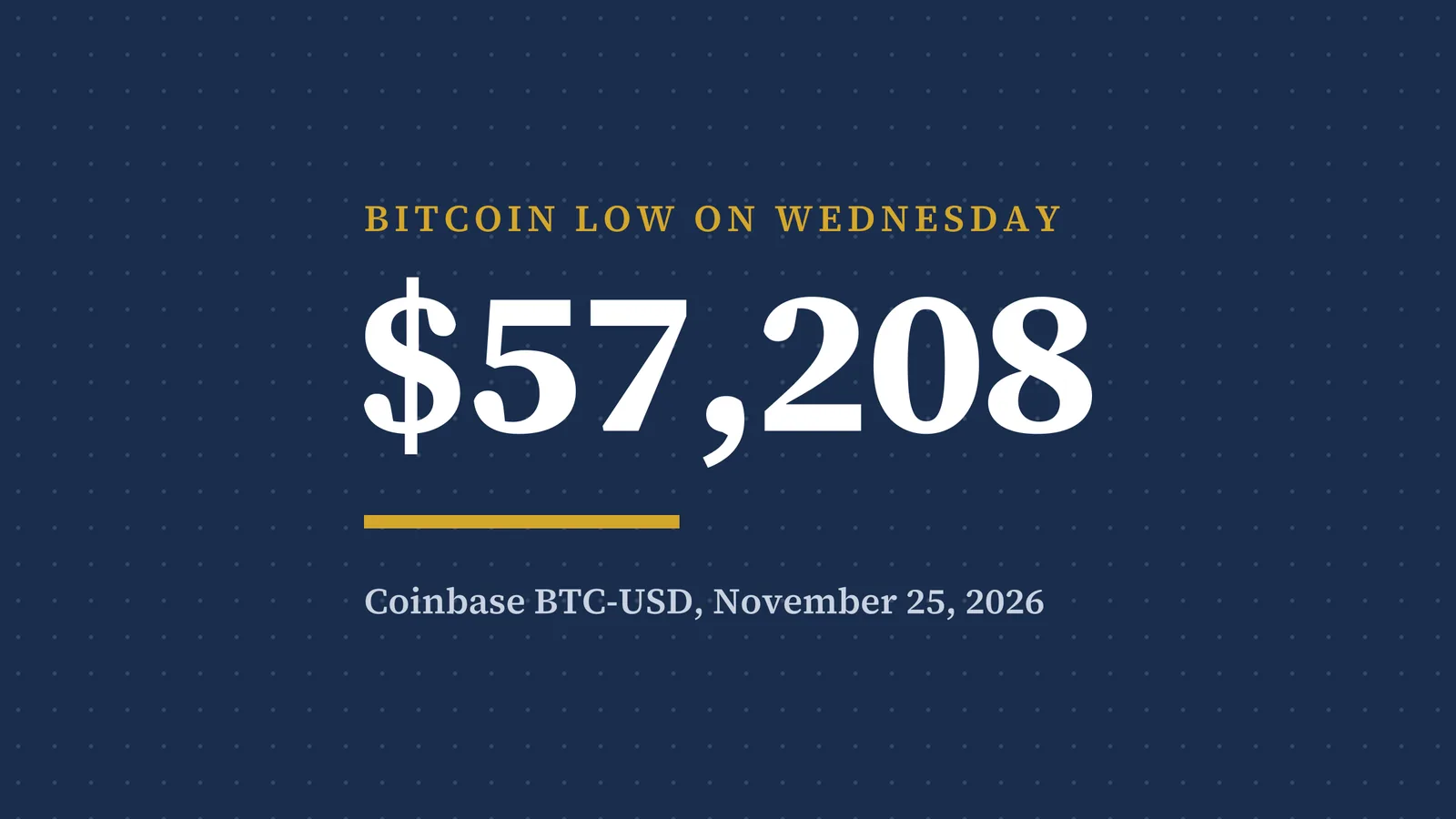
Bitcoin (BTC) fell as low as $57,208.17 on Wednesday, November 25, 2026, as US stocks opened sharply lower after a hotter-than-expected inflation report and a new US tariff proposal. Coinbase's public market data show the low came in the five minutes from 14:45 UTC, 4.2% below Bitcoin's midnight UTC price of $59,741.39. By the evening it had recovered, trading at $60,388.09 at 21:28 UTC.
A drop at the open, a recovery by the evening
Bitcoin had already slipped below $60,000 again on Tuesday and traded between about $58,400 and $59,750 through Wednesday morning, Coinbase data show. It fell from $58,766 to $58,165 in the five minutes from 13:30 UTC, when the inflation report came out, and dropped further after the US stock market opened at 14:30 UTC.
| Coinbase BTC-USD (UTC) | Price |
|---|---|
| Midnight open | $59,741.39 |
| Day's low, window from 14:45 | $57,208.17 |
| First trade back above $60,000, window from 18:15 | $60,024.10 |
| Last trade at 21:28 | $60,388.09 |
From the low to its later high of $60,428.33 in the window from 21:25 UTC, Bitcoin rose 5.6%. At 21:28 UTC it was 1.1% above its midnight price. Wednesday's low was well above its November 21 low of $55,106, its lowest price since September 2024, after which it climbed back above $60,000 the same day.
Stocks hit their lows at the same time
The Nasdaq Composite opened 3.3% below Tuesday's close and fell as low as 22,632.40, down 4.6%, according to Yahoo Finance data. Its lowest five-minute window began at 14:45 UTC, the same as Bitcoin's. It closed at 23,585.80, down 0.6% on the day. The S&P 500 fell as much as 3.2% and closed 0.3% lower at 7,182.78.
Nvidia fell as much as 9.1% to $141.17 and closed at $149.30, down 3.9%, Yahoo Finance data show.
Crypto positions worth about $512 million were liquidated over 24 hours, most of them bets on higher prices, Cointelegraph reported, citing CoinGlass data. Cointelegraph tied the move to the inflation data and the tariff news; The Block tied it to the inflation data and the stock selloff. Neither outlet gave a reason for the afternoon recovery, and we did not find one in the sources we read.
The inflation report and the tariff proposal
The Bureau of Economic Analysis said at 08:30 ET (13:30 UTC) that the personal consumption expenditures (PCE) price index, the inflation measure the Federal Reserve targets, rose 3.8% in the year to October, and 3.3% excluding food and energy. Cointelegraph said the core figure was above expectations of 3.2%. The Block reported that CME FedWatch still showed markets pricing a quarter-point Fed hike on December 9.
On the same day, the Office of the US Trade Representative said that Trade Representative Jamieson Greer had found that policies of 14 economies, including China, the European Union, Japan and India, relating to "structural excess capacity" in manufacturing are unreasonable and burden or restrict US commerce. It proposed new tariffs under Section 301 of the Trade Act of 1974, with rates, mostly stated as maximums, from 15% to 35% depending on the economy, plus a separate rate of up to 10% on some Chinese goods. These are proposals: written comments are due by January 5, 2027, and hearings begin on January 25, 2027.
Greer told CNBC on Wednesday morning that the rates were "not really additive" and would "top up a few percentage points" once they net out. He said none would likely take effect earlier than "a couple months from now." China's foreign ministry said the "so-called 'overcapacity' does not really exist," according to Reuters, as cited by CNBC.
Ether and Hyperliquid
In a report published at 11:57 UTC, CoinDesk said ether (ETH) and DeFi tokens were falling about twice as far as Bitcoin since midnight UTC. By the afternoon low the gap had closed on Coinbase: ether fell from $1,677.64 at midnight to a low of $1,606.35 around 14:45 UTC, down 4.2%. It traded at $1,691.04 at 21:28 UTC.
Hyperliquid's HYPE token fell 8% to near a three-month low of $57, The Block reported. CoinGecko data show a 24-hour low of $56.16 and a price of $61.96 at 21:27 UTC, up 3.5% over 24 hours.
James Butterfill, head of research at CoinShares, said on The Block's podcast that he thinks the market is "really close to the tail end of the bear market," The Block reported.
What it could mean for Bitcoin traders
In our assessment, Wednesday showed again how closely Bitcoin has traded with US tech stocks this month: its low and its recovery lined up with the Nasdaq and Nvidia almost to the minute. The inflation report came out an hour before the US open, and the selling eased within about 15 minutes of the open. A low that held above Saturday's level is a fact about where the price has been, not a signal of where it goes next. Points to watch are the Fed's December 9 decision, how trading partners respond to the tariff proposals before the January deadlines, and whether Bitcoin's moves keep tracking the Nasdaq.
Sources
- Coinbase Exchange — BTC-USD and ETH-USD candles and ticker (public market data API)
- US Bureau of Economic Analysis — Personal Income and Outlays, October 2026 (November 25, 2026)
- Office of the US Trade Representative — USTR Makes Determinations and Proposes Actions in 14 Section 301 Investigations (November 25, 2026)
- CNBC — U.S. unveils new Section 301 tariffs targeting China, EU and others (November 25, 2026)
- Cointelegraph — Bitcoin falls toward $57K amid US tariff fears, hot PCE data as Nasdaq drops 4% (November 25, 2026)
- The Block — Bitcoin falls below $58,000 as CoinShares' Butterfill sees 'tail end of the bear market' (November 25, 2026)
- CoinDesk — Ether, DeFi fall twice as hard as bitcoin as equities selloff resumes (November 25, 2026)
- Yahoo Finance — Chart data for the Nasdaq Composite, the S&P 500 and Nvidia
- CoinGecko — Hyperliquid (HYPE) price data (public API)
This article was researched and drafted with the help of AI tools, checked against its sources in a separate AI fact-check and edit, and approved for publication by Trading Metrics. Read our AI use policy.
This article is for information only and is not financial advice. Crypto assets and leveraged products are volatile and you can lose money. Do your own research and consider your circumstances before trading.