
Bitcoin mining difficulty falls 9.13%, the largest cut since June
The adjustment at block 975,744 lowered difficulty from about 148.4 trillion to 134.8 trillion, according to blockchain data. An early estimate points to another cut at the next adjustment, about two weeks away.
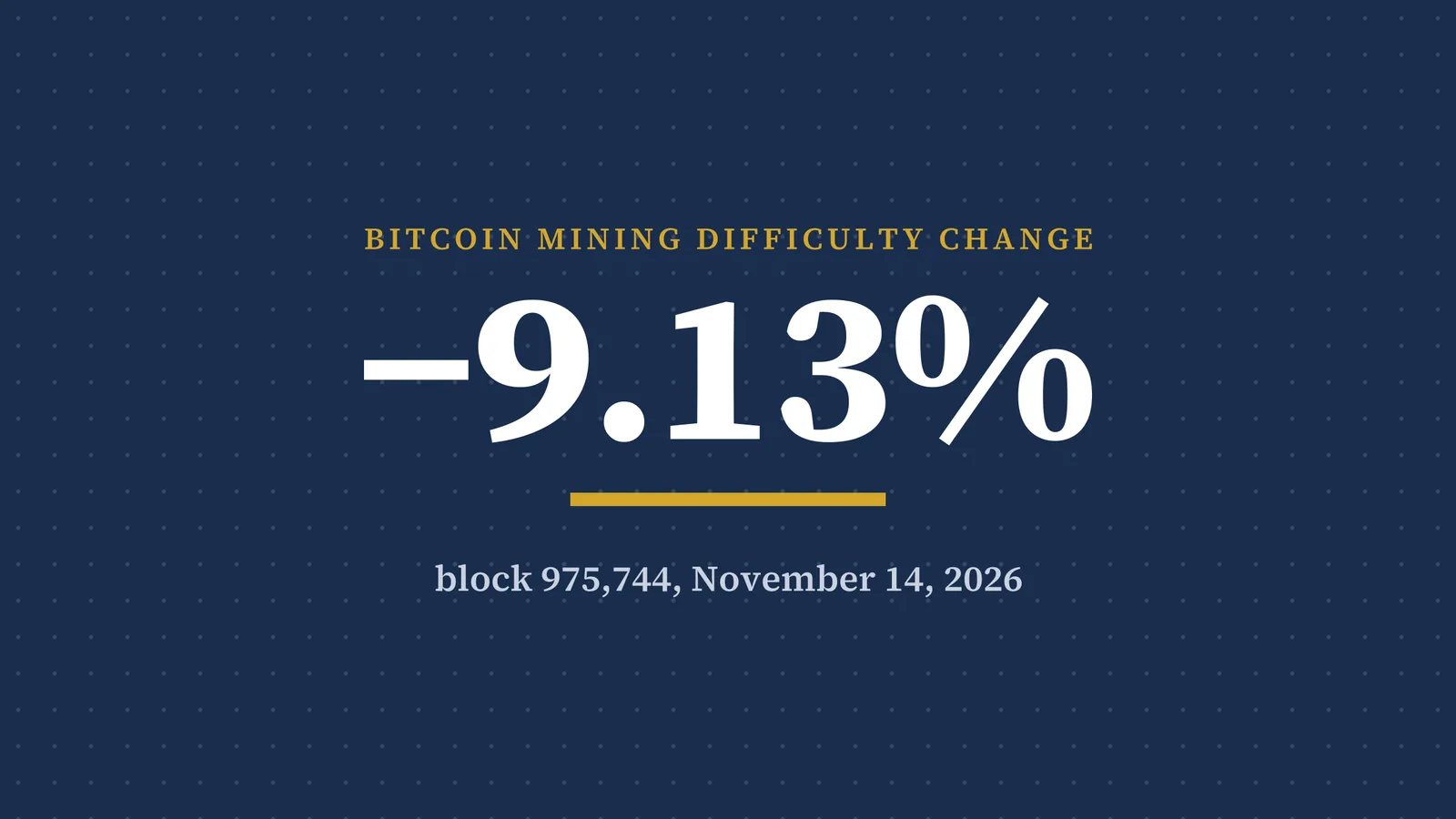
The difficulty of mining Bitcoin (BTC) fell 9.13% at block 975,744, timestamped 05:02 UTC on Saturday, November 14, according to block data from mempool.space. It was the largest downward adjustment since June 14, when difficulty fell by about 10.1%.
What the difficulty adjustment is
Bitcoin's software resets the mining difficulty every 2,016 blocks, roughly every two weeks, so that new blocks keep arriving about every 10 minutes on average. If blocks came faster than that over the last period, difficulty rises; if they came more slowly, it falls. A lower difficulty means each unit of computing power has a better chance of finding the next block and earning its reward.
A 9.13% cut therefore means blocks arrived more slowly than the 10-minute target: the last 2,016 blocks took about 15.4 days, an average of about 11 minutes per block, by our calculation from mempool.space data. Blocks arrive more slowly when less computing power, known as hash rate, is working on the network.
How it compares
| Adjustment | Block | Change |
|---|---|---|
| November 14, 2026 | 975,744 | −9.13% |
| October 29, 2026 | 973,728 | +5.54% |
| October 16, 2026 | 971,712 | +5.92% |
| June 14, 2026 | 953,568 | −10.09% |
Source: mempool.space, our rounding.
The adjustment lowered difficulty from about 148.36 trillion to about 134.82 trillion. That leaves it about 13.6% below its highest level, 155.97 trillion, set at block 921,312 on October 29, 2025, by our calculation from mempool.space data.
Every adjustment between June 14 and this one was either a smaller cut or an increase, according to the mempool.space adjustment history.
What comes next
The next adjustment is due at block 977,760. As of 10:20 UTC on November 14, mempool.space estimated a further fall of about 6.2%, based on the first blocks after the reset. The estimate will change as more blocks are mined.
The block data shows that blocks came more slowly, not why. Separately, Bitcoin's price fell below $70,000 on November 13, which lowers the dollar value of each block reward. We have not seen a source that links the price fall to the slower blocks.
What it could mean for traders
For mining companies, a lower difficulty partly offsets a lower Bitcoin price, because each machine is expected to earn more BTC than before. Listed miners such as Canaan and MARA report production and costs in their own filings, which are the place to see the effect on their results. The adjustment itself does not change Bitcoin's supply schedule.
Sources
- mempool.space (Bitcoin blockchain data) — Block 975,744 (November 14, 2026)
- mempool.space — Difficulty adjustments
This article was researched and drafted with the help of AI tools, checked against its sources in a separate AI fact-check and edit, and approved for publication by Trading Metrics. Read our AI use policy.
This article is for information only and is not financial advice. Crypto assets and leveraged products are volatile and you can lose money. Do your own research and consider your circumstances before trading.