
Lagarde to leave the ECB in February 2027, nearly nine months before her term ends
The ECB president said she wants the freedom to speak on matters beyond monetary policy. Two candidates to succeed her were put forward by the November 6 deadline.
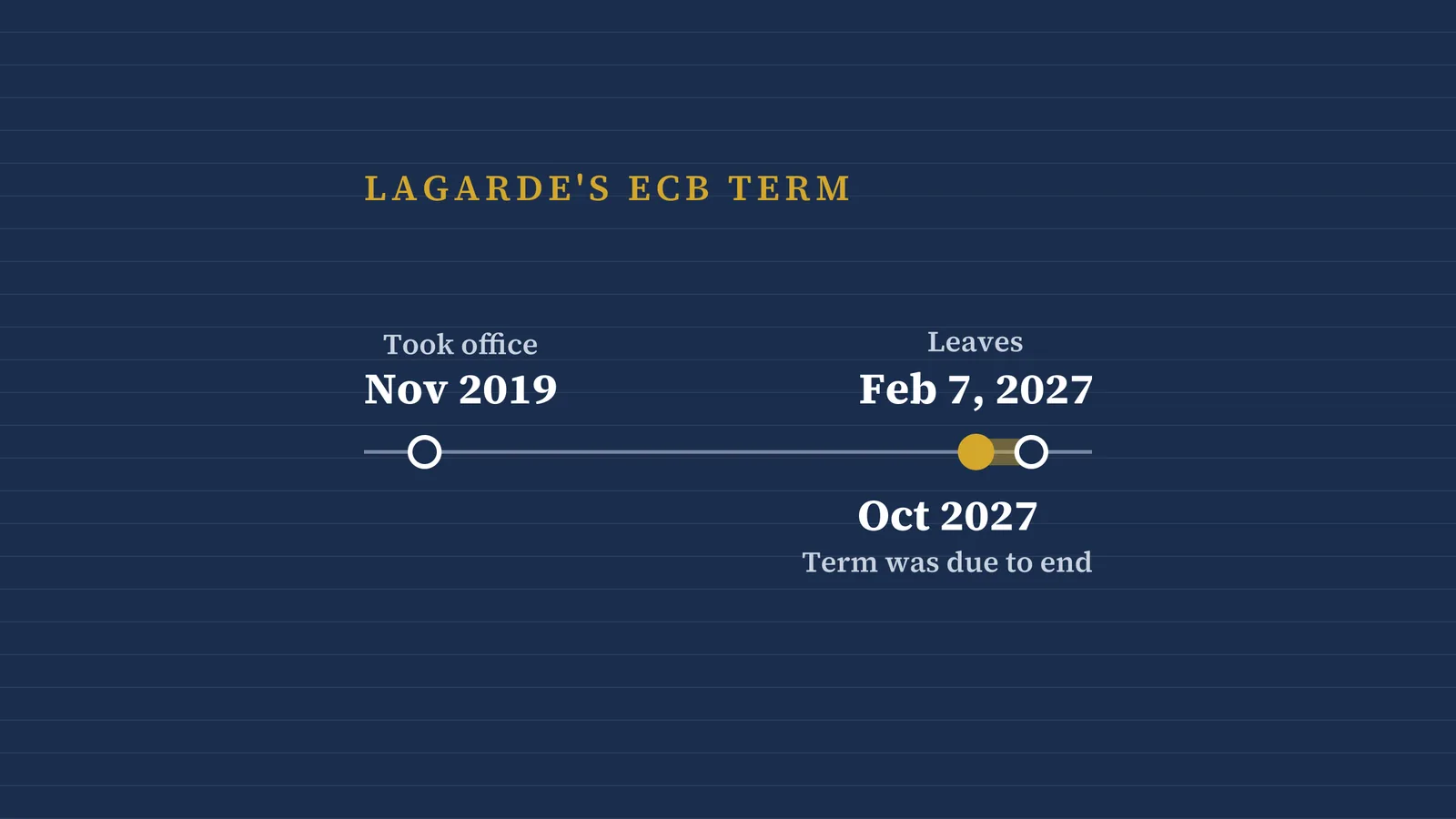
Christine Lagarde will step down as president of the European Central Bank (ECB) on February 7, 2027, the ECB announced on October 29. Her eight-year term, which began on November 1, 2019, would have run until the end of October 2027.
What Lagarde said
At the press conference that followed the ECB's October 29 decision to keep its deposit rate at 2.5%, Lagarde said she was leaving early "because I want to have the freedom of speech, the freedom of expression and the freedom to engage on matters that are not monetary policy matters," according to the ECB's transcript.
"I don't think that I can remain neutral. I don't think that I can be comfortable in that neutrality at the present time," she said.
Her exit comes ahead of France's presidential election, whose first round is scheduled for April 18, 2027. Lagarde did not refer to the election in her answers. CNBC reported that she wanted more freedom to express political opinions.
Who could replace her
By the November 6 deadline, the president of the Eurogroup, the forum of euro-area finance ministers, had received two candidacies: Pablo Hernández de Cos of Spain and Klaas Knot of the Netherlands, according to the Eurogroup. Euro-area finance ministers were due to take stock of the candidacies at the Eurogroup meeting on November 9. Before the meeting, Eurogroup President Kyriakos Pierrakakis said "the whole process would have completed itself by the end of the year," AFP reported. At that meeting, ministers took stock of the candidacies, the Eurogroup said. Afterwards, Pierrakakis said the posts of Isabel Schnabel and Philip Lane on the ECB's Executive Board also need to be filled, that leaders might consider all three appointments together, and that the final decision rests with the European Council, according to his remarks.
The ECB president is appointed by the European Council on a recommendation from the Council of the EU, after the ECB and the European Parliament are consulted. The recommendation needs a reinforced qualified majority: at least 16 of the 21 euro-area countries, representing at least 65% of the euro area's population.
Why it matters
The president leads the Governing Council's monetary policy press conferences; the Council sets euro-area monetary policy. The change comes as euro-area inflation is rising: Eurostat's flash estimate put it at 4.0% in October, up from 3.8% in September. After the October 29 decision, money markets priced about a two-in-three chance of a December rate increase, according to LSEG data cited by CNBC.
What it could mean for traders
Leadership changes at central banks can move currency and bond markets as investors reassess the likely policy path. For euro traders, the known views of the next president are a key variable. Until the European Council decides, statements from Governing Council members and from the two candidates may draw more attention.
Sources
- European Central Bank — ECB President Lagarde to step down on 7 February 2027 (October 29, 2026)
- European Central Bank — Monetary policy statement and press conference (29 October 2026) (October 29, 2026)
- European Central Bank — New President of the European Central Bank (November 1, 2019)
- Council of the EU (Eurogroup) — Statement by the Eurogroup President on the nominations for the post of ECB President (November 6, 2026)
- European Central Bank — Governing Council
- Service-Public.fr — Quelles sont les dates des prochaines élections ?
- European Central Bank — Monetary policy decisions (29 October 2026) (October 29, 2026)
- Eurostat — Euro area annual inflation up to 4.0% (November 4, 2026)
- Council of the EU (Eurogroup) — Remarks by Kyriakos Pierrakakis following the Eurogroup meeting of 9 November 2026 (November 9, 2026)
- Council of the EU (Eurogroup) — Eurogroup, 9 November 2026 (November 9, 2026)
- CNBC — The politics of President Lagarde's European Central Bank early exit — and who could replace her (October 29, 2026)
- CNBC — European Central Bank keeps key interest rate on hold at 2.5% (October 29, 2026)
- AFP via Malay Mail — EU wants new ECB chief by end of year as race begins to replace Lagarde (November 9, 2026)
This article was researched and drafted with the help of AI tools, checked against its sources in a separate AI fact-check and edit, and approved for publication by Trading Metrics. Read our AI use policy.
This article is for information only and is not financial advice. Crypto assets and leveraged products are volatile and you can lose money. Do your own research and consider your circumstances before trading.