
Bank of Russia says exchanges may start crypto trading from November 22, once it approves their rules
The central bank's new ordinance sets out how organized crypto trading must be run. It did not say whether any exchange has had its rules approved.
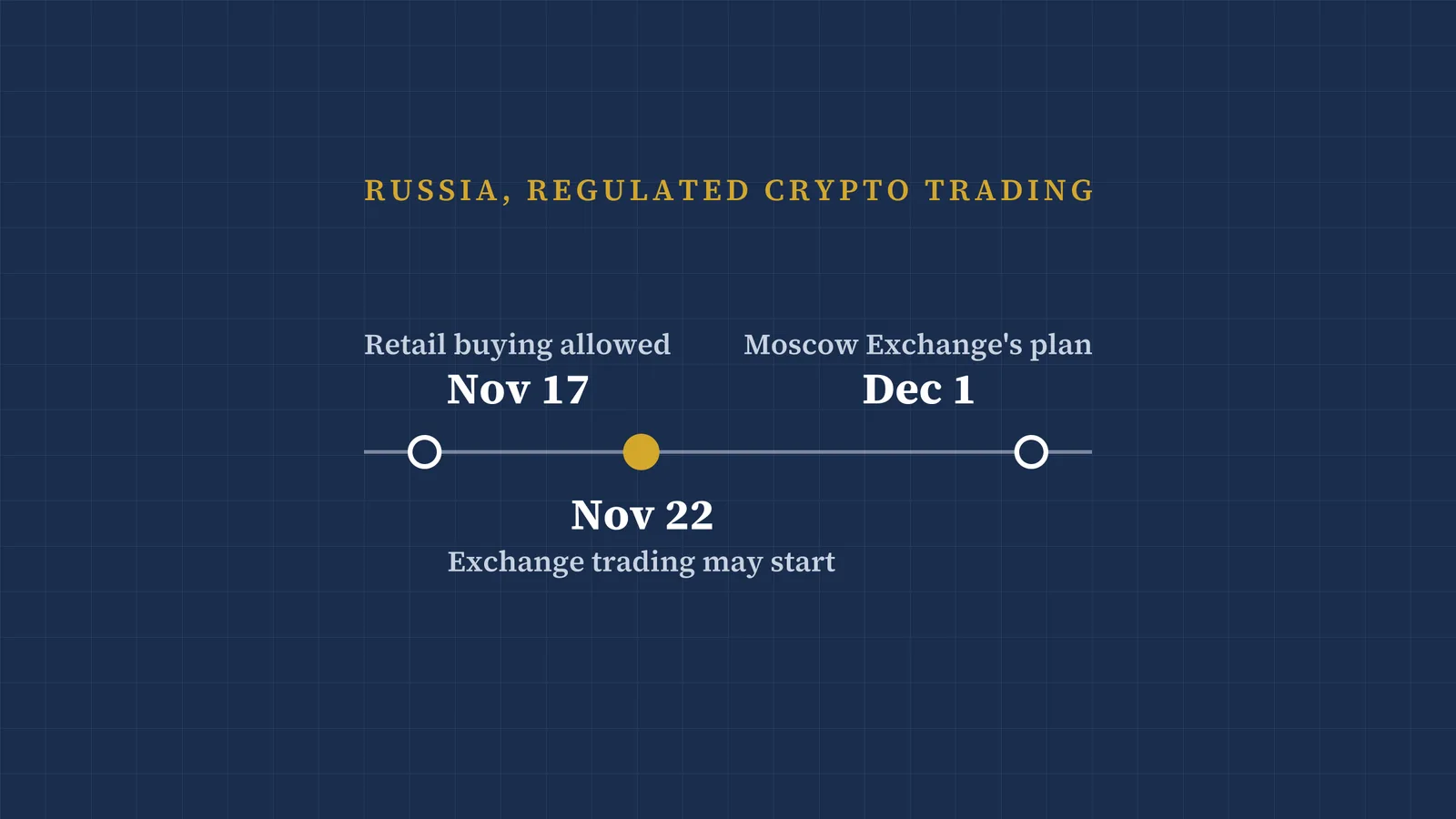
Russian exchanges may start organized trading in cryptocurrencies from November 22, 2026, but must first get the regulator's approval of their trading rules, the Bank of Russia said on November 11. The central bank said its ordinance setting requirements for organized trading in digital currencies and digital rights has been registered by the Justice Ministry.
What the Bank of Russia requires for crypto exchange trading
According to the central bank's notice, which we read in Russian and paraphrase here, exchanges that organize crypto trading must register the firms that take part, namely brokers, trust managers and central counterparties, keep records of orders and deals, and watch over the transactions. They must also calculate four price indicators: a current price, a weighted-average price, a market price and a closing price. Exchanges must also send the central bank data on how trading went and how it ended, as they already do for other assets.
The notice does not name any exchange or say whether any has had its trading rules approved.
The ordinance was registered by the Justice Ministry on November 3 and takes effect 10 days after its publication, which Trading Notified could not independently confirm, Bitcoin Magazine reported.
How it fits with the retail rules
The notice follows a separate Bank of Russia ordinance under which non-qualified investors, the Russian term for ordinary retail investors, may buy Bitcoin, ether and USDT from November 17, with a cap of 300,000 rubles a year through a single intermediary. The Moscow Exchange said on November 2 that it plans to begin crypto trading on December 1, with pilot trades in the first stage.
The Moscow Exchange has not said publicly whether its rules have been approved, according to Bitcoin Magazine.
Why it matters
The ordinance sets out how exchanges must run a crypto market under Russia's new crypto law: which participants they register, what records they keep, which price indicators they calculate and what they report to the central bank. Russia continues to ban the use of crypto to pay for goods and services inside the country, Bitcoin Magazine noted.
Elsewhere in crypto regulation, the Financial Stability Board on November 11 recommended that Türkiye set stablecoin rules, and Poland's lower house on November 6 passed a sanctions bill covering crypto assets.
What it could mean for traders
In our assessment, November 22 is the earliest possible date and not a launch date: under the central bank's notice, no exchange can open a crypto market until its trading rules have been agreed with the regulator, and neither the notice nor the reports we read say that any exchange has that agreement. For traders outside Russia the practical relevance is limited, because the Moscow Exchange and its clearing house are under US sanctions, as Bitcoin Magazine noted.
Sources
- Bank of Russia — Как проводить торги с криптовалютами: указание Банка России (November 11, 2026)
- Bank of Russia — Cryptocurrencies for non-qualified investors: Bank of Russia ordinance (November 6, 2026)
- Moscow Exchange — Moscow Exchange launches digital currency market (in Russian) (November 2, 2026)
- Bitcoin Magazine — Russia's Central Bank Clears Exchange to Open Bitcoin and Crypto Trading on Nov. 22 (November 11, 2026)
This article was researched and drafted with the help of AI tools, checked against its sources in a separate AI fact-check and edit, and approved for publication by Trading Metrics. Read our AI use policy.
This article is for information only and is not financial advice. Crypto assets and leveraged products are volatile and you can lose money. Do your own research and consider your circumstances before trading.