
Poland's lower house passes a sanctions bill that would let the interior minister freeze listed persons' crypto before a court rules
The bill, passed 240–202, counts crypto assets among the funds that can be frozen for people on a national sanctions list. It is now in the Senate.
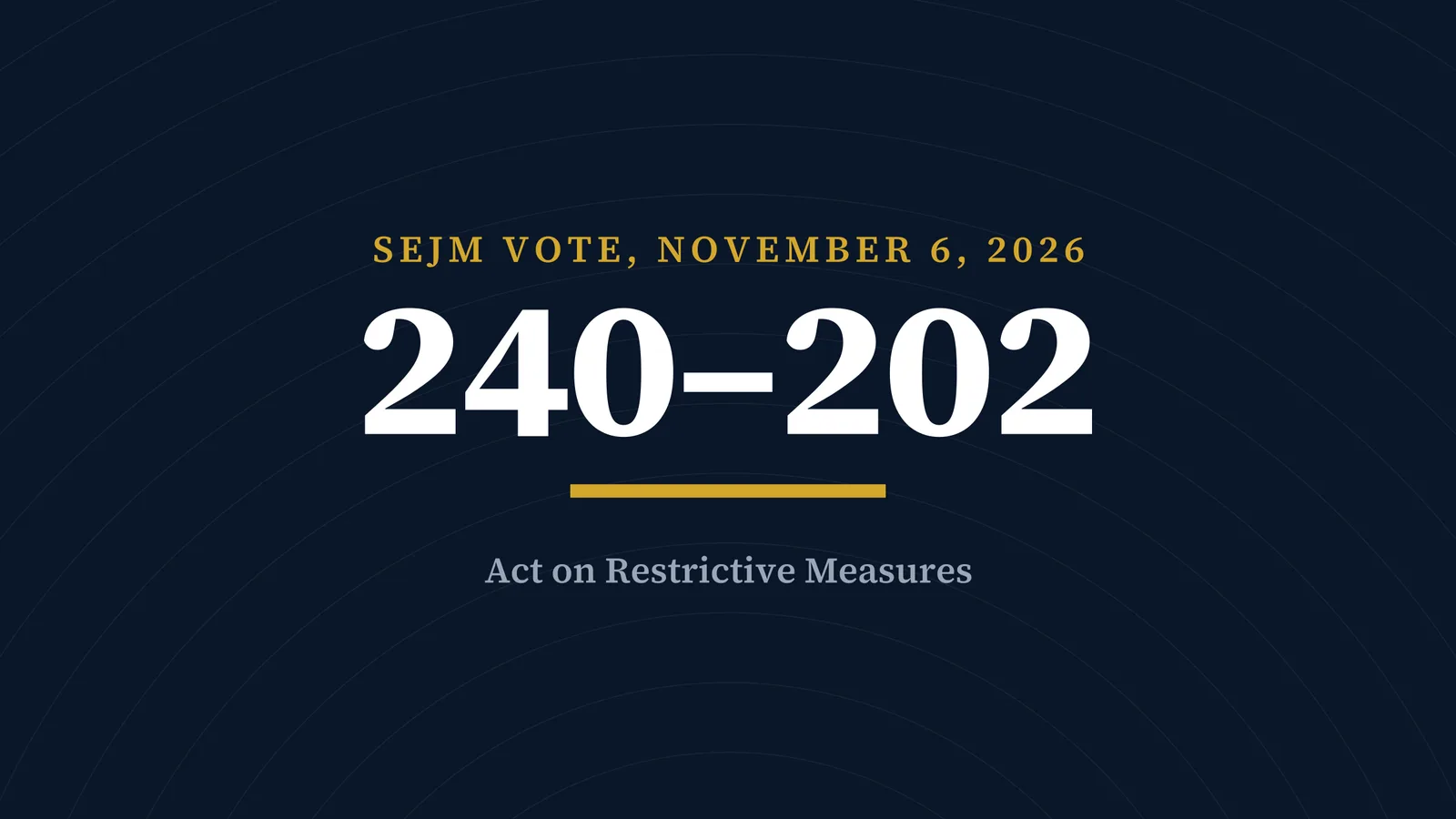
Poland's lower house of parliament, the Sejm, passed a sanctions bill on Friday, November 6, that would let the interior minister freeze the assets of people and companies placed on a national sanctions list, including their crypto assets, before any court reviews the decision. The vote was 240 to 202 with one abstention, according to Polish outlets BitHub.pl and Farmer.pl and to Bitcoin Magazine and Cointelegraph, the last two citing parliamentary records. Polish legal publisher Infor.pl reported the same 240–202 result.
What the Polish sanctions bill says about crypto
We could not open the bill's text or the Sejm's voting record ourselves: the Sejm's and Senate's websites did not load for us on November 11. The details below come from press reports, named where each is used.
According to BitHub.pl, the bill's definition of financial funds lists crypto assets, as defined in the EU's Markets in Crypto-Assets (MiCA) regulation, alongside cash, account balances, shares and bonds. A freeze covers assets a listed person owns, holds or controls. Exchanges and other firms would have to block listed clients' funds in the same way banks do, while coins held in private wallets are harder to reach, BitHub.pl and Bitcoin Magazine both noted.
BitHub.pl reported that the bill also provides for prison terms of six months to eight years for hiding or transferring funds that are to be frozen under EU sanctions. The government's summary of its draft, published in August, says the most serious sanctions offences carry up to 12 years.
How a listing would work
The interior minister keeps the list and can add a person or company on the ministry's own initiative or at the request of other institutions, among them the financial supervisor, the central bank and the financial intelligence unit, BitHub.pl and Bitcoin Magazine reported. The decision takes effect the day after publication, according to both outlets and Cointelegraph, and cannot be sent back to the minister for reconsideration, BitHub.pl and Infor.pl reported. A listed person can complain to an administrative court, but the decision stays in force until a final judgment, BitHub.pl and Bitcoin Magazine reported. Farmer.pl reported that filing a complaint does not halt the decision but that a request to suspend enforcement might still be possible if legal conditions are met; we could not check the bill's text to settle the point.
The grounds are tied to countries under EU sanctions: supporting such a country, and directly or indirectly supporting foreign information manipulation aimed at Poland's security, BitHub.pl reported. Poland has had a national sanctions list since 2022; it had 554 entries, and most of the listed individuals are citizens of Belarus and Russia, a deputy interior minister told the Sejm in September, according to BitHub.pl.
The politics
Civic Coalition, the Polish People's Party, the Left, Poland 2050, Razem and most deputies of the Centrum group voted for the bill, while Law and Justice (PiS), Confederation and three smaller groups voted against, BitHub.pl reported. The government says the bill tidies up scattered rules and implements an EU directive on penalties for breaking sanctions; the opposition says it allows assets to be frozen without a court ruling and that terms such as indirect support are too broad, according to the outlet.
What happens next
The Senate received the bill on November 9 and has 30 days to adopt, amend or reject it, Bitcoin Magazine and Cointelegraph reported. After parliament finishes its work the bill goes to President Karol Nawrocki, who in 2026 vetoed a separate bill on the crypto-asset market, according to Bitcoin Magazine.
What it could mean for crypto users
The bill does not target crypto holders in general, Bitcoin Magazine reported; it reaches the assets of people and firms on the sanctions list. In practice it would be enforced through exchanges and custodians, which would have to freeze listed clients' assets, according to BitHub.pl and Bitcoin Magazine. Freezes and cut-offs of crypto funds have been in the news elsewhere in recent weeks. In the United States, FinCEN ordered US financial institutions to cut off the exchange MEXC, an anti-money-laundering order rather than a sanctions designation, and stablecoin issuers Tether and Circle froze stablecoins tied to the Binance hack. Russia, meanwhile, has finalized rules that let retail investors buy crypto through intermediaries.
Sources
- Chancellery of the Prime Minister of Poland (gov.pl) — Projekt ustawy o środkach ograniczających (August 4, 2026)
- Bitcoin Magazine — Poland's Parliament Votes 240-202 to Let Officials Freeze Crypto Before Court Review (November 10, 2026)
- Cointelegraph — Poland's lower house backs sanctions bill covering crypto freezes (November 10, 2026)
- Infor.pl — Druk nr 3003. Sejm przyjął kontrowersyjną ustawę. "Zamrażanie majątków bez wyroku sądu" wywołało burzę (November 10, 2026)
- Farmer.pl — Sejm uchwalił „konstytucję sankcyjną”. Za łamanie przepisów do 20 mln zł kary i 12 lat więzienia (November 8, 2026)
- BitHub.pl — Sejm uchwalił ustawę 3003. Kto może stracić dostęp do majątku? (November 7, 2026)
This article was researched and drafted with the help of AI tools, checked against its sources in a separate AI fact-check and edit, and approved for publication by Trading Metrics. Read our AI use policy.
This article is for information only and is not financial advice. Crypto assets and leveraged products are volatile and you can lose money. Do your own research and consider your circumstances before trading.