
Eastern Europe's crypto economy shrank 7.9% as Ukraine drew $12 billion in stablecoins, Chainalysis says
The blockchain analytics firm ranks the region last of the eight it tracks for the year to June 2026. Russia's activity fell 14.7%, while smaller transfers and crypto ATMs grew.
Contents
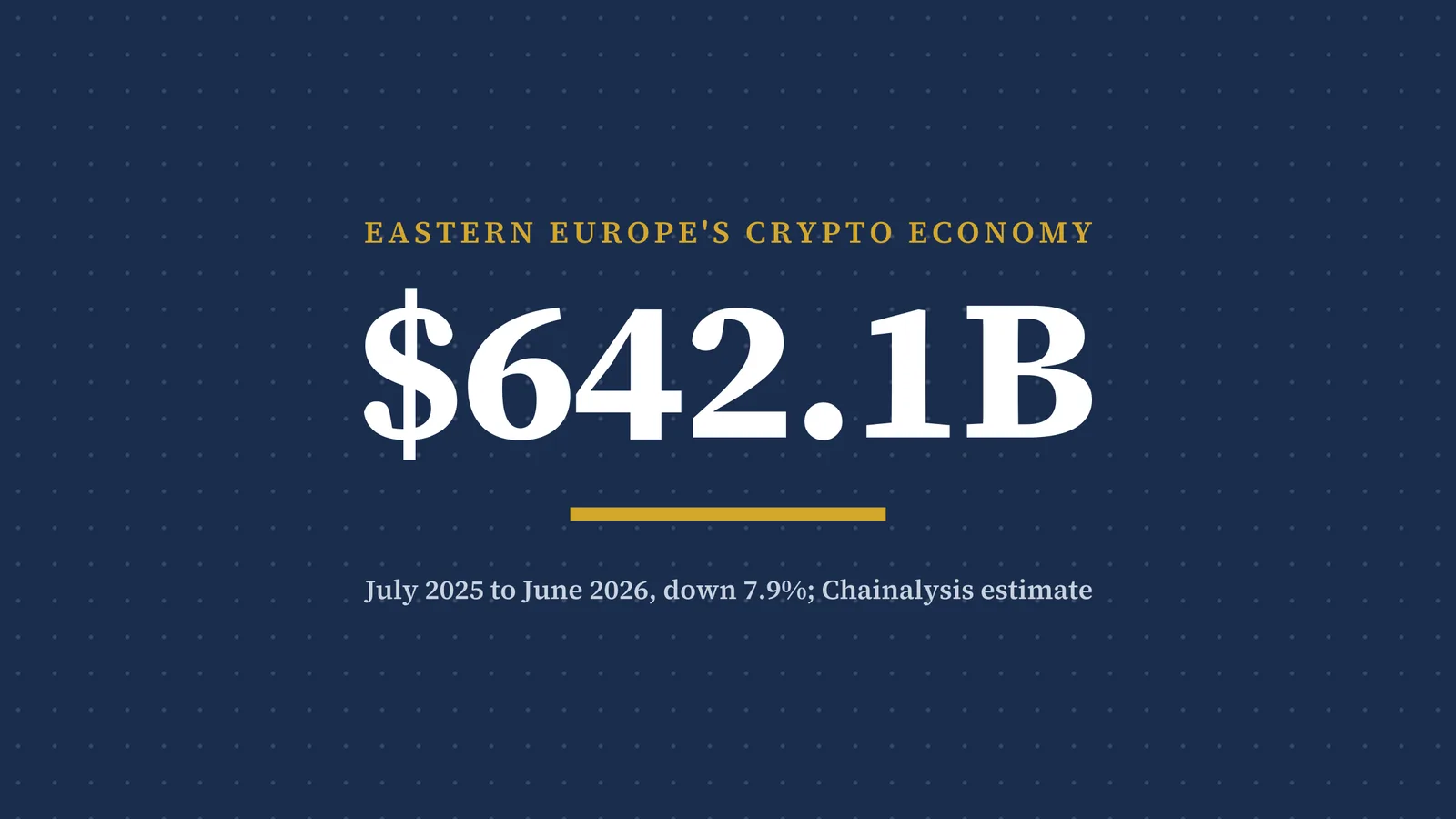
Eastern Europe's crypto economy fell 7.9% to an estimated $642.1 billion in the 12 months to June 2026, the weakest result of the eight regions Chainalysis tracks, the blockchain analytics firm said in a report published on November 17. Over the same period, Ukraine received $12 billion in cross-border stablecoin transfers between personal wallets, flows that Chainalysis links to Ukrainians living abroad.
Country by country
The post is the Eastern Europe chapter of Chainalysis's 2026 Geography of Crypto report and covers July 2025 to June 2026, compared with the 12 months before. Its map gives these figures for the ten markets in the region, listed here by size:
| Market | Crypto economy, 2026 period | Change |
|---|---|---|
| Russia | $284.1bn | −14.7% |
| Ukraine | $128.3bn | +0.2% |
| Poland | $95.6bn | −7.3% |
| Czechia | $35.3bn | −0.7% |
| Romania | $24.7bn | −4.0% |
| Hungary | $22.0bn | −0.1% |
| Belarus | $19.7bn | +27.6% |
| Bulgaria | $15.5bn | +0.6% |
| Slovakia | $12.5bn | −11.7% |
| Moldova | $4.6bn | +1.6% |
By our calculation, Russia accounted for about 44% of the regional total. Four markets grew: Belarus, Bulgaria, Ukraine and Moldova. Chainalysis notes that Belarus, as a heavily sanctioned market, is a small part of regional activity. The period ended before Russia's rules letting retail investors buy Bitcoin, ether, and USDT took effect on November 17, and before the Bank of Russia said exchanges may start crypto trading from November 22.
Chainalysis said the decline was spread across every part of its measure except domestic transfers between personal wallets, which it put up 330% from the previous period. Worldwide, it estimates the crypto economy slipped to $9.4 trillion from $9.5 trillion, according to its global adoption index published in September.
Smaller transfers and crypto ATMs grew
Most of the decline came in large transfers, according to the report's figures. The value of transfers of $10,000 or more to crypto services dropped to $488.6 billion from $591.5 billion, while transfers below $10,000 rose 8.3%, the report says. That left smaller, retail-sized transfers with 13.1% of the value sent to services in the region, ahead of Sub-Saharan Africa at 12.0% and the global average of 10.1%. Chainalysis describes the region's market as "becoming more retail-weighted."
Value received by crypto ATMs and peer-to-peer exchanges rose 1.5% in the region, against a 25.6% fall worldwide, according to the report. ATMs alone went to $33.9 million from $17.3 million, with Poland and Romania accounting for 92% of the increase. Chainalysis ranks Poland third worldwide in ATM transactions, behind the US and Canada. In Poland, ATM transactions grew 120% while centralized exchange flows fell 5%, and 90% of the ATM transactions involved stablecoins rather than Bitcoin, the firm said.
Chainalysis links the Polish trend in part to the country's delay in applying the EU's Markets in Crypto-Assets (MiCA) regulation. It says Poland's president vetoed the implementing law three times between December 2025 and June 2026 and that, as of October 2026, Poland had not designated a MiCA authority, so firms could not obtain a MiCA license there. The firm says the timing is consistent with regulation shaping how people use crypto but that its data cannot prove cause. Separately, Poland's lower house this month passed a sanctions bill that would let crypto assets be frozen.
In Romania, Chainalysis found a temporary shift from centralized exchanges toward instant exchanges and decentralized exchanges after the government announced in July 2025 that the tax on individuals' crypto gains would rise from 10% to 16% from January 1, 2026. Romanians sent $41.8 million to instant exchanges in the period, up from $26.4 million, the report says, and activity returned to the regional norm once the new rate applied.
Stablecoin flows to Ukraine
The $12 billion that reached Ukraine consisted of cross-border stablecoin transfers between personal wallets, Chainalysis said. Of that, $2.41 billion came in transfers under $10,000, which the firm treats as remittance-like. Across 36 countries in Western Europe, Eastern Europe and North America, those with larger Ukrainian populations, both the prewar diaspora and refugees who arrived after Russia's full-scale invasion began in 2022, sent more crypto to Ukraine, it said, in a relationship it describes as nearly proportional.
Canada was the largest sender of transfers under $10,000, at $359 million, according to the report. Ukraine was the top destination for retail stablecoin transfers from 16 of the 21 markets on Chainalysis's map with at least $5 million in outbound retail stablecoin transfers, and among the top three for 19. Moldova sent nearly 45% of its cross-border wallet transfers to Ukraine. A Chainalysis spokesperson told Cointelegraph that the flows were mostly in US dollar stablecoins but did not give a breakdown by token.
How Chainalysis arrives at the figures
The "crypto economy" is Chainalysis's own measure, not an official statistic. According to the methodology in its global report, it adds three things: value received by crypto services such as exchanges, lending protocols and bridges; transfers between personal wallets within a country; and transfers from abroad into personal wallets. Stablecoins count at any size, while Bitcoin is capped at $10,000 for domestic and $100,000 for cross-border transfers, and other tokens moving between personal wallets are left out.
The firm assigns service activity to countries using web traffic estimates, adjusts those values for income differences, and drops transfers it cannot attribute to a country. It calls the result a lower bound and says the real totals are very likely larger. The full downloadable report was not reviewed for this article.
What it could mean for crypto markets in Eastern Europe
In our assessment, the data describe a region where on-chain activity is shrinking in value but shifting toward smaller transfers, stablecoins and cash-based access points such as ATMs. Because the figures are model-based estimates attributed through web traffic and adjusted for income, they are better read as a comparison between countries and periods than as exact volumes. The developments to watch are outside the dataset: Poland's unresolved MiCA legislation, the start of regulated retail crypto trading in Russia, and whether Romania's higher tax rate leaves a lasting mark in the next period's figures.
Sources
- Chainalysis — Refugees, ATMs, and Tax Shifts: What's Driving Crypto in Eastern Europe (November 17, 2026)
- Chainalysis — 2026 Global Crypto Adoption Index (September 23, 2026)
- Cointelegraph — Eastern Europe crypto flows fall 7.9% as Ukraine draws $12B in stablecoins (November 17, 2026)
This article was researched and drafted with the help of AI tools, checked against its sources in a separate AI fact-check and edit, and approved for publication by Trading Metrics. Read our AI use policy.
This article is for information only and is not financial advice. Crypto assets and leveraged products are volatile and you can lose money. Do your own research and consider your circumstances before trading.