
SEC reports 348 enforcement actions for fiscal 2026 and highlights crypto fraud cases
The agency obtained orders for $1.095 billion in monetary relief. Cases it singled out include an alleged $95.6 million fraud at a Bitcoin mining business.
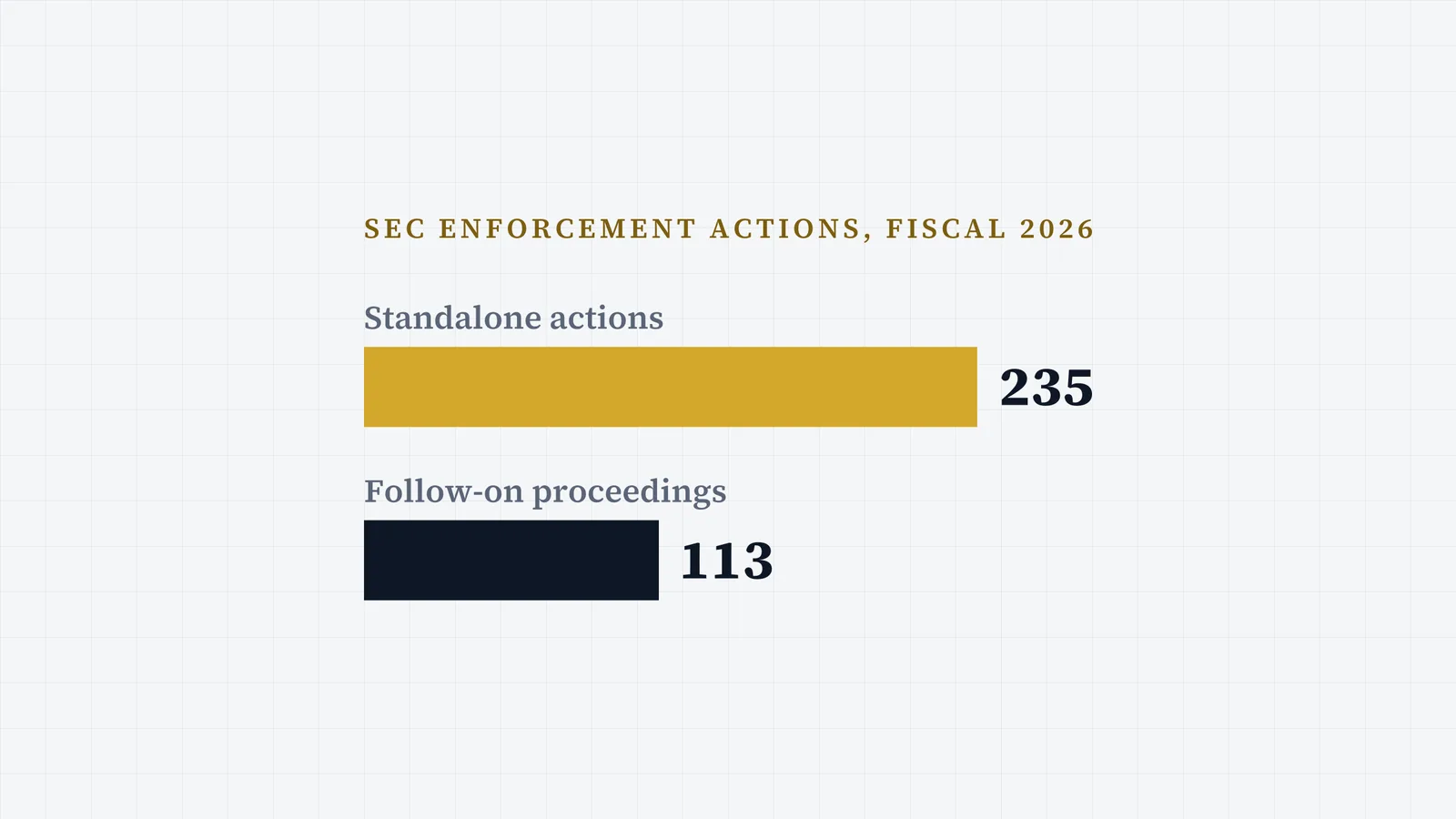
The US Securities and Exchange Commission (SEC) filed 348 enforcement actions in the fiscal year that ended on September 30 and obtained orders for $1.095 billion in monetary relief, the agency said on November 10. Among the cases it highlighted were two involving crypto, including one in which the founder of a Bitcoin mining business is accused of raising more than $95.6 million through a fraud scheme.
What the SEC enforcement results show
The 348 actions comprised 235 standalone cases and 113 "follow-on" administrative proceedings, which seek to bar or suspend people from parts of the securities industry after a conviction or court order. The SEC reported 456 actions, 303 of them standalone, for fiscal 2025; its new release does not give a prior-year comparison.
Of the $1.095 billion in monetary relief, $752 million was disgorgement, the repayment of gains, plus interest, and $343 million was civil penalties. A court in a separate, non-SEC case deemed $235 million of the disgorgement already satisfied, the SEC said. In two of every three standalone cases, the SEC charged at least one individual.
SEC Chairman Paul Atkins said enforcement actions and financial remedies "are not the only or most telling measures" of the program.
The crypto cases the SEC highlighted
The descriptions below are the SEC's allegations, not findings; the release does not name the defendants. The cases involving crypto include:
- Three purported crypto asset trading platforms and four investment clubs, charged with allegedly defrauding retail investors of at least $14 million through a confidence scam promoted on social media, with the money sent overseas.
- The founder and chief executive of a Bitcoin mining business, charged with allegedly raising more than $95.6 million from about 6,400 investors through a fraud scheme and misappropriating $48.5 million of investor funds.
The SEC also said a new analytics office in its enforcement division is improving its blockchain and financial-flow analysis.
What else changed
The agency said it updated its enforcement manual for the first time since 2017 and rescinded a rule under which it would not settle a case unless the defendant agreed not to publicly deny the allegations. It also signed a memorandum of understanding with the Commodity Futures Trading Commission (CFTC) on enforcement cooperation. The two agencies' division of labor is itself being tested in court, in a court fight over perpetual futures on stocks, and is the subject of market-structure legislation that is stalled in Congress.
Why it matters
The annual results are the SEC's own summary of where it spends its enforcement effort. The two crypto cases described above are both alleged investor frauds, and the release says the division focused on misconduct that harms retail investors. Other US agencies have been active too: on November 6, FinCEN ordered US financial institutions to cut off the exchange MEXC.
What it could mean for traders
In our assessment, the report is a reminder that the SEC's public priority in crypto is fraud that harms retail investors, such as fake trading platforms and investment schemes. It does not announce new rules, and a count of cases says little by itself about how any single company or token will be treated.
Sources
- US Securities and Exchange Commission — SEC Announces Enforcement Annual Results for Fiscal Year 2026 (press release 2026-113) (November 10, 2026)
- US Securities and Exchange Commission — SEC Announces Enforcement Results for Fiscal Year 2025 (press release 2026-34) (April 7, 2026)
- Cointelegraph — SEC enforcement actions fall 24%, crypto cases in spotlight (November 11, 2026)
This article was researched and drafted with the help of AI tools, checked against its sources in a separate AI fact-check and edit, and approved for publication by Trading Metrics. Read our AI use policy.
This article is for information only and is not financial advice. Crypto assets and leveraged products are volatile and you can lose money. Do your own research and consider your circumstances before trading.